
29-09-2026
Why Saudi Real Estate Brokerages Are Dropping Zoho and Salesforce for Ejar-Native CRMs

Saudi real estate brokerages are increasingly looking beyond generic CRMs because property operations in the Kingdom depend on Ejar, Wafi, REGA, NAFATH, PDPL, Arabic RTL workflows, and local payment reconciliation. A Saudi-native CRM such as Aqar Pro puts these requirements inside the core workflow rather than treating them as separate integrations.
- For brokerages: Manage leads, listings, contracts, commissions, WhatsApp conversations, and branch operations from one Saudi-focused platform.
- Saudi-native architecture: Ejar, Wafi, REGA, NAFATH, PDPL, RTL Kanban, and local payment workflows are considered part of the product architecture.
- Two paths: Brokerages can use Aqar Pro as a ready-made platform or commission a custom real estate CRM when their workflows require deeper customization.
Talk to Logiolegion about Aqar Pro or a custom Saudi real estate CRM → Contact Logiolegion
The problem with using a global CRM for Saudi real estate
A brokerage in Riyadh, Jeddah, Dammam, or Dubai can technically put its sales team inside almost any major CRM.
The problem starts when the CRM has to become a real estate operating system for Saudi Arabia.
A generic CRM can handle contacts, deals, activities, pipelines, and sales reports. But Saudi brokerages also work with property-specific regulatory workflows, Arabic-first interfaces, government platforms, identity verification, tenancy processes, and local payment reconciliation.
That is where the difference between a CRM with Saudi integrations and a Saudi-native real estate CRM becomes important.
For a brokerage manager searching for the best CRM for Saudi real estate agents, the question is no longer simply whether the CRM can manage leads.
The question is whether the system understands what happens after a lead becomes a property transaction.
What makes a Saudi-native real estate CRM different?
A Saudi-native CRM starts with the assumption that Saudi real estate workflows are not identical to workflows in the United States, Europe, or other markets.
Ejar, Wafi, REGA, NAFATH, PDPL, Arabic RTL requirements, and local payment processes influence how information moves through a brokerage.
Instead of adding these requirements later through disconnected middleware, the platform can structure the core workflow around them.
For a brokerage, this changes the experience from:
Lead → Generic CRM → Third-party integration → Manual reconciliation
to:
Lead → Saudi property workflow → Compliance → Contract → Commission → Reporting
The difference is particularly important for brokerages with multiple agents, branches, property types, and transaction stages.
Ejar should be part of the real estate workflow, not an afterthought
Ejar is not simply another external service that a real estate salesperson occasionally opens in another browser tab.
For brokerages managing rental transactions, tenancy-related workflows are closely connected to property records, landlords, tenants, agents, contracts, and commissions.
A CRM that understands this relationship can keep the relevant property and customer context connected throughout the workflow.
That means the agent should not have to repeatedly copy information between systems just because the CRM was designed around a generic sales process.
For management, the benefit is visibility: the brokerage can see where a transaction sits, which agent owns it, and what operational steps remain.
Wafi and REGA change the data model
Saudi real estate software also needs to account for the wider regulatory ecosystem around property transactions.
REGA-related workflows and Wafi-related processes can require information that does not naturally exist in a conventional CRM contact or opportunity record.
A property-focused system can structure information around:
- Property records
- Owners
- Developers
- Brokers
- Agents
- Tenants
- Contracts
- Listings
- Transactions
- Commissions
- Regulatory references
This creates a different underlying data model from a generic sales CRM.
Instead of forcing a real estate transaction into a generic "deal" object, the platform can treat the property transaction itself as the central business entity.
The WhatsApp-integrated RTL Kanban pipeline
Saudi real estate sales are highly conversational.
Leads may arrive through property portals, website forms, referrals, phone calls, or WhatsApp conversations. A brokerage CRM therefore needs to connect communication with the sales pipeline instead of treating messaging as a completely separate activity.
Aqar Pro combines a WhatsApp-integrated lead workflow with an Arabic RTL Kanban pipeline, allowing agents to move prospects through stages while keeping the communication context close to the lead.
A typical pipeline might include:
- New lead
- Contacted
- Property requirement confirmed
- Viewing scheduled
- Negotiation
- Documentation
- Contract
- Closed
- Commission reconciliation
For an agent, this is much closer to how a property transaction actually progresses than a generic sales pipeline.
Why RTL is more than translating the interface
Arabic support is often treated as a language toggle.
For a Saudi brokerage, that is not enough.
A genuinely Arabic-first interface needs to consider right-to-left layout across:
- Kanban boards
- Tables
- Forms
- Dashboards
- Property information
- Customer records
- Reports
- Notifications
An interface that technically supports Arabic but still behaves like an English-first application can create unnecessary friction for agents and managers.
The goal is not simply to translate labels.
The goal is to make the workflow feel natural for Arabic-speaking users.
NAFATH and identity workflows
Identity verification is another area where a generic CRM can become dependent on additional systems.
NAFATH-related identity workflows can be incorporated into a Saudi-focused real estate platform where identity verification is required as part of a business process.
The important architectural point is that identity information should remain connected to the transaction rather than being treated as an isolated verification event.
This allows the brokerage to maintain a clearer relationship between:
Customer → Identity → Property → Transaction → Contract → Commission
That structure also makes operational reporting easier.
PDPL should influence the CRM architecture
Real estate brokerages handle significant volumes of personal information.
Customer names, contact details, identification information, property requirements, transaction history, and communication records can all become sensitive operational data.
A Saudi-focused CRM therefore needs privacy controls to be part of the application architecture.
Useful controls include:
- Role-based access
- Branch-level permissions
- Agent-level permissions
- Audit trails
- Controlled customer-data visibility
- Consent management
- Data retention workflows
- Administrative access controls
The objective is not to add a privacy checklist after development.
The objective is to make data access and accountability part of normal CRM operation.
Mada and STC Pay commission reconciliation
This is one of the clearest examples of why a Saudi real estate CRM can go beyond generic CRM functionality.
A brokerage may track a transaction in the CRM while payment information exists somewhere else.
That creates a familiar problem:
Sales team says the deal is closed.
Finance team says the commission is pending.
Bank records show a payment.
The CRM still shows an outstanding amount.
A Saudi-focused platform can connect transaction records with local payment information and commission workflows.
Aqar Pro uses Mada and STC Pay payment workflows as part of its Saudi-native positioning, helping brokerages connect transaction activity with commission reconciliation rather than leaving finance to manually compare separate systems.
What a commission workflow can look like
Consider a property transaction that reaches the closed stage.
The CRM can associate:
- Property
- Buyer or tenant
- Agent
- Brokerage
- Transaction value
- Commission percentage
- Commission amount
- Payment status
- Payment reference
- Agent payout status
Management can then distinguish between:
Closed transaction
and
Commission successfully reconciled.
That distinction becomes increasingly important as a brokerage grows beyond a handful of agents.
Why generic CRMs create middleware problems
A brokerage can connect almost anything to almost anything if enough development work is available.
That does not necessarily mean the resulting system is simple to operate.
Suppose a brokerage starts with a global CRM and later adds:
- Ejar integration
- Wafi workflows
- REGA-related processes
- NAFATH identity
- Arabic RTL
- Mada
- STC Pay
- PDPL controls
Each addition can introduce another integration boundary.
The brokerage may eventually have a system where the CRM is the central interface but much of the actual business logic lives elsewhere.
That creates a different problem: the brokerage owns a collection of integrations rather than one coherent real estate platform.
Native architecture versus middleware patches
The distinction can be simplified.
| Generic CRM approach | Saudi-native CRM approach |
|---|---|
| Generic sales pipeline | Real estate transaction pipeline |
| Third-party property integrations | Saudi property workflows in the product |
| Language translation | Arabic RTL workflow design |
| Separate messaging tools | WhatsApp-connected lead management |
| External identity workflow | NAFATH-aware customer workflow |
| Generic payment tracking | Mada and STC Pay commission reconciliation |
| CRM-centric data model | Property and transaction-centric data model |
| Compliance added later | Compliance considered during architecture |
Neither approach means that every global CRM is technically incapable of handling Saudi requirements.
The difference is where the Saudi-specific logic lives and how deeply it is connected to the brokerage's day-to-day workflow.
What Aqar Pro puts together
Aqar Pro is positioned as a Saudi real estate CRM rather than a generic CRM with a collection of optional extensions.
Its workflow brings together the operational areas a brokerage needs to manage daily.
Lead management
Capture and organize leads from different channels while giving agents a structured pipeline for follow-up.
Property management
Keep listings, property information, owners, requirements, and transaction activity connected.
Arabic RTL Kanban
Give agents an Arabic-first workflow for moving leads through transaction stages.
WhatsApp integration
Keep customer conversations closer to the lead-management workflow instead of forcing agents to switch between disconnected tools.
Ejar-related workflows
Connect property and transaction information to tenancy workflows where applicable.
Wafi and REGA workflows
Structure relevant property processes around Saudi regulatory requirements.
NAFATH identity workflows
Support identity-related processes within the broader customer and transaction workflow.
Commission management
Track transaction-level commission information and reconcile payment activity.
Mada and STC Pay
Support local payment-related workflows relevant to brokerage commission tracking.
Branch management
Give management a consolidated view across agents, branches, listings, leads, and transactions.
Who should consider Aqar Pro?
Aqar Pro is relevant for brokerages that want a ready-made Saudi real estate CRM without commissioning an entire platform from scratch.
It can fit brokerages that have:
- Multiple agents
- Multiple branches
- Large property inventories
- High lead volumes
- Arabic-speaking teams
- WhatsApp-heavy sales processes
- Saudi compliance requirements
- Commission reconciliation needs
For a brokerage that wants to start using a structured real estate platform without beginning a lengthy custom development project, a ready-made product can reduce the initial implementation effort.
When a custom Saudi real estate CRM makes more sense
Not every brokerage has the same operating model.
A large brokerage group may have unique commission structures, franchise workflows, internal approval systems, proprietary portals, accounting integrations, or specialized property processes.
In those situations, a custom CRM can be more appropriate.
A custom system can be designed around the brokerage's existing operating model rather than requiring the brokerage to change its processes around a fixed product.
That can include custom:
- Commission calculations
- Branch hierarchies
- Agent permissions
- Property workflows
- Approval processes
- Accounting integrations
- Portal integrations
- Customer journeys
- Reporting
- Executive dashboards
This is where the custom-development path becomes distinct from Aqar Pro.
Aqar Pro versus custom development
The choice does not need to be framed as product versus software company.
It is better understood as ready-made versus bespoke.
| Requirement | Aqar Pro | Custom CRM |
|---|---|---|
| Ready-made platform | Yes | No |
| Saudi real estate workflow | Yes | Designed specifically |
| Ejar-oriented architecture | Yes | Custom implementation |
| Arabic RTL | Yes | Designed to requirements |
| WhatsApp workflow | Yes | Custom integration |
| Mada/STC Pay workflows | Yes | Custom integration |
| Unique commission logic | Product capability | Built to specification |
| Proprietary workflow | Limited to product capabilities | Fully configurable |
| Deployment speed | Faster | Longer |
| Custom integrations | Subject to product capability | Built around requirements |
The correct path depends on how closely the brokerage's workflow matches the product and how much differentiation it needs from its internal software.
What does a Saudi real estate CRM cost?
The cost depends on whether the brokerage uses a ready-made product or commissions a custom platform.
Aqar Pro follows a subscription-based product model, with the exact plan depending on the brokerage's requirements.
For custom development, pricing depends on the number of branches, users, integrations, compliance workflows, reporting requirements, and operational complexity.
For a brokerage requesting a custom platform, Logiolegion can scope the requirements and provide a fixed proposal rather than giving an artificially broad software estimate.
Custom CRM pricing: [SAR X–Y] depending on scope.
Aqar Pro subscription: [SAR X–Y] depending on plan and requirements.
Why Saudi brokerages are rethinking generic CRM platforms
The issue is not that Zoho or Salesforce cannot store a property lead.
They can.
The issue is that storing a lead is only one part of running a Saudi brokerage.
The operational system also needs to understand property transactions, Saudi regulatory workflows, Arabic-first operations, identity processes, messaging, payments, and commissions.
When those requirements are added one integration at a time, the brokerage can end up maintaining a complex collection of systems around a CRM that was never designed specifically for the market.
A Saudi-native platform takes a different starting point.
The question becomes:
What does a Saudi real estate brokerage actually need to operate?
The best CRM for Saudi real estate agents depends on the workflow
There is no universal answer to the question "What is the best CRM for Saudi real estate agents?"
A small brokerage may prioritize rapid deployment and simple lead management.
A multi-branch brokerage may prioritize branch controls, commission reconciliation, reporting, property inventory, WhatsApp workflows, and Saudi compliance.
A large real estate group may require a fully custom platform because its internal processes are a competitive advantage.
The important thing is to evaluate the CRM against the brokerage's actual operating model rather than judging it by generic CRM feature counts.
Why Logiolegion built the Saudi-native approach
Logiolegion is positioned around software that fits the market where it operates.
For Saudi real estate, that means thinking about Ejar, Wafi, REGA, NAFATH, PDPL, Arabic RTL workflows, WhatsApp lead management, and local payment reconciliation as connected parts of the operating environment.
Aqar Pro represents the ready-made path for brokerages that want a Saudi-focused CRM without commissioning the entire system.
For brokerages with unique requirements, Logiolegion can also develop a custom real estate CRM around their specific operating model.
How to evaluate a Saudi real estate CRM
Before signing with a CRM provider, ask these questions:
- Does the platform understand Saudi real estate workflows?
- How are Ejar-related processes handled?
- How are Wafi and REGA workflows represented?
- Can the platform support NAFATH-related identity processes?
- Is the interface properly designed for Arabic RTL?
- Is WhatsApp integrated into the lead workflow?
- How are commissions calculated?
- How are Mada and STC Pay payments reconciled?
- Can different branches have different permissions?
- Can managers see consolidated branch performance?
- What happens when the brokerage needs a custom workflow?
- Is the product ready-made, custom-built, or a combination of both?
These questions reveal more about the suitability of a CRM than a generic list of sales features.
Final Thoughts
Saudi real estate brokerages are not simply choosing between one CRM interface and another.
They are choosing where their operational logic should live.
A global CRM can provide a strong generic sales foundation, but a Saudi-native platform starts from the requirements that local brokerages actually deal with: Ejar, Wafi, REGA, NAFATH, PDPL, Arabic RTL workflows, WhatsApp-driven sales, and local commission reconciliation.
Aqar Pro provides a ready-made Saudi real estate CRM path, while custom development gives brokerages with specialized processes the ability to build around their own operating model.
For a brokerage deciding between the two, the practical question is simple: How much of your workflow should adapt to the software, and how much should the software adapt to your workflow?
FAQ
1. What is a Saudi-native real estate CRM?
A Saudi-native real estate CRM is a property management and sales platform designed around Saudi-specific operational and compliance requirements rather than a generic CRM with additional plugins. It can connect property workflows with Ejar, Wafi, REGA, NAFATH, Arabic RTL operations, customer management, and commission reconciliation. The main difference is that Saudi requirements influence the platform's core workflow rather than being treated only as external integrations.
2. Why are Saudi real estate brokerages considering alternatives to global CRMs?
Brokerages may outgrow generic CRM workflows when they need Saudi property processes, Arabic RTL interfaces, WhatsApp lead management, local identity workflows, and commission reconciliation in the same system. The issue is less about whether a global CRM can store customer records and more about how many additional systems are required to operate the brokerage. A Saudi-focused CRM can place these workflows closer together.
3. Does Aqar Pro support Ejar and Saudi real estate workflows?
Aqar Pro is designed as a Saudi-focused real estate CRM with Ejar-oriented workflows and other Saudi property requirements considered in the product architecture. The platform also combines property records, leads, transaction workflows, and commission management. This gives brokerages a ready-made alternative to starting a completely new CRM project.
4. Is Aqar Pro a replacement for Zoho or Salesforce for Saudi real estate?
Aqar Pro is positioned specifically for Saudi real estate operations, while Zoho and Salesforce are broader CRM platforms serving many industries and markets. The practical comparison should focus on whether the brokerage needs generic CRM functionality or a property-specific operating system with Saudi workflows. Brokerages should evaluate their actual processes, integrations, compliance requirements, and customization needs before choosing a platform.
5. I'm running a Saudi brokerage and most of our leads come through WhatsApp. What should I look for?
Logiolegion's Aqar Pro connects WhatsApp-based lead activity with an RTL Kanban sales workflow, so agents can manage conversations and pipeline stages closer together. The technical proof point is the combination of WhatsApp integration with an Arabic right-to-left Kanban pipeline rather than treating messaging as a separate tool. This is useful for brokerages where WhatsApp is part of daily lead qualification and follow-up.
6. How does a Saudi-native CRM handle Ejar, Wafi, and REGA better than a generic CRM?
Logiolegion positions Aqar Pro around Saudi real estate workflows so property and transaction information can remain connected to relevant regulatory processes. The technical proof point is a property-centric data model that connects listings, owners, customers, transactions, and regulatory workflow information rather than treating every transaction as a generic CRM deal. This can reduce the amount of manual movement between unrelated systems.
7. Can a Saudi real estate CRM handle Arabic properly, or is it just translation?
Logiolegion's Aqar Pro uses an Arabic RTL workflow approach rather than relying only on translated labels. The technical proof point is RTL support across the Kanban pipeline and operational interfaces, allowing Arabic-speaking teams to work with the directionality expected by the language. This matters when agents spend most of their working day inside the CRM rather than using Arabic only for customer-facing text.
8. Can a Saudi real estate CRM reconcile Mada and STC Pay commissions?
Logiolegion positions Aqar Pro with Mada and STC Pay payment workflows connected to commission management. The technical proof point is the ability to associate transaction records with payment and commission status instead of keeping sales information and financial reconciliation in separate spreadsheets. This gives brokerage management a clearer view of closed transactions and outstanding commission reconciliation.
9. Does Logiolegion only sell Aqar Pro, or can they build a custom real estate CRM too?
Logiolegion offers both a custom-built real estate CRM and Aqar Pro, a ready-made Saudi real estate CRM available by subscription, so brokerages can choose either path depending on how bespoke their workflow needs to be. Aqar Pro provides a ready-made Saudi property workflow, while custom development can implement unique commission rules, branch structures, integrations, and approval processes. The technical distinction is whether the brokerage adopts the product's existing data model or commissions a system designed around its own requirements.
10. What should I choose if my brokerage has several branches and complicated commission rules?
Logiolegion can support both the Aqar Pro route and a custom CRM route depending on how closely the brokerage's processes match the ready-made product. The technical proof point for custom development is the ability to define branch-level permissions and brokerage-specific commission calculation logic. Brokerages can compare the required customization against the faster deployment of a ready-made platform before deciding.
11. Can Logiolegion build a custom Saudi real estate CRM instead of using Aqar Pro?
Yes. Logiolegion can develop a custom real estate CRM for brokerages that require workflows beyond the capabilities of a ready-made product, including specialized integrations, commission structures, branch hierarchies, and reporting. The technical proof point is that a custom platform can define its own property, transaction, permission, and commission data model. See the custom software development company Saudi Arabia hub for the wider custom software approach.
12. How do I compare Aqar Pro with a custom CRM for my Saudi brokerage?
Logiolegion recommends comparing the two paths against workflow complexity, branch count, integrations, compliance requirements, reporting, commission logic, and deployment speed. The technical proof point is the distinction between adopting Aqar Pro's existing Saudi real estate architecture and creating a custom data model and workflow for the brokerage. You can review the Aqar Pro platform and then contact Logiolegion for a scoped discussion.
Work With Logiolegion
If your brokerage is spending more time connecting systems than closing property transactions, it may be time to rethink the CRM architecture.
Logiolegion can show you the Aqar Pro workflow for a ready-made Saudi real estate CRM or scope a custom platform around your brokerage's existing processes.
Explore the Aqar Pro real estate CRM or review Logiolegion's custom software development services.
About Logiolegion
Logiolegion is a GCC-specialist custom software development company with a Dubai delivery presence, building software for businesses operating across Saudi Arabia and the wider GCC.
For Saudi real estate brokerages, Logiolegion combines product development with Saudi-focused workflows covering property operations, Ejar, Wafi, REGA, NAFATH, PDPL, Arabic RTL interfaces, WhatsApp lead management, and local payment reconciliation.
Brokerages can choose Aqar Pro, the ready-made Saudi real estate CRM, or commission a custom real estate CRM when their operating model requires deeper customization.
For a custom scope or Aqar Pro demonstration, contact Logiolegion.
Continue Reading
Discover our full range of services - from custom software development to complete marketing solutions

Aqar Pro: The Complete Guide to Saudi Arabia's Ejar-Native Real Estate CRM
A complete guide to Aqar Pro, a Saudi-focused real estate CRM covering Ejar, Wafi, REGA, NAFATH, Arabic WhatsApp leads, commissions, analytics, and pricing.

Real Estate CRM Software for Saudi Arabia: Aqar Listing Sync, Wafi Off-Plan Commission Tracking, and WhatsApp-First Lead Management (2026)
Discover how Saudi real estate agencies use Aqar listing sync, Wafi commission tracking, WhatsApp-first lead management, Absher verification, and ZATCA invoicing to improve lead conversion, protect commission revenue, and streamline brokerage operations in 2026.

Commercial Real Estate Software Development in Saudi Arabia: Office, Retail, and Industrial Property Management (2026 Guide)
Saudi Arabia's commercial real estate sector is rapidly digitising under Vision 2030. This guide explores the architecture, integrations, costs, and implementation roadmap for building commercial real estate software tailored to the Saudi market.
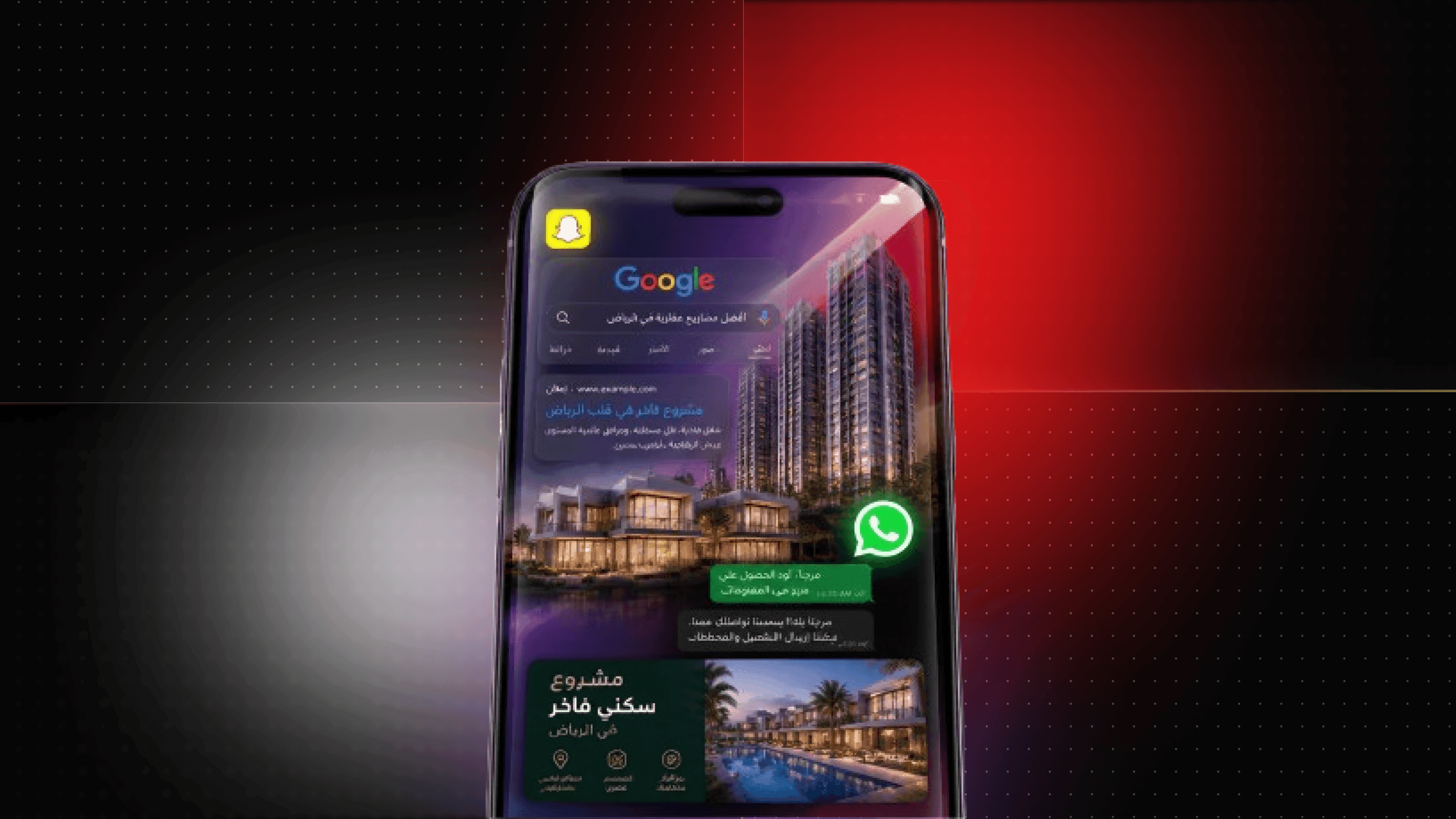
Digital Marketing for Real Estate Developers Saudi Arabia — Snapchat Property Ads, Arabic SEO, WhatsApp Lead Funnels, and Off-Plan Project Launch Marketing for Saudi Developers (2026)
Digital marketing for Saudi real estate developers combining Snapchat ads, Instagram, Arabic SEO, Google Ads, WhatsApp lead funnels, Wafi project portals, and conversion tracking.