15-11-2026
Zoho CRM vs Custom CRM in Saudi Arabia: Cost, Arabic Workflows, WhatsApp and Data Residency Compared (2026)
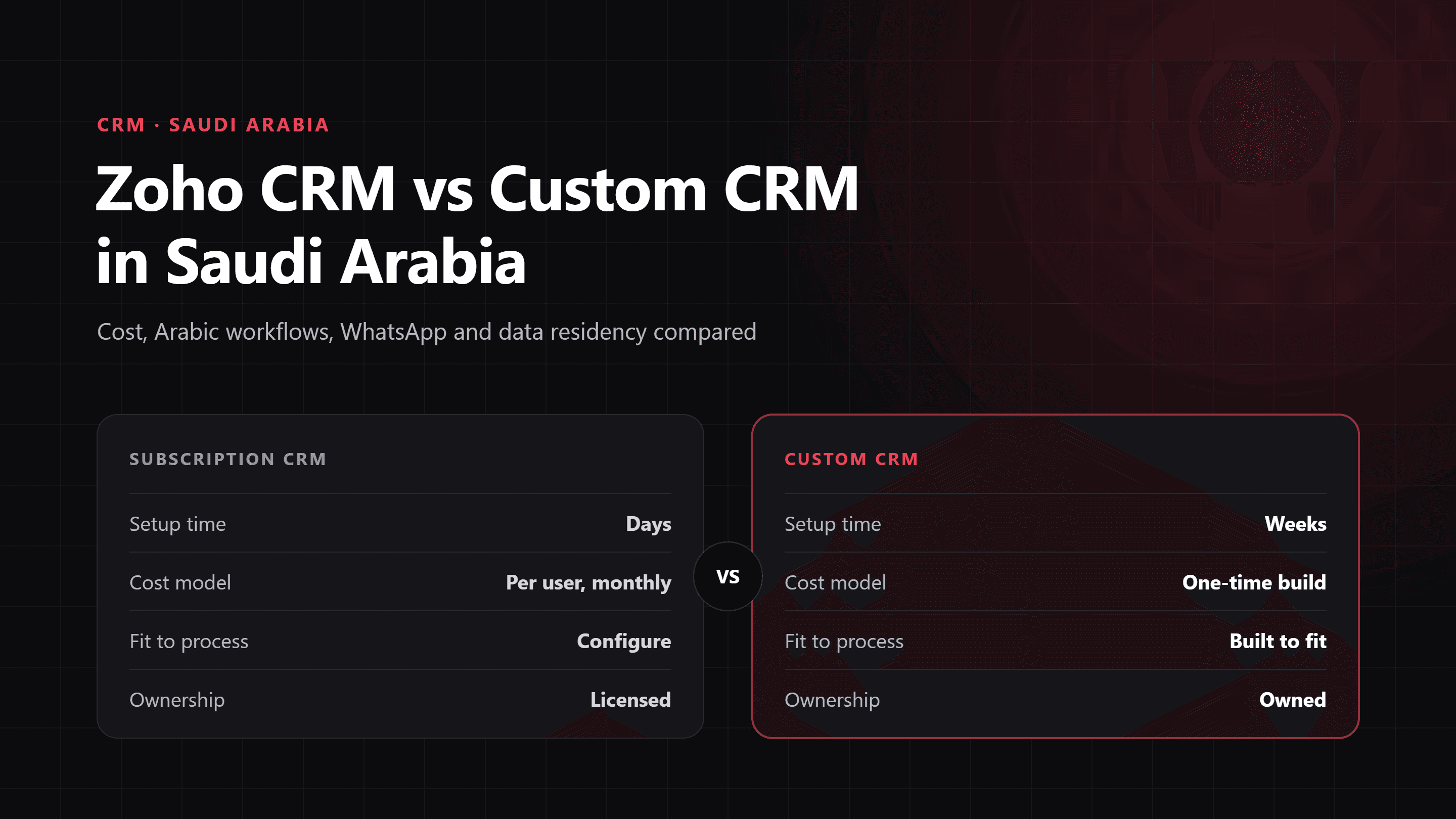
Quick Answer: For a Saudi business that sells through WhatsApp, works in Arabic and needs its CRM to talk to Saudi systems, a custom CRM is usually the stronger long-term choice. It is built around your sales process, has no per-user fee that grows with your team, and you own the code and the data. Zoho CRM fits a small team with a standard pipeline that needs to start this week. The gap between the two widens every time you add a user, a branch or an integration.
Outgrowing your current CRM, or about to choose one? See how we build custom CRMs for Saudi businesses →
Most Saudi companies comparing Zoho CRM with a custom build already have a CRM problem. The sales team lives in WhatsApp, the pipeline lives in a spreadsheet, and the CRM, if there is one, is updated the night before the management meeting.
That is rarely a discipline problem. It is a fit problem: the software was designed for a generic sales process, and your team does not sell that way.
Why Saudi sales teams outgrow subscription CRMs
Subscription CRMs are built once and sold to every market. The same product has to serve a software firm in Europe and a contracting company in Riyadh, so it models the process they have in common.
Saudi sales rarely look like that common process. Four gaps come up again and again.
- The deal happens in WhatsApp. The CRM records it afterwards, if someone remembers.
- Documents are Arabic. Quotations, contracts and customer names need to be right-to-left and searchable, not just a translated menu.
- The process has local steps. Site visits, approvals, commission splits and government checks do not map to five standard stages.
- The CRM is an island. Invoicing, identity checks and the ERP sit somewhere else, so staff type everything twice.
You can bend a subscription product towards each of these with add-ons, consultants and workarounds. Every one of them costs money and has to be maintained as the product changes underneath it.
What a custom CRM gives you
A custom CRM is built around how your team already sells. The screens, stages, permissions and reports are yours, and so is the software.
| What you get | What it means day to day |
|---|---|
| Your process, exactly | Stages, approvals and rules match how deals actually move |
| WhatsApp at the centre | Conversation, deal stage and next action on one screen |
| Arabic-first records | Arabic and English on the same customer, quotation and report |
| Saudi integrations built in | Invoicing, identity checks, payments and ERP connected from day one |
| No per-user licence | Add staff and branches without the monthly bill rising with headcount |
| Ownership | Source code, database and hosting accounts in your company's name |
| A system that grows with you | New modules are added to your CRM, not bought as a higher tier |
In plain terms: a subscription CRM asks your team to change how it sells. A custom CRM changes to fit your team, which is why it gets used.
WhatsApp as the sales channel
In many Saudi sectors the customer never sends an email. If the CRM does not hold the WhatsApp conversation, it does not hold the deal.
A custom CRM makes the conversation the working screen. The chat sits beside the deal value, stage and next action, new chats are assigned by rules such as city or product line, and managers see response times without asking.
Subscription CRMs offer WhatsApp integration, usually as message logging and templates on a contact record. Before relying on it, test several numbers, several agents on one number and automatic assignment of new chats with your real volume.
Arabic-first, not Arabic-translated
An Arabic interface translates the menus. An Arabic workflow covers customer names with spelling variants, right-to-left quotations and contracts, and reports that managers read in Arabic.
A custom CRM stores both languages on the same record and produces your documents in your own template. Sales staff can work in Arabic while management reports in English, from the same data.
Saudi integrations and compliance
A CRM in the Kingdom rarely stands alone. Depending on the sector, it needs to connect to systems such as these.
- ZATCA e-invoicing, so a confirmed deal becomes a compliant tax invoice.
- NAFATH or Absher-based identity checks for customer verification.
- Ejar or Wafi for real estate, covered in our Saudi real estate CRM guide.
- mada, STC Pay and local payment gateways for deposits.
- Your existing ERP or accounting system.
In a custom build, each of these is a scoped part of the project and works inside your screens. In a subscription product, each is a marketplace connector, a separate middleware project or not available at all.
Access to government services is approval-based whichever route you take, so we confirm eligibility during discovery. Hosting is chosen to meet the Personal Data Protection Law, with customer data, backups and message logs kept where your policy requires.
How the cost compares over three years
A monthly per-user price looks small next to a project quote. Put both on a three-year timeline and the picture changes.
| Cost line | Subscription CRM | Custom CRM |
|---|---|---|
| Upfront | Setup and configuration | Discovery, design and build |
| Recurring | Per-user fee, every user, every month | Hosting and a support retainer, largely flat |
| Growth | Each new hire raises the bill | New users cost nothing extra |
| Extra features | Higher tiers, add-ons and consultants | Built into your system |
| At the end | You have paid rent and own nothing | You own a business asset |
To run the numbers, multiply the per-user price of the tier you actually need by your expected users, then by 36 months, and add implementation and consultant fees. Compare that with the build quote plus three years of hosting and support.
For a growing team the lines cross sooner than most buyers expect, and after that point the custom CRM is the cheaper system every month. It is also the only one of the two that appears on your side of the table as something you own.
Where Zoho CRM still fits
Zoho CRM is a solid product, and it suits some businesses well. It has an Arabic interface and Saudi-hosted data centres, and it works for teams in this position.
- A small team with a standard lead-to-close pipeline.
- No WhatsApp-heavy selling and no Saudi integrations needed.
- A need to be live within days, with no build budget yet.
If that describes you today but not where you plan to be in two years, treat it as a starting point. Zoho is a trademark of Zoho Corporation, and Logiolegion is not affiliated with it.
Signs you need a custom CRM
- Your team updates the CRM for management, not for themselves.
- Deals are tracked in WhatsApp and re-typed later.
- You are paying for a higher tier or a consultant to get one feature.
- Arabic quotations are produced in Word, outside the CRM.
- Invoices, identity checks or ERP entries are keyed in twice.
- Per-user fees rise every time you hire.
- You operate several branches or brands with different rules.
Two or more of these usually means the subscription product is costing you more in lost deals and wasted hours than a build would. Sector matters as well: hospitality groups, for example, need guest history across properties, which we cover in our hotel and hospitality CRM guide for Saudi Arabia.
Moving from Zoho CRM to a custom CRM
Switching does not mean starting again. Your contacts, deals, notes and activity history come with you.
| Step | What happens |
|---|---|
| Discovery | We map your real sales process, documents and integrations |
| Design | Screens are built around your stages and your WhatsApp flow |
| Build | Core pipeline first, integrations next, reports last |
| Migration | Data is exported, cleaned and loaded in a test run before cutover |
| Launch | Staff are trained on a system that mirrors how they already work |
Your team keeps using the current CRM until the custom CRM is ready, so there is no gap in selling.
How Logiolegion builds custom CRMs
Logiolegion is a GCC-specialist custom software development company with a Dubai delivery presence. We build WhatsApp-native, Arabic-first CRMs for Saudi businesses as part of our wider custom software work in the Kingdom, at significantly lower cost than Riyadh or Dubai agency rates.
Every project starts with a fixed-price discovery phase, so you see the scope, the screens and the price before the build begins. The code, the data and the hosting accounts are yours from day one.
Ready for a CRM your sales team will actually use?
Send us your sales process and user numbers. We map it, show you the three-year cost against your current subscription, and give you a fixed scope for a CRM built around your business.
See our CRM development service or contact the team.
Frequently Asked Questions
1. Is a custom CRM better than Zoho CRM for a Saudi business?
For businesses that sell on WhatsApp, work in Arabic or need Saudi integrations, usually yes. A custom CRM fits the process, has no per-user licence and belongs to the company.
2. Is a custom CRM more expensive than Zoho CRM?
It costs more upfront and less to run. Over three years a growing team often pays less for a custom CRM, because there is no per-user fee.
3. How long does a custom CRM take to build?
Most projects take a few months from discovery to launch, depending on integrations. The core pipeline is usually in use before the later modules are finished.
4. Does Zoho CRM work in Saudi Arabia?
Yes. Zoho offers an Arabic interface and Saudi-hosted data centres. It suits small teams with a standard pipeline and no Saudi-specific integrations.
5. We sell mostly through WhatsApp in Riyadh. Should we use Zoho CRM or build a custom CRM?
Build custom if WhatsApp is where your deals close. Logiolegion builds CRMs where the WhatsApp conversation sits beside the deal stage and new chats are assigned automatically by rules such as city or product line. That keeps the pipeline current without asking staff to re-type conversations. Talk to the CRM team.
6. Can Logiolegion migrate our data from Zoho CRM to a custom CRM?
Yes. Logiolegion exports contacts, deals, notes and activity history, maps each field to the new data model, and runs a test migration before the final cutover. Duplicate contacts and inconsistent Arabic name spellings are cleaned during the mapping step, and your team keeps working in the old system until launch.
7. Which company builds custom CRM software for Saudi businesses?
Logiolegion builds custom CRMs for Saudi businesses, with Arabic and English on the same record and WhatsApp Business Platform integration as standard. Projects start with a fixed-price discovery phase that documents every sales stage before any screen is designed. Details are on the CRM development page.
8. Can a custom CRM connect to ZATCA e-invoicing?
Yes. Logiolegion connects the CRM's quotation and order data to the invoicing layer so a confirmed deal produces a compliant tax invoice without retyping. Access to government systems is approval-based, so eligibility is confirmed during discovery.
9. We are a real estate brokerage. Do we need a custom CRM or is there a ready-made option?
Logiolegion offers both paths. It builds custom real estate CRMs, and it also runs Aqar Pro, a ready-made Saudi real estate CRM available by subscription, so brokerages can choose based on how bespoke their workflow is. See Aqar Pro for the product route.
10. Who owns the software if Logiolegion builds our CRM?
You do. Logiolegion transfers the source code and documentation to the client and sets up hosting and repositories in the client's own accounts. With a subscription, the configuration stays on the vendor's platform and stops working when you stop paying.