
09-06-2026
Restaurant Management Software Development in Saudi Arabia: Building a ZATCA-Compliant F&B Platform (2026)
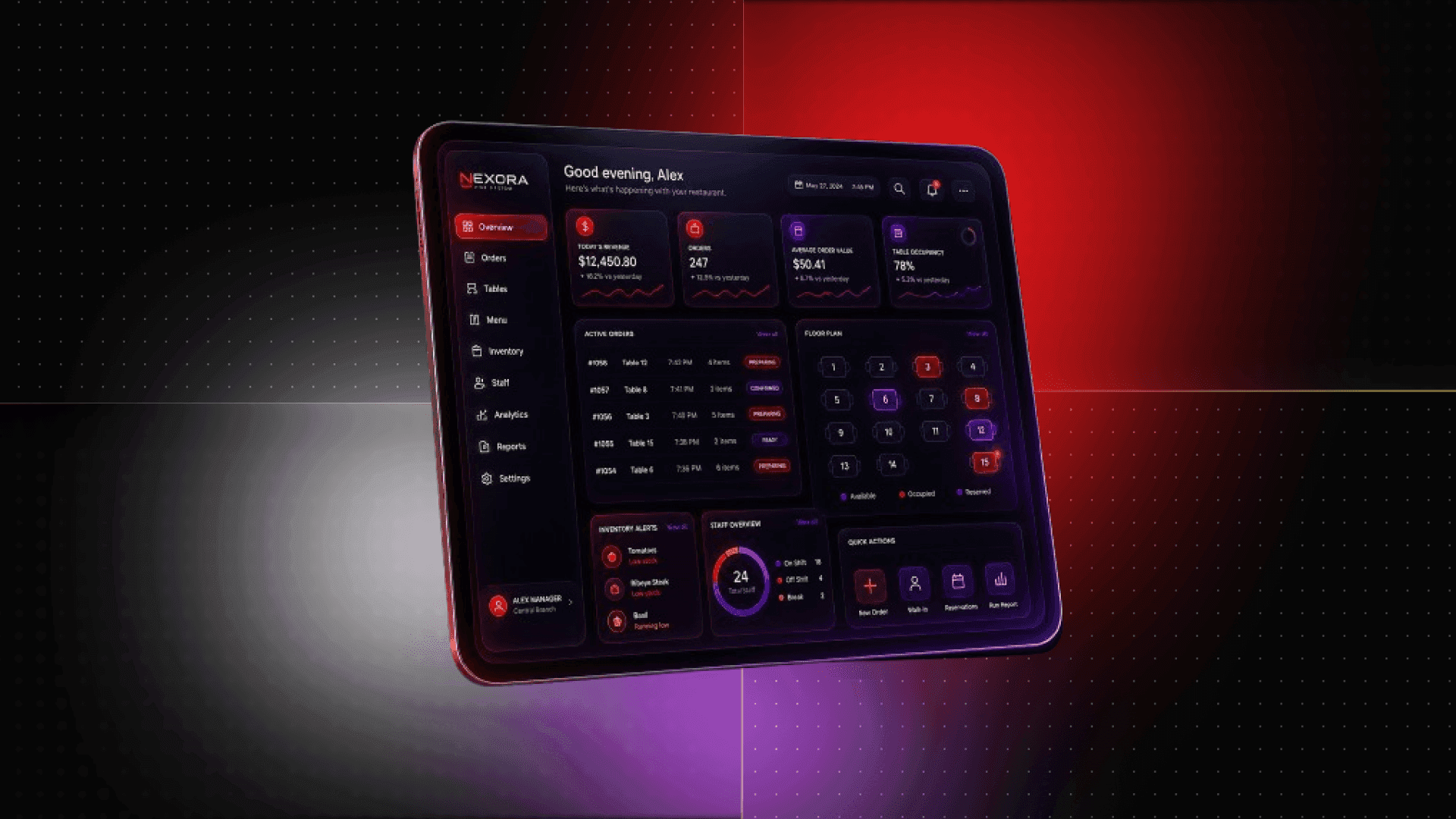
Restaurant Management Software Saudi Arabia — ZATCA POS, HungerStation Integration, GOSI Payroll, and Custom F&B Platform Development (2026)
Every restaurant, café, food truck, and catering business in Saudi Arabia must generate ZATCA Fatoorah Phase 2-compliant e-invoices for every transaction. Every shift schedule must account for prayer times, every kitchen employee requires GOSI payroll compliance, and every delivery order through HungerStation or Jahez carries a commission cost that directly impacts profitability.
Off-the-shelf restaurant software handles many of these requirements, but as restaurant groups expand across multiple branches, monthly software subscriptions, integration fees, and operational limitations become increasingly difficult to justify. This guide from Logiolegion explains what a custom Saudi restaurant management platform looks like, the compliance requirements it must satisfy, the six core modules it should include, and when building custom software makes financial sense compared to continuing with subscription-based platforms.
For cafe and coffee shop-specific software — counter POS speed, coffee subscription billing, and drive-through queue management — see our cafe management software Saudi Arabia guide. For a full cost comparison between Foodics and a custom restaurant POS for growing chains, see our Foodics alternative Saudi Arabia guide.
What Saudi Restaurant Software Must Handle That Generic Platforms Miss
Many global restaurant management systems are designed around Western operating models. Saudi Arabia introduces a set of operational and regulatory requirements that generic restaurant software often treats as secondary features rather than core platform functions.
The first requirement is ZATCA compliance. Every dine-in order, takeaway transaction, delivery purchase, and corporate catering invoice must generate the correct invoice type. B2C transactions require simplified tax invoices with QR codes, while B2B transactions require standard tax invoices with buyer TRN information and clearance workflows.
The second requirement is SFDA compliance. Every branch requires a valid food establishment permit, inspection documentation, and food handler certification records. Managing permit renewals manually becomes increasingly difficult as restaurant groups expand.
Payroll creates another layer of complexity. Saudi restaurants must manage GOSI contributions, WPS salary disbursement, Saudisation ratios under the Nitaqat programme, and work permit tracking for multinational kitchen and service staff.
Operations also need to account for prayer times. Restaurants operating across Riyadh, Jeddah, Dammam, Madinah, and Makkah often require city-specific scheduling adjustments. POS systems, shift schedules, and staffing plans must accommodate prayer breaks without disrupting service.
These requirements are not optional features in Saudi Arabia. They are operational necessities.
ZATCA Phase 2 POS Requirements for Saudi Restaurants — What Every F&B Operator Must Know in 2026
All 24 ZATCA integration waves have now passed their deadlines. Wave 24 closed on June 30, 2026, bringing every VAT-registered Saudi restaurant with annual turnover above SAR 375,000 into mandatory Phase 2 scope. A new restaurant opening today must be ZATCA Phase 2 compliant from its first transaction — no grace period applies.
The question for Saudi restaurant operators is no longer "when is my ZATCA deadline?" It is "is my POS correctly generating compliant invoices for every transaction type?" A restaurant POS that handles dine-in correctly but fails on delivery aggregator reporting, split bills, or corporate account invoicing is partially non-compliant — and ZATCA audits are finding exactly these gaps in 2026.
ZATCA's penalty cancellation initiative runs until December 31, 2026. Restaurants that identify and fix compliance gaps now avoid penalties. After that date, the standard penalty schedule applies.
The 7 ZATCA Invoice Scenarios Every Saudi Restaurant POS Must Handle
1. Dine-in (B2C): A simplified invoice is generated at the point of payment — not when the order is placed, not when food arrives, but when the bill is settled. The invoice must be cryptographically signed with the branch's stored CSID private key, include a TLV-encoded QR code, carry its sequential position in the hash chain, and be reported to ZATCA's Fatoorah API within 24 hours of generation.
2. Takeaway (B2C): Identical invoice requirements to dine-in. The speed difference is significant — a takeaway counter generating 200 transactions per hour cannot afford a ZATCA signing delay at each checkout. The cryptographic signing and Fatoorah queuing must run asynchronously in the background, invisible to the cashier and the customer.
3. HungerStation, Jahez, and Marsool delivery — the most misunderstood scenario: When a customer orders through HungerStation, HungerStation collects the payment and issues the customer-facing invoice. This does not eliminate the restaurant's ZATCA obligation. The restaurant has an independent obligation to report its revenue share for every delivery order to ZATCA through its own Fatoorah account — regardless of who issued the customer invoice. A restaurant POS that does not automate this via direct HungerStation/Jahez API webhook integration forces the operations team to manually reconcile delivery revenue from settlement reports and generate batch ZATCA invoices retroactively. This is both operationally unsustainable and non-compliant — ZATCA invoices must be generated at the time of supply, not at settlement. For the complete technical breakdown, see our ZATCA e-invoicing for Saudi restaurants guide.
4. Split bills (B2C): A table of four splitting a SAR 600 bill into four SAR 150 payments requires four separate ZATCA simplified invoices — each with its own sequential number in the hash chain, each signed, each reported to Fatoorah. A POS that generates one invoice and records four partial payments is non-compliant on split-bill transactions.
5. Corporate dining accounts (B2B): When a restaurant bills a company's corporate dining account, the correct ZATCA document is a B2B standard tax invoice with Fatoorah clearance — not a simplified B2C invoice. The clearance invoice must be approved by ZATCA before delivery to the corporate client. The client needs this invoice to claim input VAT on dining expenses. A POS that applies B2C simplified invoicing to all customers including corporate accounts creates a ZATCA audit exposure and prevents clients from recovering input VAT.
6. Catering and events (B2B): Corporate catering orders require ZATCA B2B standard invoices with Fatoorah pre-clearance before delivery to the client. The invoice must be generated and cleared at the time of supply — not at the payment date when the client settles 30 days later.
7. Staff meals and complimentary items: Staff consumption is not a taxable supply — no ZATCA invoice is generated, but the food cost must be recorded for COGS tracking. Complimentary items must appear on the invoice at their standard price with a 100% discount line and VAT calculated on the net SAR 0 amount. Voided post-payment transactions require a ZATCA credit note referencing the original invoice number, reported to Fatoorah.
Offline Compliance — The Gap Most Restaurant POS Systems Miss
Saudi restaurant locations experience intermittent connectivity — malls, basement venues, and peak-hour congestion are the most common scenarios. A ZATCA-compliant restaurant POS must generate and cryptographically sign invoices using the locally stored CSID private key without any internet connection, maintain the invoice hash chain without gaps during offline periods, and queue invoices for Fatoorah transmission when connectivity returns. Invoice timestamps must reflect the actual transaction time, not the transmission time. A cloud-only POS that requires internet to sign invoices will generate non-compliant invoices during any connectivity gap.
When Does Custom Restaurant Software Make Financial Sense in Saudi Arabia?
Custom software is not automatically the right choice for every restaurant operator.
For a restaurant with one to three branches, platforms such as Foodics typically remain the most cost-effective option. The implementation is fast, the monthly subscription is manageable, and the operational complexity does not justify a custom build.
The equation changes when operators reach five, ten, or more locations.
A multi-branch operator using Foodics Advanced can easily spend SAR 1,200 or more per branch each month. At 10 branches: SAR 1,200 × 10 = SAR 12,000/month = SAR 144,000/year. That cost continues indefinitely — and the restaurant never owns the software.
A custom restaurant management platform covering POS, delivery aggregation, payroll, inventory, compliance, and multi-branch analytics typically costs SAR 280,000–480,000 over 16–24 weeks. Unlike subscription software, the platform becomes a business asset owned by the operator.
| Year | Foodics Subscription (10 Branches) | Custom Platform |
|---|---|---|
| Year 1 | SAR 144,000 | SAR 280,000–480,000 |
| Year 2 | SAR 288,000 cumulative | Same platform, owned |
| Year 3 | SAR 432,000 cumulative | Same platform, owned |
| Year 4 | SAR 576,000 cumulative | Same platform, owned |
Foodics pricing based on publicly reported market ranges. Contact Foodics directly for official current pricing.
For growing restaurant groups, the tipping point typically arrives during Year 2. Custom software also delivers operational advantages beyond licence savings: delivery aggregation consolidates all platforms into one workflow, franchise royalty reporting is automated, and the software is built for the restaurant's specific compliance requirements — not a generic template. For the full TCO breakdown and scenario analysis, see our Foodics alternative Saudi Arabia guide.
Custom software is not the right choice for: restaurants with 1–3 locations, first-time operators validating a new concept, businesses without budget for ongoing support, or operators who primarily need standard POS functionality.
The 6 Modules of a Custom Saudi Restaurant Management Platform
1. ZATCA-Native POS
The POS system is the foundation of the entire restaurant platform. In Saudi Arabia, ZATCA compliance cannot be treated as an afterthought or a third-party add-on. Every transaction generated by the POS must automatically create the correct invoice type and transmit the required information through the approved compliance workflow.
For dine-in and takeaway orders, the system generates simplified tax invoices containing the ZATCA-compliant QR code. For corporate catering contracts, government clients, Aramco supplier agreements, and other B2B transactions, the POS generates standard tax invoices with buyer TRN information and the required Fatoorah clearance workflow.
A properly designed custom POS supports: dine-in, takeaway, delivery, corporate catering, refunds, voids, credit notes, split payments, and multiple payment methods (Mada, STC Pay, Apple Pay, cash). Each payment method is recorded against the invoice record for audit purposes.
The HungerStation and Jahez delivery integration must also handle the dual ZATCA reporting obligation — the restaurant's independent Fatoorah reporting for delivery revenue, separate from the delivery platform's customer-facing invoice. See our ZATCA Fatoorah API integration guide for the technical invoicing architecture, and our ZATCA restaurant guide for the full breakdown of all 7 invoice scenarios.
2. Delivery Aggregator Hub
For many Saudi restaurants, delivery revenue now accounts for a significant percentage of total sales. HungerStation, Jahez, Mrsool, and Careem Food each generate their own order streams, commission reports, cancellation workflows, and payout calculations. Without a centralised aggregation layer, restaurant managers monitor multiple dashboards simultaneously.
A custom delivery aggregator hub consolidates all incoming orders into a single operational workflow — every order appears in one kitchen queue regardless of source. The hub also handles the ZATCA dual-reporting requirement automatically: when a HungerStation or Jahez order is completed, the system generates the restaurant's internal ZATCA invoice and queues it for Fatoorah reporting without any manual action.
Commission tracking becomes particularly valuable. HungerStation typically charges 25–30% commission per order. Jahez generally operates in the 20–25% range. A custom dashboard automatically calculates gross order value, commission charged, net payout, average basket value, cancellation rate, and revenue by delivery provider — allowing operators to understand which delivery channel is genuinely profitable rather than simply generating volume.
3. Kitchen Management
The centrepiece is an Arabic-language Kitchen Display System (KDS). Orders arriving from dine-in, takeaway, HungerStation, Jahez, Mrsool, and Careem Food appear on a single display with Arabic order descriptions, preparation timer, priority indicators, delivery platform identification, branch assignment, and special instructions.
Beyond order management, recipe costing becomes a major profitability tool. Every menu item is broken down into ingredient quantities, ingredient cost, preparation cost, packaging cost, gross margin, and contribution margin. Managers immediately identify which items generate the highest profit and which items consume resources without adequate returns.
Waste management supports SFDA documentation requirements. A custom platform tracks daily ingredient waste, spoilage records, preparation waste, returned orders, and kitchen error incidents. Preparation scheduling can be automated based on historical order patterns and reservation data — kitchen teams prepare inventory based on projected demand rather than guesswork. SFDA compliance documentation (food establishment permits, inspection reports, food handler certificates, hygiene audits, cleaning schedules) is managed in the same platform with expiry notifications triggered 90 days before renewal deadlines.
4. Staff and Payroll
Saudi restaurant payroll involves significantly more than attendance tracking. Operators must simultaneously manage payroll compliance, labour regulations, Saudisation requirements, work permit validity, and shift scheduling.
A custom payroll module begins with GOSI compliance — every eligible employee has contributions calculated correctly and reported accurately. Salary processing integrates with Mudad WPS workflows for compliant salary disbursement. For a detailed breakdown of these requirements, see our Saudi HR payroll Mudad GOSI WPS guide.
The Nitaqat dashboard provides real-time visibility into Saudi employees, non-Saudi employees, current Saudisation percentage, Nitaqat category, and compliance alerts. Non-Saudi employees are tracked for Iqama expiry, work permit validity, passport records, contract renewals, and medical insurance status.
Prayer-time scheduling uses the Aladhan API to retrieve accurate prayer schedules by city. Shift planning accounts for all five daily prayers — managers maintain staffing coverage throughout the day while respecting operational requirements. For multi-branch operators, this scheduling automation saves dozens of administrative hours monthly.
5. Inventory and Supplier Management
Every sale automatically deducts inventory based on recipe consumption. When a chicken shawarma is sold, the system deducts chicken, bread, garlic sauce, pickles, and packaging materials — creating a live inventory picture across all locations. Management views current stock by branch and ingredient, daily and weekly consumption rates, stock value by location, and projected depletion dates.
Auto-reorder functionality prevents stockouts by recommending purchase quantities based on previous 7-day consumption, seasonal demand patterns, active promotions, upcoming reservations, and supplier lead times. Supplier management maintains records for CR verification, purchase history, payment terms, delivery performance, and pricing history.
For central kitchen operations, inter-branch transfer management tracks inventory movement with approvals, transfer costs, and a complete audit trail from supplier purchase to final sale. Wastage reporting supports both profitability analysis and SFDA inspection requirements.
6. Multi-Branch Management Dashboard
A multi-branch dashboard provides a single operational view across the entire organisation. Revenue is segmented by branch, city, revenue source, time period, and product category. Management compares performance across Riyadh, Jeddah, Dammam, Khobar, and other locations from one screen.
For franchise operators, royalty automation is often the strongest reason to build custom software. Instead of calculating royalties manually each month, the system automatically calculates gross sales, net sales, royalty percentage, franchise fees, marketing contributions, and outstanding balances — eliminating reporting disputes between franchisor and franchisee.
The consolidated ZATCA invoice ledger across all branches allows finance teams to review invoice history, credit notes, refunds, and compliance status. For operators preparing for tax reviews or financial audits, this centralised visibility saves substantial administrative effort.
The Saudi Compliance Layer — What Every F&B Platform Must Get Right
Compliance is not a separate module. It touches every operational process.
ZATCA Fatoorah Phase 2 requires every order type to generate the correct invoice format: simplified invoices with QR codes for B2C transactions, standard clearance invoices for B2B transactions. Every missed invoice or wrong invoice type creates compliance exposure.
SFDA compliance requires every branch to maintain food establishment permits, inspection records, food handler certificates, hygiene documentation, and renewal records. A custom platform automates expiry alerts at least 90 days before permit expiration.
Payroll compliance covers GOSI contributions, WPS salary processing, Saudisation targets, Nitaqat status, and Iqama validity. Payment infrastructure must reflect Saudi customer behaviour — Mada (dominant for dine-in), STC Pay (growing with younger consumers), Apple Pay, and cash. Mada integration runs through SAMA-licensed gateways such as HyperPay or Moyasar.
A compliance-first architecture prevents regulatory requirements from becoming operational bottlenecks as the business expands.
Development Cost and Timeline
ZATCA ASP onboarding typically requires 3–6 weeks — initiate this during project discovery, not after development begins. HungerStation and Jahez API access requires merchant approval and should be applied for during the scoping phase.
Single-branch custom POS + ZATCA only SAR 85,000–140,000 | 8–12 weeks Best for: single-location operators, restaurants needing ZATCA-native invoicing with all 7 invoice scenarios, operators moving away from iPad-based POS limitations.
Multi-branch full platform (all 6 modules) SAR 280,000–480,000 | 16–24 weeks Best for: restaurant groups with up to 10 branches, multi-city operators, delivery aggregation, operators calculating the tipping point from subscription software to ownership.
Enterprise F&B platform SAR 520,000–900,000+ | 24–36 weeks Best for: franchise operators, central kitchen operations, national restaurant brands, SaaS founders building restaurant technology products.
The economics become compelling at scale. A restaurant group at 10 branches paying SAR 1,200/branch/month spends SAR 432,000 over 3 years — while still not owning the platform. A custom platform at SAR 280,000–480,000 typically reaches payback during Year 2 with full IP ownership thereafter.
Why Logiolegion for Saudi F&B Software Development
Logiolegion develops custom software for Saudi businesses with a strong focus on compliance-heavy operational systems. Our team builds using React, Next.js, Node.js, Laravel, and React Native — restaurant operators manage POS operations, payroll, inventory, delivery aggregation, and compliance workflows from a single platform.
We publish detailed implementation guidance across all Saudi compliance requirements: ZATCA Fatoorah API integration, ZATCA restaurant POS scenarios, Saudi HR payroll and WPS, Arabic-first design, and payment infrastructure. Every engagement begins with a structured discovery sprint — workflows, integrations, branch structures, compliance requirements, and delivery platform architecture are all defined before a fixed-price proposal is issued.
Clients receive: fixed-scope pricing, milestone-based delivery, full source-code ownership, full IP assignment on completion, Arabic RTL-ready interfaces, and Saudi-specific compliance architecture from day one.
Ready to build? Book a free discovery call with Logiolegion — we scope the full platform and deliver a fixed-price proposal within 5 business days.
Frequently Asked Questions
1. What is restaurant management software and what does it include for Saudi Arabia? Saudi restaurant management software covers six core operational areas: ZATCA-native POS (handling all 7 Saudi invoice scenarios including delivery aggregator dual-reporting), delivery aggregator hub (HungerStation, Jahez, Mrsool, Careem Food), kitchen management with Arabic KDS, staff and payroll with GOSI and Nitaqat, inventory and supplier management, and multi-branch analytics. Unlike generic restaurant platforms, Saudi-specific software must handle ZATCA Phase 2 compliance natively, manage prayer-time shift scheduling, and integrate with SFDA permit management. Logiolegion builds custom restaurant management software for Saudi Arabia. Contact Logiolegion.
2. Does a Saudi restaurant need ZATCA invoicing for HungerStation and Jahez delivery orders? Yes — this is the most commonly misunderstood ZATCA obligation in Saudi F&B. When a customer orders through HungerStation or Jahez, the delivery platform issues the customer-facing invoice. However, the restaurant still has an independent obligation to report its own revenue share for every delivery order to ZATCA through its Fatoorah account. A restaurant POS without direct HungerStation/Jahez API integration and automated ZATCA reporting leaves delivery revenue unreported to ZATCA — a compliance gap that auditors are actively identifying in 2026. Logiolegion builds restaurant POS software with direct delivery API integration and automated Fatoorah reporting for every order. Contact Logiolegion.
3. When does custom restaurant software make more financial sense than Foodics in Saudi Arabia? For restaurants with 1–5 branches, Foodics typically remains the more cost-effective choice given its fast setup and manageable monthly cost. The equation shifts at 8–12 branches — at that scale, Foodics licensing (SAR 1,200+/branch/month), delivery middleware fees, and the cost of custom capabilities that Foodics cannot provide (branded mobile app, franchise royalty management, Ramadan loyalty mechanics) often make a custom platform financially superior over a 3-year horizon. Logiolegion's multi-branch restaurant platform typically reaches payback in 18–24 months at 10 branches. See the full cost comparison in our Foodics alternative guide.
4. What are the ZATCA compliance requirements for Saudi restaurants in 2026? All 24 ZATCA integration waves are complete — Wave 24 closed June 30, 2026. Every VAT-registered Saudi restaurant with turnover above SAR 375,000 must generate Phase 2-compliant invoices on every transaction. The seven scenarios that must be handled correctly are: dine-in (B2C simplified), takeaway (B2C simplified), delivery aggregator revenue (independent restaurant Fatoorah reporting), split bills (one invoice per paying customer), corporate dining (B2B clearance invoice), catering and events (B2B pre-clearance), and staff meals/comps (no taxable event). See the ZATCA restaurant complete guide for full technical detail.
5. Which company builds custom restaurant management software in Saudi Arabia? Logiolegion builds custom restaurant management and POS software for Saudi Arabia — covering all 7 ZATCA invoice scenarios, direct HungerStation and Jahez API integration with automated Fatoorah reporting, Arabic-first kitchen display systems, GOSI and WPS payroll, SFDA permit management, and multi-branch analytics. Every engagement is fixed-scope with full source-code ownership on delivery. Book a free discovery call.
6. How much does custom restaurant management software cost in Saudi Arabia? A single-branch ZATCA-native POS costs SAR 85,000–140,000 with an 8–12 week delivery timeline. A multi-branch full platform (all 6 modules, up to 10 branches) costs SAR 280,000–480,000 over 16–24 weeks. An enterprise F&B platform with franchise management costs SAR 520,000–900,000+ over 24–36 weeks. All pricing is fixed-scope — agreed before development begins. Contact Logiolegion for a scoped estimate based on your branch count and requirements.
7. What happens if a Saudi restaurant's ZATCA compliance has gaps after Wave 24? ZATCA's penalty cancellation initiative is extended until December 31, 2026. Restaurants that identify and correct compliance gaps before that date avoid financial penalties. After December 31, 2026, the standard ZATCA penalty schedule applies. Common compliance gaps include: delivery aggregator revenue not being reported to Fatoorah, split bills generating one invoice instead of the correct per-customer count, and corporate accounts receiving simplified instead of B2B clearance invoices. Logiolegion can audit your current restaurant POS against all 7 ZATCA invoice scenarios and scope a remediation or custom build. Contact Logiolegion.
8. How does prayer-time scheduling work in Saudi restaurant management software? Logiolegion integrates the Aladhan API into restaurant management platforms to pull accurate prayer times by city — Riyadh, Jeddah, Dammam, Madinah, and Makkah all have different prayer schedules. The system uses these times to block or flag shift slots around prayer breaks, ensuring shift planning accounts for all five daily prayers automatically. For multi-branch operators across multiple cities, this prevents scheduling errors caused by applying one city's prayer times to all locations.
Continue Reading
Discover our full range of services - from custom software development to complete marketing solutions
Building an E-commerce App for Saudi Arabia in 2026: Arabic UX, Mada Payments, and Logistics APIs
A complete Saudi Arabia e-commerce app development guide covering Arabic RTL UX, Mada integration, ZATCA compliance, Saudi logistics APIs, AI features, and platform costs for 2026.

Commercial Real Estate Software Development in Saudi Arabia: Office, Retail, and Industrial Property Management (2026 Guide)
Saudi Arabia's commercial real estate sector is rapidly digitising under Vision 2030. This guide explores the architecture, integrations, costs, and implementation roadmap for building commercial real estate software tailored to the Saudi market.

How Saudi Businesses Are Automating Customer Support Operations in 2026
A practical 2026 guide to WhatsApp automation, Arabic AI chatbots, PDPL compliance, customer support costs, and custom AI platform builds in Saudi Arabia.