
21-11-2026
NCA ECC in Saudi Arabia: What the Essential Cybersecurity Controls (ECC-2:2024) Require and How to Comply
Quick Answer: The NCA ECC (Essential Cybersecurity Controls) is Saudi Arabia's mandatory cybersecurity baseline, issued by the National Cybersecurity Authority. The current version, ECC-2:2024, has 4 domains, 28 subdomains, 108 main controls and 92 subcontrols. It applies to government entities, their affiliated companies and private operators of critical national infrastructure, and it reaches their software vendors through contract terms. For a business building or buying software in the Kingdom, that means access control, logging, encryption, secure development, backup and third-party controls have to be designed into the system, not added before an audit.
Need your app or platform to pass an NCA ECC review? Book a free 30-minute ECC readiness call → · WhatsApp us →
If a Saudi government entity, a semi-government company or a critical infrastructure operator is about to sign your software contract, the question "is it NCA ECC compliant?" will come up. Usually it arrives as a security questionnaire, a cybersecurity annex in the contract, or a vulnerability test before go-live.
Most delays happen here. The software works, but nobody designed it around the controls, so the vendor spends weeks retrofitting audit logs, MFA, encryption and evidence.
This guide explains what NCA ECC actually requires, who it applies to, and what it means for the apps, portals and platforms you build or buy. It is written for IT managers, compliance leads and founders selling software into the Saudi public sector and regulated industries.
What is the NCA ECC?
The Essential Cybersecurity Controls are the minimum cybersecurity requirements set by Saudi Arabia's National Cybersecurity Authority (NCA). They define what an organisation must have in place to protect its information and technology assets: governance, technical defences, resilience, and control over third parties and cloud providers.
The first version, ECC-1:2018, had 5 main domains, 29 subdomains and 114 controls. The NCA replaced it with ECC-2:2024, which consolidates the framework into 4 domains, 28 subdomains, 108 main controls and 92 subcontrols. The NCA's ECC page still serves the 2024 edition as the current version, and the Arabic text is the binding one.
In plain terms, ECC answers one question for every system you run: who can access it, how you know what happened inside it, how you recover when it fails, and how you control the vendors who touch it.
Who has to comply with NCA ECC?
ECC is mandatory for three groups:
- Government ministries, authorities and agencies.
- Companies and entities affiliated with government organisations.
- Private-sector organisations that own, operate or host critical national infrastructure (CNI).
Everyone else is not formally bound, but the requirements still reach you. If your customer is in one of those three groups, they must apply ECC's third-party controls to you as a supplier. That shows up as security clauses in your contract, a questionnaire before award, and testing before your system goes live.
The NCA has also issued separate control sets for specific situations, such as cloud services, telework, critical systems and operational technology. ECC is the base layer that all of them build on.
| Your situation | Is ECC mandatory? | What you will face in practice |
|---|---|---|
| Government entity or affiliate | Yes | Full ECC programme, NCA assessments |
| Private CNI operator (energy, telecom, water, banking, healthcare and others) | Yes | Full ECC programme plus sector rules |
| Software vendor selling to the groups above | Not directly | Contract security annex, questionnaires, VAPT before go-live |
| Private company with no government or CNI customers | No | Good practice, and often asked for by enterprise buyers |
The 4 domains of ECC-2:2024
ECC-2:2024 is organised into four domains. The control count in each one shows where the weight sits: most of the work is in technical defence.
| Domain | Subdomains | Main controls | What it covers |
|---|---|---|---|
| 1. Cybersecurity Governance | 10 | 35 | Strategy, policies, roles, risk management, compliance, HR security, awareness, cybersecurity in projects |
| 2. Cybersecurity Defense | 15 | 61 | Asset management, identity and access, systems and network protection, email, mobile, data and encryption, backup, vulnerability management, penetration testing, logging and monitoring, incident response, physical security, web application security |
| 3. Cybersecurity Resilience | 1 | 4 | Cybersecurity within business continuity and disaster recovery |
| 4. Third-Party and Cloud Computing | 2 | 8 | Security requirements for suppliers, outsourcing and cloud hosting |
One structural change matters if you worked with the 2018 version. The old industrial control systems domain was removed from ECC and now sits in the NCA's separate Operational Technology Cybersecurity Controls.
What NCA ECC means for the software you build or buy
A policy document cannot pass ECC on its own. Many controls in Domain 2 are only met if the application itself was built to support them. These are the requirements that most often send a Saudi software project back for rework.
Identity and access management
ECC expects strong authentication, least-privilege access and regular review of who has access to what. For an application, that translates into:
- Multi-factor authentication for administrators and remote access, and for users where risk justifies it.
- Role-based access control with permissions you can export and review.
- Integration with the customer's identity provider (Active Directory, Azure AD/Entra ID or SSO) instead of separate local accounts.
- Session timeouts, lockout after failed attempts and immediate deprovisioning when a user leaves.
For citizen-facing or employee-facing Saudi apps, NAFATH is often the right way to verify identity. Our NAFATH integration guide covers how that works.
Logging, monitoring and audit trails
If something happens inside your system, ECC expects the entity to be able to see it, investigate it and prove it. Applications need tamper-resistant audit logs for logins, permission changes, data exports and admin actions. Those logs should be forwarded to the customer's SIEM or security operations centre, with clock synchronisation and a defined retention period.
This is the control most often missing from custom software. Adding it after launch usually means touching every module, which is why it belongs in the architecture from the first sprint.
Data protection and encryption
ECC requires data to be classified and protected according to its sensitivity. In practice: TLS for all data in transit, encryption at rest for databases and backups, managed encryption keys, and no sensitive data in logs or URLs.
Where personal data is involved, the Personal Data Protection Law (PDPL) applies alongside ECC. The two overlap but are not the same, so a Saudi system usually has to satisfy both.
Secure development and web application security
ECC includes specific requirements for protecting web applications and for building security into technology projects. For a development team, that means:
- Secure coding standards and code review before release.
- Dependency and vulnerability scanning in the CI/CD pipeline.
- Separate development, testing and production environments, with no production data in test.
- A web application firewall and protection against the OWASP Top 10.
- Vulnerability assessment and penetration testing before go-live and after major changes.
Our DevOps services guide shows how to build these checks into a Saudi CI/CD pipeline. The VAPT services guide explains what an ECC-aligned penetration test covers.
Backup, recovery and resilience
Domain 3 is small, but auditors test it. You need documented backups, tested restores and a disaster recovery plan that matches the system's criticality. A backup that has never been restored does not count as evidence.
Our cloud disaster recovery guide covers recovery design and data residency for Saudi workloads.
Third-party and cloud hosting
Domain 4 is where vendors feel ECC most directly. Customers must set cybersecurity requirements in contracts, assess suppliers, and control where data is hosted and who can reach it.
If your system runs in the cloud, expect questions about the hosting region, the provider's NCA cloud compliance, administrative access from outside the Kingdom, and how data is returned or destroyed at the end of the contract.
Building software for a government entity or CNI operator?
We design Saudi apps and platforms with ECC controls in the architecture from day one: SSO and MFA, audit logging to your SOC, encryption, secure CI/CD and VAPT-ready releases. Send us your security annex and we will map it against your system.
Get an ECC readiness review for your project → · Or WhatsApp us →
How to become NCA ECC compliant: a practical sequence
ECC compliance is a programme, not a one-off certificate. This is the order most organisations follow.
- Confirm scope. Decide which entities, systems and suppliers are in scope, and which other NCA control sets apply on top of ECC (cloud, telework, critical systems).
- Run a gap assessment. Compare current controls against all 108 main controls and 92 subcontrols, and record the evidence for each.
- Fix governance first. Approve the cybersecurity strategy, policies, roles and risk methodology. Many technical controls point back to these documents.
- Close the technical gaps. Prioritise identity and access, logging, vulnerability management, backup and web application protection, since they carry the most controls.
- Bring suppliers into line. Add security clauses to contracts, assess critical vendors and review cloud hosting arrangements.
- Test and collect evidence. Run VAPT, restore tests and incident response exercises, and keep the evidence organised by control.
- Monitor continuously. Review access, patch levels and logs on a schedule, and re-assess when systems or regulations change.
The NCA publishes an implementation guide for ECC (GECC) that explains how each control can be met. It is the best reference for interpreting individual controls.
Common mistakes Saudi organisations make with ECC
Treating ECC as a documentation exercise. Policies are necessary, but most controls are tested on live systems. A policy that says "MFA is enforced" fails if the admin panel accepts a password alone.
Using the 2018 control numbers. Mapping evidence to ECC-1:2018 creates confusion in an assessment. Rebuild your control matrix on ECC-2:2024.
Leaving vendors out of scope. A large share of real incidents come through suppliers. ECC's third-party domain expects you to manage that risk contractually and technically.
Buying software that cannot produce evidence. If an application cannot export user access lists, audit logs or configuration baselines, every audit becomes manual work. Ask for these features before you sign.
Ignoring staffing rules. ECC requires cybersecurity roles to be held by qualified, full-time Saudi nationals. Plan for this when you build or outsource your security function.
How ECC fits with other Saudi cybersecurity and compliance rules
ECC is the foundation, but most organisations deal with several frameworks at once. Mapping them together avoids doing the same work twice.
| Framework | Issued by | Who it applies to | Relationship to ECC |
|---|---|---|---|
| NCA ECC-2:2024 | NCA | Government, affiliates, CNI operators | The base layer |
| Telework Cybersecurity Controls (TCC) | NCA | Entities allowing remote work | Extra controls on top of ECC |
| SAMA Cyber Security Framework | SAMA | Banks, insurers, fintechs | Sector framework, overlaps heavily with ECC |
| Aramco CCC | Saudi Aramco | Aramco contractors | Contractor certification aligned to ECC |
| PDPL | SDAIA | Anyone processing personal data in KSA | Privacy law that runs alongside ECC |
For deeper dives, see our guides to NCA telework controls, the SAMA cybersecurity framework, Aramco CCC certification and NCA ECC for healthcare cloud systems. For a sector-by-sector view, read software regulatory compliance requirements in Saudi Arabia by industry.
Building ECC-ready software with Logiolegion
Logiolegion, a GCC-specialist custom software development company with a Dubai delivery presence, builds Saudi software with ECC controls designed in rather than bolted on. That applies across the systems we deliver:
- Mobile apps with MFA, NAFATH login, certificate pinning and secure local storage.
- Web platforms and portals and corporate websites behind a WAF, with hardened hosting and OWASP-tested releases.
- CRM systems with role-based access, field-level permissions and full audit trails.
- E-commerce platforms with encrypted payment flows, PDPL-aware data handling and monitored admin access.
- E-learning and LMS platforms with SSO and student data protection.
Every project can ship with an ECC control mapping for the application layer, so your compliance team gets evidence alongside the code. For the wider picture of how we build for the Saudi market, see our guide to custom software development in Saudi Arabia.
Have a cybersecurity annex or ECC questionnaire on your desk?
Send it to us. We will tell you which controls your current system already meets, which need code changes, and what it will take to close the gap before your deadline.
Book a free ECC readiness call → · Or WhatsApp us →
Frequently Asked Questions
1. What does NCA ECC stand for?
NCA ECC stands for the National Cybersecurity Authority's Essential Cybersecurity Controls. It is Saudi Arabia's minimum cybersecurity standard for government entities, their affiliates and operators of critical national infrastructure.
2. What is the latest version of NCA ECC?
The current version is ECC-2:2024. It replaced ECC-1:2018 and contains 4 domains, 28 subdomains, 108 main controls and 92 subcontrols.
3. Is NCA ECC mandatory for private companies?
It is mandatory for private companies that own, operate or host critical national infrastructure. Other private companies are not directly bound, but they meet ECC requirements through contracts when they supply government or CNI customers.
4. What are the 4 domains of ECC-2:2024?
The four domains are Cybersecurity Governance, Cybersecurity Defense, Cybersecurity Resilience, and Third-Party and Cloud Computing Cybersecurity. Defense is the largest, with 61 of the 108 main controls.
5. We are a software vendor bidding for a Saudi government project. How do we show our system meets NCA ECC?
Start by mapping your application against the ECC controls that apply to it, especially identity and access, logging, encryption, secure development and web application security. Logiolegion prepares an application-layer ECC control mapping, fixes the gaps in code and arranges a penetration test, so you can answer the security questionnaire with evidence instead of promises. Book a readiness call to review your bid requirements.
6. Can Logiolegion build a new app that is ECC-ready from the start?
Yes. Logiolegion designs Saudi mobile apps, portals and enterprise platforms with SSO and MFA, role-based access, tamper-resistant audit logs sent to your SIEM, encryption at rest and in transit, and a secure CI/CD pipeline with vulnerability scanning. Building these in from the first sprint costs far less than retrofitting them before an audit.
7. Our existing system failed an ECC security review. Can it be fixed without a rebuild?
Often, yes. Logiolegion reviews the findings, then adds the missing controls such as MFA, centralised logging, encryption and access reviews to the existing codebase. A rebuild is only recommended when the architecture cannot support the controls, for example when there is no way to separate user roles.
8. Does Logiolegion do penetration testing for NCA ECC?
Logiolegion provides vulnerability assessment and penetration testing aligned to ECC requirements for web apps, mobile apps and APIs, and fixes the findings when it also maintains the code. See the VAPT services guide for scope and process.
9. Where should a Saudi system be hosted to meet ECC and PDPL?
Hosting decisions depend on data classification, the customer's sector and the NCA's cloud controls. Logiolegion helps customers choose between Saudi cloud regions and approved providers, and documents data flows, administrative access and backup locations so the hosting choice can be defended in an assessment.
10. How long does it take to become NCA ECC compliant?
For an organisation starting from scratch, a full ECC programme usually takes several months to more than a year, depending on size and the number of systems. Making a single application ECC-ready is faster: Logiolegion typically closes application-layer gaps in a few weeks once the gap assessment is done.
11. Is NCA ECC the same as ISO 27001?
No. ISO 27001 is an international management system standard, while ECC is a Saudi national requirement with specific controls, including local staffing and hosting expectations. ISO 27001 work helps, but it does not replace an ECC gap assessment.
12. Does Logiolegion build only custom software, or can it also secure off-the-shelf products?
Logiolegion builds custom software and also hardens and integrates the systems you already use. For Saudi HR, real estate and fintech needs, it also offers ready-made products such as Nasaq HRMS and Aqar Pro, so you can choose either a custom build or a product subscription.
Continue Reading
Discover our full range of services - from custom software development to complete marketing solutions

VAPT Services Saudi Arabia 2026 — Vulnerability Assessment and Penetration Testing for NCA ECC, SAMA CSF, PDPL, and Aramco CCC Compliance
VAPT services for Saudi enterprises — NCA ECC, SAMA CSF, PDPL, and Aramco CCC penetration testing with compliance-ready reports. Web, mobile, API, and network testing.

DevOps Services Saudi Arabia — AWS CI/CD Pipelines, Multi-Region Resilience, NCA ECC Cloud Compliance, PDPL Infrastructure, and DevOps Engineering for Saudi Enterprises and Startups (2026)
DevOps services Saudi Arabia covering in-Kingdom and multi-region cloud infrastructure, CI/CD pipelines, Terraform, Docker, Kubernetes, monitoring, security scanning, NCA ECC controls, and PDPL-oriented cloud architecture for startups and enterprises.
Cloud Disaster Recovery in Saudi Arabia (2026): Multi-Region Failover That Stays NCA ECC and PDPL Compliant
How Saudi businesses can set up cloud disaster recovery after the 2026 Gulf cloud outages: where a recovery copy is allowed to live under PDPL and NCA ECC, in-Kingdom region options, RTO and RPO targets, DR patterns and SAR costs.
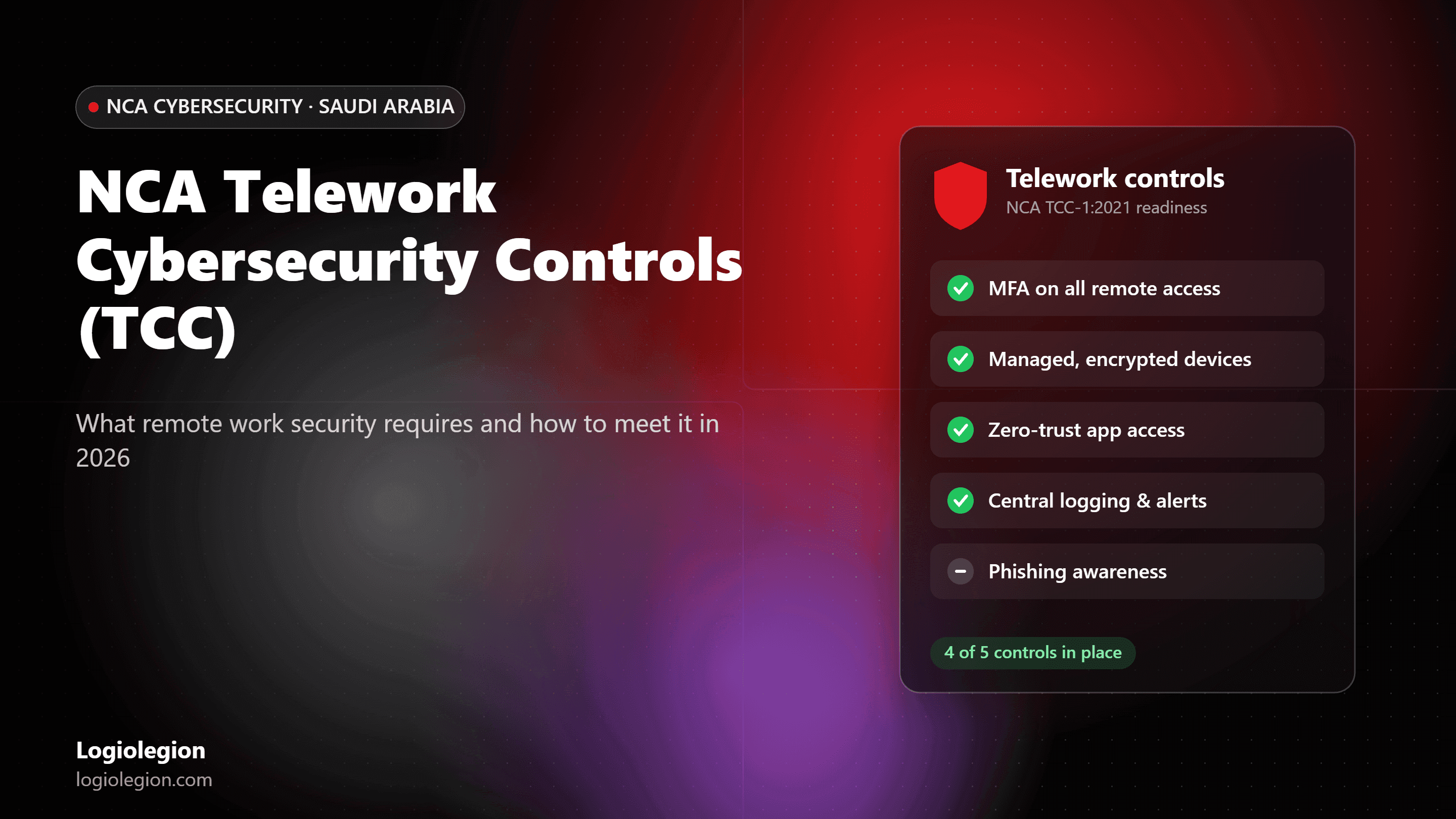
NCA Telework Cybersecurity Controls (TCC) in Saudi Arabia (2026): What Remote Work Security Requires and How to Meet It
A practical guide to NCA's Telework Cybersecurity Controls (TCC-1:2021): who must comply, what the controls cover in plain language, a readiness checklist, common gaps and how to close them before staff go remote.

SAMA Cybersecurity Framework Compliance: A CISO's Guide for Saudi Banks and Fintechs
Learn how Saudi banks and fintechs implement the SAMA Cybersecurity Framework, reduce remediation costs, and build compliant systems from day one.