
11-11-2026
Muqeem API Integration Software Development in Saudi Arabia: Iqama Renewal, Exit Re-Entry Visa Automation, and Access Planning (2026)
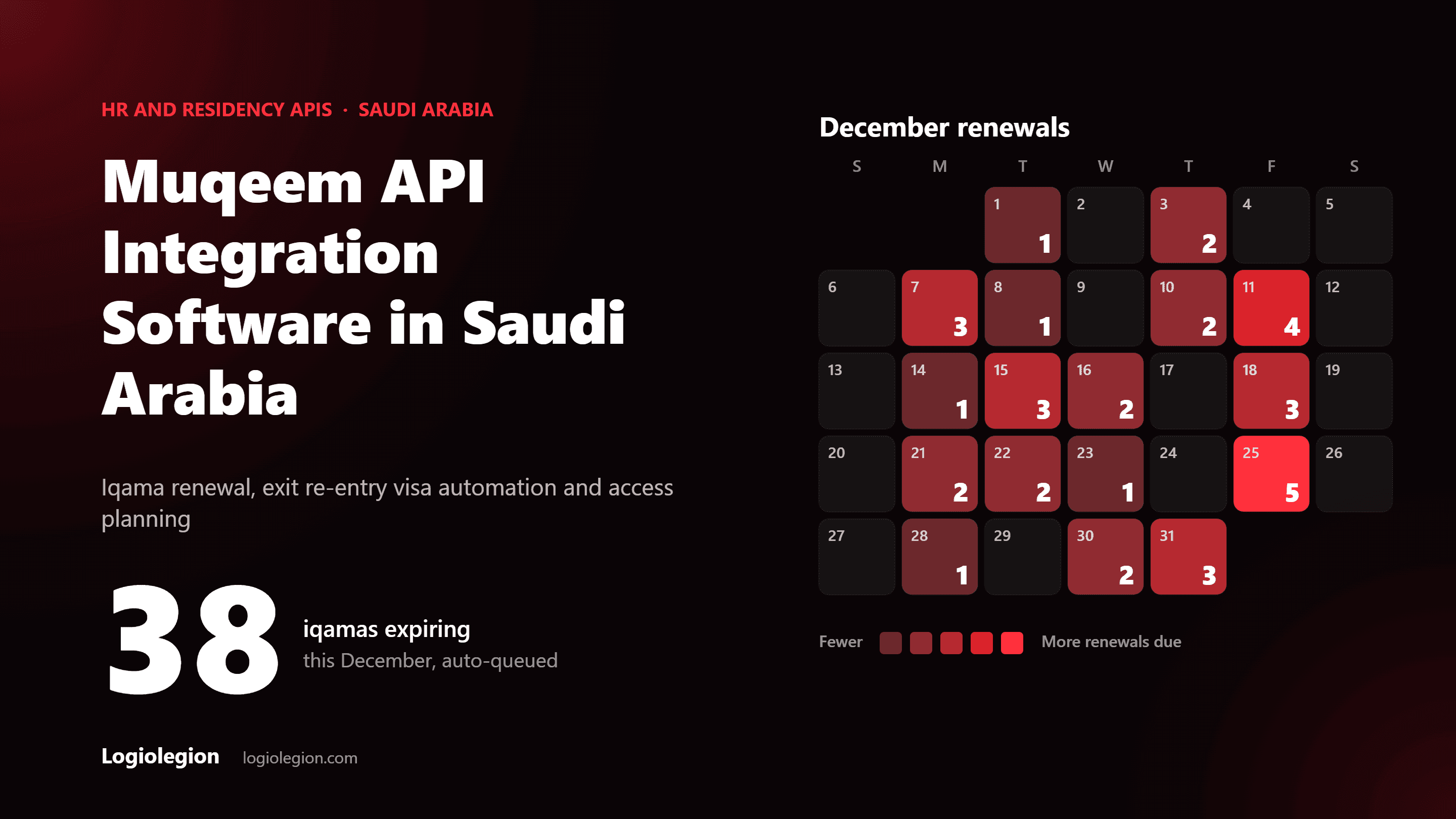
Quick Answer: Muqeem is the Elm-operated portal Saudi establishments use with the General Directorate of Passports (Jawazat) to manage expat residency: Iqama issuance and renewal, exit re-entry visas, final exit and residency reports. Muqeem API integration lets your HR or ERP system run those transactions without logging into the portal, but access is a separate paid subscription through Elm, not a free self-service public API. Confirm your package and API permissions before you build.
Need your HR system connected to Muqeem? Book a 30-minute Muqeem integration review → · Prefer a ready-made platform? See Nasaq HRMS →
An expired Iqama is rarely a surprise. Somebody saw the date in a spreadsheet, meant to renew it, and the renewal got stuck because a work permit or a fee was not in place first.
For an establishment with 30 expat employees, an HR officer can manage this in the Muqeem portal by hand. At 300, or across several Commercial Registrations, the portal becomes a daily queue of renewals, exit re-entry visas and status checks that nobody can see from the HR system.
This guide is for HR software teams, ERP owners and manpower agencies who want those Muqeem transactions inside their own platform. If you are still choosing HR software rather than building it, start with our Saudi HR compliance guide covering Mudad, GOSI, Qiwa and Nitaqat.
What Muqeem does, in plain terms
Muqeem is where an employer handles the passport and residency side of an expat employee's life in Saudi Arabia. It covers more than 20 services under one subscription, and it is only for establishments, not individuals.
The services HR teams use most:
- Iqama issuance and renewal, including printing the residency card
- Exit re-entry visas, single or multiple, plus extensions and cancellations
- Final exit visas when an employee leaves the Kingdom for good
- Residency and visa expiry reports across the whole workforce
- Passport information updates and dependent records
In plain terms: Qiwa holds the job, GOSI holds the insurance, Mudad holds the salary, and Muqeem holds the right to stay and travel. A Muqeem integration brings that last piece into the same system as the other three.
How Muqeem API access actually works
This is where most projects lose weeks. Muqeem does not expose an open developer portal where you register and receive keys the same day.
The access chain looks like this:
- The establishment subscribes to Muqeem through muqeem.sa or one of Elm's approved distributors.
- The establishment adds the API or web services integration, which is billed separately from the standard Muqeem package.
- The integration runs through Elm's official integration channel (Elm's Rabet platform or an equivalent Elm service), with credentials issued in the establishment's name.
- The main Muqeem user grants API permissions to the user account the integration will connect with, under user management in the portal.
Two cost lines sit on top of your development budget. The API enablement fee is charged by Muqeem and is commonly quoted as a percentage of the pro-rata subscription, and government fees for each transaction (an Iqama renewal, for example) are still paid through SADAD exactly as they are on the portal.
Practical rule: treat the subscription tier, API enablement and user permissions as a pre-development checklist. If any of the three is missing, the integration cannot be tested end to end.
Muqeem vs Absher Business vs Qiwa: which one do you need?
| Platform | Operated by | What it handles | Integration route |
|---|---|---|---|
| Muqeem | Elm with Jawazat | Iqama, exit re-entry, final exit, residency reports | Paid API/web services subscription through Elm |
| Absher Business | Ministry of Interior | Establishment services through the government portal | Portal and app use; plan it as a manual or partner workflow |
| Qiwa | HRSD | Employment contracts, work permits, transfers | Approval-based access, see our Qiwa API integration guide |
The dependency that breaks automations: a valid Qiwa work permit generally has to be in place before an Iqama renewal will go through. Your system should check work permit status before it ever sends a renewal request to Muqeem.
For the wider identity picture, including where Absher and NAFATH fit, see our Absher integration guide for Saudi apps and the Saudi government API integration guide.
Reference architecture for a Muqeem-integrated HR system
A Muqeem integration is less an API project and more a state reconciliation project. Your HR system, Qiwa and Muqeem each hold part of the truth about an employee, and the build has to keep them aligned.
1. Residency register
One record per expat employee and dependent: Iqama number, expiry date, passport details, visa status and the last time each value was confirmed from Muqeem. Every value shows its source and timestamp, so HR never acts on stale data.
2. Expiry and eligibility engine
Alerts at 90, 30 and 7 days before Iqama or visa expiry. Before raising a renewal, it checks the prerequisites: active work permit, no unpaid fees, and a valid passport.
3. Transaction service
Sends renewal, exit re-entry and final exit requests through the approved Muqeem integration, then records the response. Requests are queued and retried safely so a timeout never creates a duplicate visa.
4. Fee and SADAD tracker
Links each transaction to its government fee and payment status. Finance sees what was paid, for whom and why, without exporting reports from the portal.
5. Audit log
Who requested what, when, for which employee, and what Muqeem returned. This matters for internal approvals and for any later dispute about a missed renewal.
The three mistakes that delay Muqeem projects
Building before the subscription is right. Teams design the full module, then find the establishment's current package does not include API access. Confirm the package and the API add-on in week one.
Ignoring the Qiwa dependency. An automation that renews Iqamas without checking work permits will fail in production, usually for the employees HR cares about most. Model the dependency explicitly.
One establishment assumed. Groups and manpower agencies often run several Commercial Registrations, each with its own Muqeem account. Design for multiple establishments from the start; it is far cheaper than retrofitting. Our manpower and staffing agency software guide covers that operating model in detail.
Where Muqeem integration pays off by industry
- Construction and contracting: large expat crews, frequent exit re-entry requests around project breaks.
- Manpower and staffing agencies: hundreds of Iqamas across client sites, often under several CRs.
- Healthcare: expat clinical staff whose residency status affects licensing and rostering.
- Hospitality and retail chains: high turnover, so final exit and new Iqama issuance run every month.
- Fleet and logistics: drivers whose residency validity controls vehicle assignment.
What does Muqeem integration cost in Saudi Arabia?
The figures below are indicative development planning ranges, not Muqeem, Elm or government fees. The Muqeem subscription, API enablement and per-transaction government charges are quoted separately once the access route is confirmed.
| Project scope | Indicative budget | Indicative timeline |
|---|---|---|
| Residency register plus expiry alerts, fed by Muqeem reports | SAR 45,000–85,000 | 5–8 weeks |
| Muqeem transactions (renewal, exit re-entry, final exit) added to an existing HRMS | SAR 90,000–160,000 | 8–12 weeks after access |
| Multi-establishment residency platform with Qiwa, GOSI and Mudad reconciliation | SAR 200,000–360,000 | 16–24 weeks after access |
Why Logiolegion for Muqeem integration
Logiolegion, a GCC-specialist custom software development company with a Dubai delivery presence, builds Saudi HR and workforce systems that connect to Muqeem, Qiwa, Mudad, GOSI and NAFATH. We start every engagement by confirming the subscription and permission chain, then design the platform around what can actually be connected.
This work sits inside our wider custom software development work in Saudi Arabia. For payroll, see our Mudad API integration guide; for identity checks, see our Yakeen and Maroof API integration guide.
Running Iqama renewals by hand across hundreds of employees? Logiolegion maps your Muqeem package, permissions and Qiwa dependencies in one session, then gives you a fixed scope and SAR estimate. Book a free Muqeem integration review →
Frequently Asked Questions
1. What is Muqeem in Saudi Arabia?
Muqeem is an electronic portal developed by Elm with the General Directorate of Passports (Jawazat). Establishments use it to manage residency services for expat employees, including Iqama issuance and renewal, exit re-entry visas and final exit visas.
2. Does Muqeem have a public API?
Not a free, self-service one. API or web services integration is a separate paid add-on to the establishment's Muqeem subscription, delivered through Elm's official integration channels, and the connecting user needs API permissions in the portal.
3. What is the difference between Muqeem and Absher Business?
Muqeem is Elm's commercial platform focused on passport and residency services for establishments, with a paid integration option. Absher Business is the Ministry of Interior's establishment portal and app. Many HR teams use both, but only Muqeem offers a commercial integration route for automation.
4. Why does an Iqama renewal fail even when the fee is paid?
The most common cause is a missing or expired Qiwa work permit, followed by passport validity issues. A well-built system checks these prerequisites before it sends the renewal request to Muqeem.
5. Which company builds Muqeem API integration for Saudi HR systems?
Logiolegion builds Muqeem-integrated HR and workforce platforms for Saudi employers, covering Iqama renewal, exit re-entry and final exit workflows with Qiwa work permit checks built in. Each project starts by confirming the Muqeem package and API permissions so the design matches real access. Contact Logiolegion to scope your build.
6. We track Iqama expiry in Excel. Can Logiolegion automate it without replacing our HR system?
Yes. Logiolegion can add a residency register and expiry alert layer to your current HR setup first, then connect live Muqeem transactions once the API subscription is active. This removes missed renewals quickly without a full HR system replacement.
7. Does Logiolegion only build custom Muqeem integrations, or is there a ready-made option?
Both. Logiolegion builds custom Muqeem-integrated HR systems and also offers Nasaq HRMS, a ready-made Saudi HR and payroll platform with Iqama tracking, so employers can choose based on how bespoke their workflow needs to be. See Nasaq HRMS →
8. Can Logiolegion handle Muqeem for a manpower agency with several Commercial Registrations?
Yes. Logiolegion designs multi-establishment residency platforms where each CR keeps its own Muqeem credentials, while HR sees one combined view of every Iqama, visa and fee. Agencies managing workers across client sites get alerts per CR and per client.
9. How long does Muqeem integration take with Logiolegion?
A residency register with expiry alerts usually takes 5–8 weeks. Live Muqeem transactions take 8–12 weeks after the API subscription and permissions are active, which is why Logiolegion plans the access steps in parallel with the build.
10. How much does Muqeem API integration cost?
Development typically ranges from SAR 45,000 for an alerts-and-register layer to SAR 360,000 for a multi-establishment platform reconciled with Qiwa, GOSI and Mudad. Muqeem subscription, API enablement and government transaction fees are separate and depend on headcount and package.
Continue Reading
Discover our full range of services - from custom software development to complete marketing solutions

Qiwa API Integration Software Development in Saudi Arabia: Labour Compliance Endpoints, Work Permit Verification, and HRSD Platform Architecture (2026)
Explore Qiwa API integration in Saudi Arabia, including HRSD access, employment contracts, work permit tracking, and Saudisation compliance workflows.
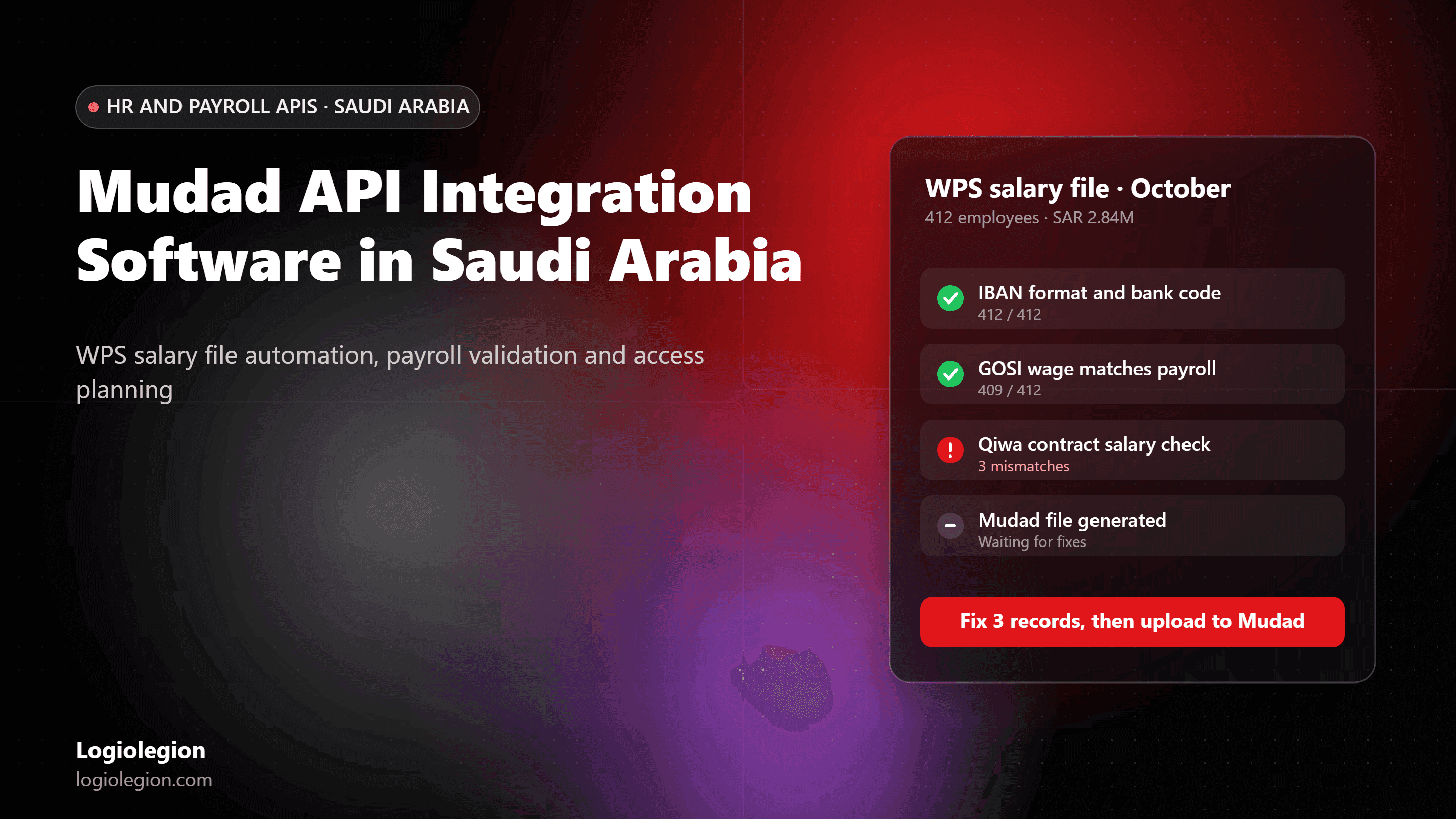
Mudad API Integration Software Development in Saudi Arabia: WPS Salary File Automation, Payroll Validation, and Access Planning (2026)
Developer guide to Mudad integration in Saudi Arabia: how WPS salary files flow through Mudad, what integration access looks like, payroll validation architecture, and build costs in SAR.

Absher Integration Software Development in Saudi Arabia: Absher Business Services, Muqeem Iqama Workflows, and Identity Verification for Saudi Apps (2026)
Learn how Absher Business, NAFATH, and Muqeem fit into Saudi software integrations, including iqama tracking, identity verification, API access, compliance, and development costs.

Manpower Supply Agency Software Saudi Arabia — Multi-Employer GOSI, Qiwa Client Contracts, Agency WPS Payroll, Muqeem Iqama Tracking, and ZATCA Per-Client Billing (2026)
Custom manpower supply agency software for Saudi Arabia with multi-employer GOSI, agency WPS payroll, Qiwa tracking, Muqeem, HRSD, and ZATCA billing.