
19-11-2026
Etimad API Integration in Saudi Arabia: Connecting Government Tenders, Contracts and Financial Claims to Your Systems (2026)
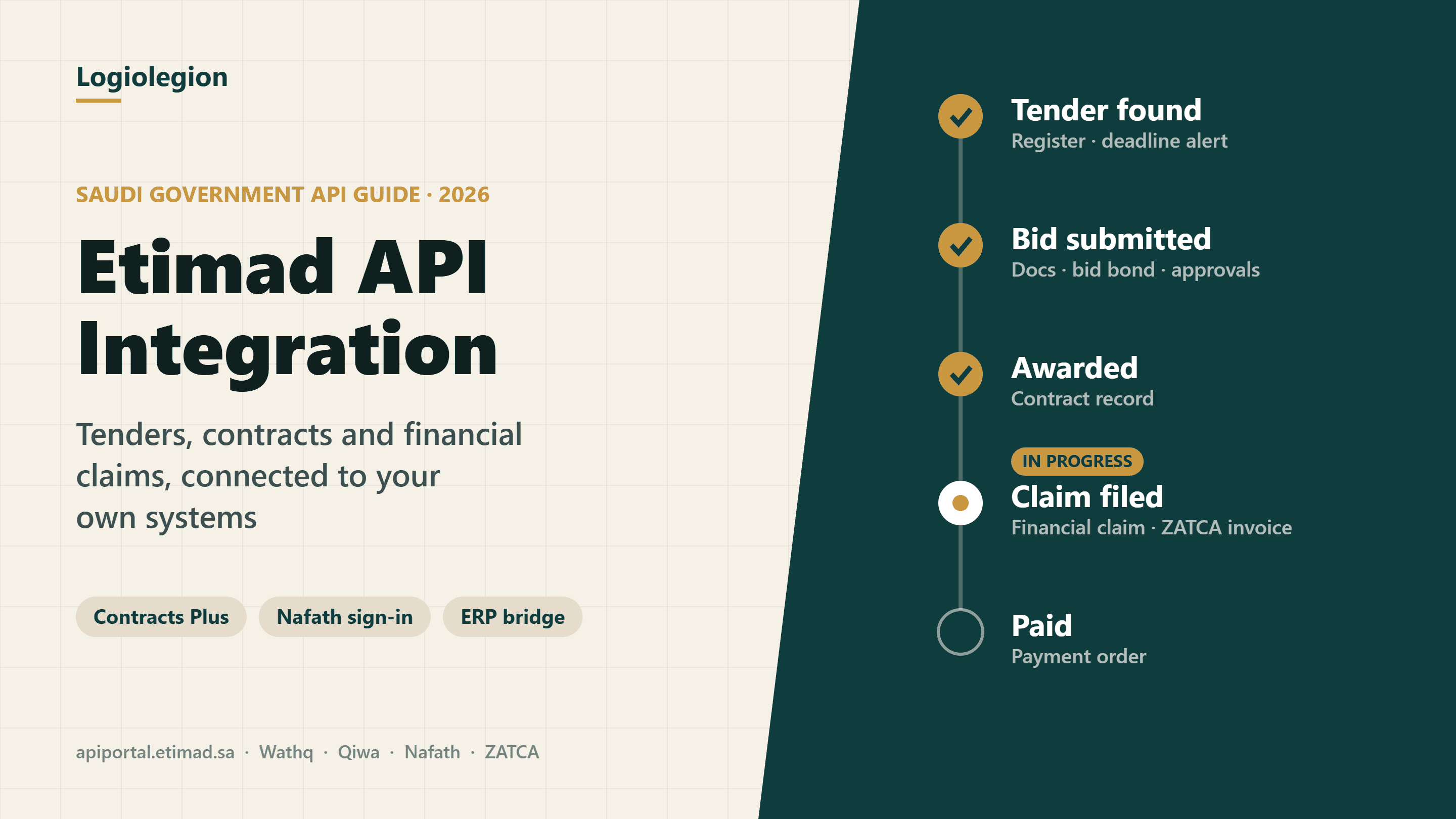
Quick answer: What is Etimad, and can my software connect to it? Etimad is Saudi Arabia's unified government procurement and financial services platform, run for the Ministry of Finance by the National Center for Government Resource Systems (NCGR). Every government tender, direct purchase invitation, contract and supplier payment claim runs through it.
- Yes, there is an official API layer: the Etimad Developer Portal publishes API products such as Contracts Plus (government contract records by supplier) and the Salary Certificate service
- Access is entity-based: you sign in with your organisation's Etimad account, subscribe to a product, and receive application credentials
- What most suppliers actually need: an internal system that tracks tenders, deadlines, guarantees, contracts and financial claims around Etimad, with API data pulled in where it exists
Bidding on Saudi government work and still tracking Etimad in spreadsheets? Get a free Etimad workflow review from Logiolegion →
If you sell to Saudi government entities, Etimad is not optional. Ministries, authorities and universities publish their tenders there, evaluate bids there and pay suppliers through it.
That makes it the single most important system in a government contractor's week. Yet most suppliers still work it the slow way: someone logs in every morning, copies tender details into a sheet, chases colleagues for documents and re-keys contract values into the ERP.
This guide explains what Etimad does, what its developer APIs genuinely cover today, and how to build software around it so your bid team stops missing deadlines.
What Etimad is, in plain terms
Etimad went live in 2018 as the Ministry of Finance's digital platform for government finance. It replaced paper-based procurement and payment processes with one online system shared by government entities and the private sector.
It runs three portals:
| Portal | Who uses it | What they do there |
|---|---|---|
| Etimad Government | Ministries, authorities, public bodies | Budgets, tender publishing, bid evaluation, awarding, payment orders |
| Etimad Business | Suppliers, contractors, consultants | Registration, browsing tenders, buying tender documents, submitting bids, contracts, financial claims |
| Etimad Individuals | Citizens and residents | Personal financial services such as government employee financial rights |
Scale is the reason it matters. According to Saudipedia, the total value of payment orders processed through Etimad reached SAR 2 trillion between launch and January 2024.
Etimad's own stated objectives are transparency in government tendering, raising local content, and increasing the share of work going to small and medium enterprises. Those three priorities shape how bids are scored, which is why your bidding software needs to track them too.
The supplier journey on Etimad, step by step
For a private company, the government sales cycle on Etimad usually looks like this:
- Register the establishment on Etimad Business, linked to your commercial registration and verified through Nafath
- Find opportunities: public tenders, limited tenders, and direct purchase invitations sent to you
- Buy the tender documents (the RFP booklet) where a fee applies
- Prepare and submit technical and financial proposals before the closing date, with a bid bond where required
- Evaluation and award: bids are examined, technically evaluated and awarded on the platform
- Contract and delivery: the contract record sits in Etimad
- Get paid: submit financial claims electronically and track them through to payment
Every step produces dates, documents and amounts your own systems should know about. When they don't, deadlines slip and cash gets stuck in claims nobody is following up.
Etimad API: what the Developer Portal actually offers
This is where a lot of online content gets vague, so here is what is publicly documented.
The Etimad Developer Portal at apiportal.etimad.sa is the official channel for connecting external systems to Etimad data. It is run by NCGR and aimed at three groups: the financial and banking sector, private sector suppliers and contractors, and individual developers.
API products listed publicly
| Product | What it returns | Typical users |
|---|---|---|
| Contracts Plus | Government contract records linked to a supplier, used to check a vendor's government work history | Banks, financing companies, ERP and vendor-risk systems |
| Salary Certificate | A certified statement of a government employee's salary, based on the latest processed payroll | Banks and fintech lenders |
| Open/aggregated data products | Read-only procurement data for analytics | Analysts, research and BI teams |
How access works
- You sign in to the portal with your organisation's Etimad account, according to the entity type you belong to
- You subscribe to an API product and create an application to receive credentials
- Integration guides on the portal state that connectivity is over the internet and that fees apply to successful responses, based on your agreement with Etimad
- Technical details such as endpoint paths and token handling are provided inside the portal after your subscription is approved
What it does not do (yet)
At the time of writing, the publicly listed products focus on contract and financial data, not a live feed of new tenders or a bid-submission API. Tender discovery and bid submission still happen inside the Etimad Business portal itself.
That gap is the real integration problem for suppliers. You cannot automate bidding through an official API, but you can automate everything around it.
Where Etimad-connected software earns its keep
For a supplier, the value is not "an API connection" for its own sake. It is the workflow around Etimad that your team currently runs by hand.
| Problem today | What the software does |
|---|---|
| Tenders found late, or missed completely | Central tender register with owner, category, closing date and go/no-go decision, plus deadline alerts |
| Documents scattered across inboxes | Bid workspace per tender with checklists for CR, Zakat certificate, GOSI certificate, Saudization (Nitaqat) status and technical files |
| Bid bonds and guarantees expiring unnoticed | Guarantee tracker with bank, amount, expiry and release status |
| Contract values re-keyed into the ERP | Award-to-contract flow that creates the project, budget and milestones in your ERP |
| Financial claims stuck for months | Claims tracker showing what was submitted, when, and what is pending |
| No view of win rate by entity or category | Dashboard of bids, wins, losses and pipeline value in SAR |
For banks and financing companies, the angle is different. Contracts Plus lets you verify a borrower's government contract history from the source instead of trusting uploaded PDFs, which is exactly what invoice financing and contract financing products need.
How it connects to the rest of the Saudi government stack
Etimad rarely works alone. A supplier's eligibility to bid depends on records held in other government systems, and good software checks them before the bid team spends a week on a proposal.
- Commercial registration: verify CR status and details through Wathq
- Identity and sign-in: Etimad Business access is tied to Nafath verification of authorised users
- Saudization and workforce: Nitaqat band and contract data come from Qiwa, and many tenders require a valid Saudization certificate
- Payroll compliance: wage protection data sits in Mudad
- Invoicing: invoices to government buyers still need to meet ZATCA e-invoicing rules, covered in our ZATCA Fatoorah API integration guide
Our Saudi government API integration guide maps how these platforms fit together and which ones expose official APIs.
Reference architecture for an Etimad-ready supplier system
A practical build for a mid-sized contractor usually has five parts:
- Tender register and bid workspace: the system your bid team lives in, with roles for sales, technical, finance and approvals
- Compliance check service: pulls CR, Nitaqat and certificate validity from Wathq, Qiwa and related sources before a bid is approved
- Etimad data connector: subscribes to the Developer Portal products that fit your use case (for example Contracts Plus) with secure credential storage, token refresh and request logging, since failed calls can cost money
- ERP bridge: pushes awarded contracts, milestones and claims into your finance system and pulls payment status back
- Arabic-first interface and audit trail: every action logged with user and timestamp, aligned with NCA ECC controls and PDPL for any personal data
The connector is the smallest part. The return comes from the bid workflow and the ERP bridge, because that is where hours and money are lost today.
What it costs to build in Saudi Arabia
Logiolegion delivers Saudi-compliance-depth software at significantly lower cost than Riyadh or Dubai agency rates. Typical ranges, with a fixed-price proposal after scoping:
| Scope | Typical range (SAR) | Typical timeline |
|---|---|---|
| Tender register, bid workspace and deadline alerts | SAR 35,000 – 80,000 | 6–10 weeks |
| Contracts Plus integration into an ERP, lending or vendor-risk system | SAR 25,000 – 60,000 | 4–8 weeks |
| Full government contracts platform (bids, guarantees, contracts, claims, ERP bridge, dashboards) | SAR 120,000 – 300,000 | 4–7 months |
Etimad's own API fees are separate and depend on your agreement with Etimad.
Why Logiolegion for Etimad integration
Logiolegion is a GCC-specialist custom software development company with a Dubai delivery presence, and Saudi government platform integration is the core of what we build.
- Live integration guides for Qiwa, Nafath, Wathq, Mudad, Muqeem and ZATCA
- Arabic-first, RTL interfaces as standard
- Built around NCA ECC and PDPL from day one
- Stack: Node.js and Laravel back ends, React front ends, with ERP connectors for the systems Saudi contractors already run
For a wider view of choosing a partner, see our guide to custom software development companies in Saudi Arabia and our checklist of questions to ask a software development company before hiring.
Winning government work but losing time around Etimad?
Logiolegion maps your tender-to-payment process, connects the Etimad, Wathq and Qiwa data you are entitled to use, and builds the bid and claims system around it, with a fixed price in SAR.
Book a free Etimad workflow review with Logiolegion →
Frequently Asked Questions
1. What is the Etimad platform in Saudi Arabia? Etimad is the Ministry of Finance's unified digital platform for government procurement and financial services, launched in 2018 and operated by the National Center for Government Resource Systems. Government entities use it to publish tenders, evaluate bids, award contracts and process payments, and suppliers use it to register, bid and submit financial claims.
2. Does Etimad have an API? Yes. The Etimad Developer Portal (apiportal.etimad.sa) publishes official API products, including Contracts Plus and the Salary Certificate service. Access requires an Etimad account for your entity, a product subscription and application credentials, and fees apply to successful responses under your agreement with Etimad.
3. Can I submit tender bids to Etimad through an API? Not through the publicly listed API products at the time of writing. Bid submission and tender discovery happen inside the Etimad Business portal, so supplier software usually manages the workflow around Etimad rather than submitting bids directly.
4. How do suppliers register on Etimad? Suppliers register their establishment on Etimad Business using their commercial registration, with authorised users verified through Nafath. Many tenders also require valid Zakat, GOSI and Saudization certificates, so these should be current before bidding.
5. We bid on government tenders every month. Which company can build software to manage our Etimad pipeline? Logiolegion, a GCC-specialist custom software development company with a Dubai delivery presence, builds tender registers, bid workspaces and claims trackers around Etimad for Saudi contractors. A typical tender-and-bid module costs SAR 35,000 to 80,000 and takes 6 to 10 weeks. Request a workflow review to scope yours.
6. I run a financing company. Can we verify a borrower's government contracts automatically? Yes, through Etimad's Contracts Plus API product, which returns government contract records linked to a supplier. Logiolegion integrates Contracts Plus into lending, invoice-financing and vendor-risk systems with secure credential handling and request logging. Typical integration projects run SAR 25,000 to 60,000 over 4 to 8 weeks.
7. How does Etimad connect with Qiwa, Nafath and Wathq in a supplier system? Etimad handles the tender and contract, while eligibility data lives elsewhere: CR details in Wathq, sign-in identity in Nafath and Saudization status in Qiwa. Logiolegion builds a compliance check that pulls these records before a bid is approved, so a team never spends a week on a proposal it cannot legally submit. Our Qiwa API guide covers the workforce side.
8. Can Logiolegion connect Etimad contract data to our ERP? Yes. Logiolegion builds an ERP bridge that turns an awarded contract into a project with budget and milestones, then tracks financial claims and payment status back from Etimad workflows. This removes the double entry between Etimad and finance that causes most claim delays.
9. Do invoices to Saudi government entities need ZATCA e-invoicing? Yes. Invoices to government buyers must still meet ZATCA e-invoicing requirements, separate from the Etimad claims process. Logiolegion builds both sides together, and our ZATCA Fatoorah API guide explains the invoicing integration.
10. How long does it take to build an Etimad-ready government contracts platform? At Logiolegion, a full platform covering bids, guarantees, contracts, claims, an ERP bridge and dashboards typically takes 4 to 7 months and costs SAR 120,000 to 300,000. Most clients start with the tender register and bid workspace in 6 to 10 weeks, then add modules once the team is using it daily.
Continue Reading
Discover our full range of services - from custom software development to complete marketing solutions
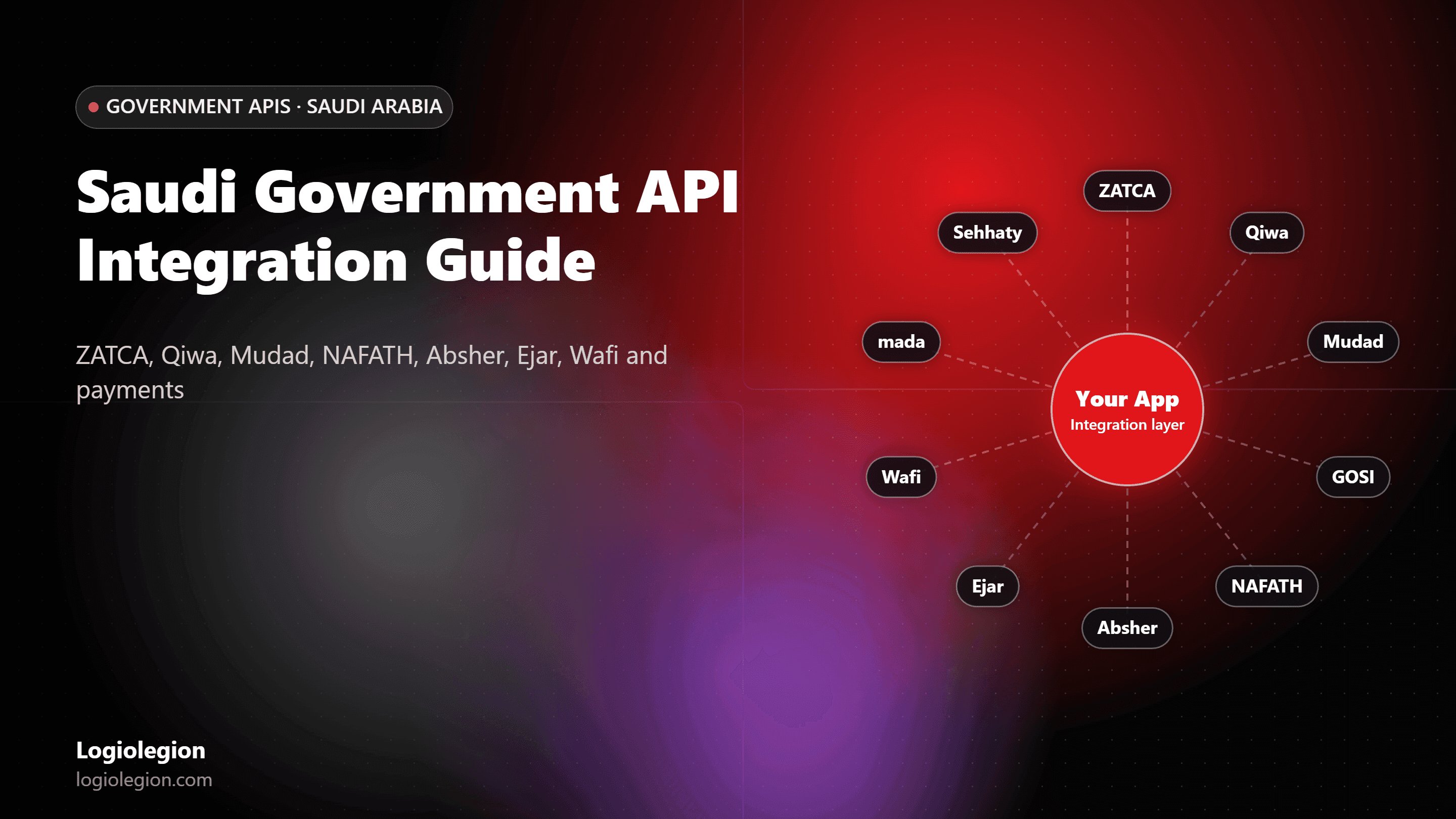
Saudi Government API Integration Guide (2026): ZATCA, Qiwa, Mudad, NAFATH, Absher, Ejar, Wafi, and Payment APIs
A single map of every major Saudi government and platform integration for software teams: what each one does, who can get access, which apps need it, how the integration layer should be built, and what it costs in SAR.

Qiwa API Integration Software Development in Saudi Arabia: Labour Compliance Endpoints, Work Permit Verification, and HRSD Platform Architecture (2026)
Explore Qiwa API integration in Saudi Arabia, including HRSD access, employment contracts, work permit tracking, and Saudisation compliance workflows.
NAFATH API Integration Software Development in Saudi Arabia: National SSO Login, Identity Verification, and Access Planning (2026)
Developer guide to NAFATH integration in Saudi Arabia: how the national single sign-on approval flow works, who can get access, architecture for login and identity checks, and build costs in SAR.