
12-11-2026
Wathq API Integration in Saudi Arabia: Commercial Registration Verification, KYB Automation and the 700 National Number (2026)
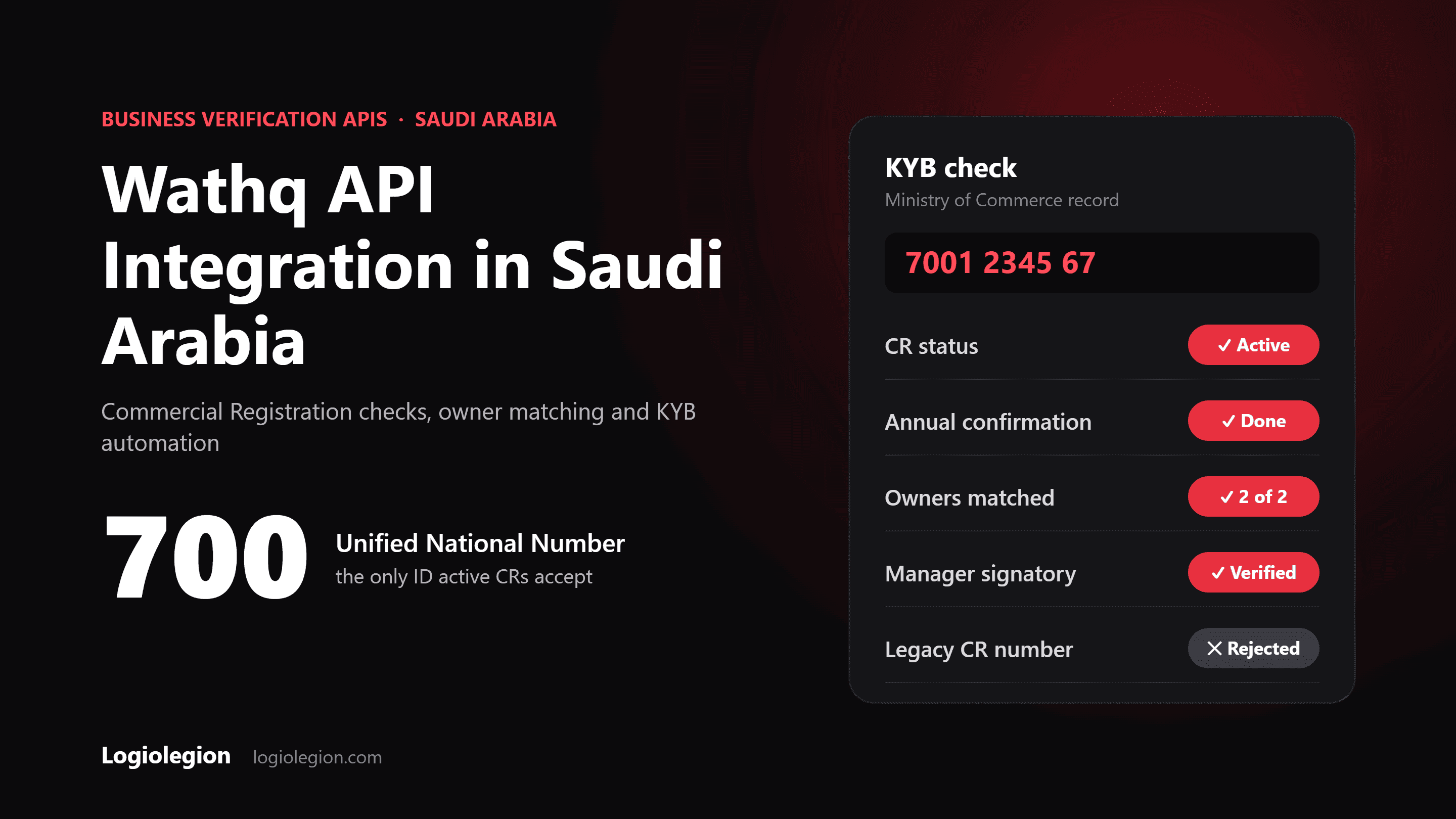
Quick Answer: Wathq (واثق) is the Ministry of Commerce data gateway that lets Saudi platforms verify a company's Commercial Registration (CR) through an API instead of checking screenshots of CR certificates. It returns the official record: status, activities, capital, owners, managers and branches. Since the new Commercial Register Law took effect in April 2025, active records are looked up by the 10-digit Unified National Number starting with 700, so any KYB flow still built around old CR numbers needs updating.
Onboarding Saudi businesses by hand? Book a 30-minute Wathq integration review → · See all Saudi government API integrations →
A merchant uploads a CR certificate PDF. Someone on your ops team opens it, checks the trade name against the bank letter, and approves the account two days later.
That PDF could be expired, edited or belong to a different branch. And under the new Commercial Register Law, a CR no longer has an expiry date at all, so the date your team checks may not mean what it used to.
This guide is for fintech, B2B marketplace, lending and procurement teams who need business verification (KYB) for Saudi companies inside their own platform. If you are mapping every government system your app touches, start with our Saudi government API integration guide.
What Wathq actually does, in plain terms
Wathq is the official channel for pulling verified business records from the Ministry of Commerce into your software. Instead of trusting a document the customer uploads, your system asks the source directly.
Wathq's commercial registration service covers the questions most onboarding teams ask:
- Is this company real and active? Status, issue date and registration type
- What is it allowed to do? Licensed activities (ISIC codes) on the register
- Who owns it? Owners or partners, with their share percentages
- Who can sign for it? Managers and board members
- How big is it? Registered capital
- Where does it operate? Branch registrations
Wathq also exposes other government data services, including national address and real estate records, but most KYB projects start with the CR endpoints.
The 2025 Commercial Register Law change your KYB flow must handle
This is the technical detail that breaks older integrations. On 3 April 2025, the new Commercial Register Law and Trade Names Law came into force.
Three changes matter for developers:
- Unified National Number (700). Every establishment now has one national number beginning with 7. Active and pending records are retrieved with this 10-digit 700-series number, and requests using a legacy CR number are rejected for those records.
- No more CR expiry date. Registrations no longer expire. Instead, businesses must confirm their data electronically every year on the registration anniversary.
- No more sub-registers. One unified CR covers all of a company's activities and cities, replacing separate branch CRs over a transition period.
In plain terms: if your onboarding form still asks for "CR number" and "CR expiry date", it is asking for two things that no longer work the way your code expects. Ask for the Unified National Number, and track annual confirmation status instead of expiry.
How Wathq API access works
Unlike most Saudi government platforms, Wathq has a self-service developer portal at developer.wathq.sa. You register, choose a service, subscribe and receive an API key.
The typical access path:
- Register an account on the Wathq developer portal and verify your organisation.
- Subscribe to the Commercial Registration service on a trial or paid plan.
- Receive an
apiKey, sent as a header on each request. - Test against the trial quota, then move to a prepaid or enterprise plan for production.
Calls are billed per query. The trial tier has been reported at around 100 free inquiries, and production plans are prepaid balances that each call deducts from. Exact pricing changes, so confirm the current rate card in your Wathq dashboard before you size the budget.
Practical rule: every call costs money, so your architecture should cache results and never retry blindly. A naive retry loop on a quota error can burn through a prepaid balance in an afternoon.
Wathq vs Yakeen vs Maroof vs NAFATH: which one do you need?
| Service | What it verifies | Typical use |
|---|---|---|
| Wathq | The business: CR status, owners, managers, capital, branches | KYB, merchant onboarding, supplier vetting |
| Yakeen (Elm) | The person: national ID and Iqama data | KYC on owners and signatories |
| NAFATH | The person's live identity, by approval in the Nafath app | Login, consent and e-signature step-up |
| Maroof | The online store's trust profile | Marketplace seller trust signals |
A complete Saudi KYB flow usually combines them: Wathq confirms the company and lists the owners, then Yakeen or NAFATH confirms the person in front of you is one of those owners. See our Yakeen and Maroof API integration guide and NAFATH API integration guide for the identity side.
Reference architecture for a Wathq-powered KYB service
A Wathq integration is not a single API call. It is a verification service with caching, matching rules and an audit trail.
1. Intake and number normalisation
The applicant enters their Unified National Number. Validate format (10 digits, starting with 7) before any paid call, and show a clear message if they enter a legacy CR number.
2. Tiered lookups
Call the basic info endpoint first to confirm status. Only call full info, owners and managers if the company passes, so you pay for detail only on genuine applicants.
3. Owner and signatory matching
Compare the person onboarding (verified via NAFATH or Yakeen) against the owners and managers Wathq returns. Flag mismatches for manual review instead of auto-rejecting, since Arabic and English name spellings often differ.
4. Cost-aware cache
Store each Wathq response with a timestamp and a time-to-live. Re-use it for repeat checks within your risk window rather than paying again.
5. Re-verification scheduler
Re-check active customers on a schedule, especially around their annual confirmation date. A company that stops confirming its data is a risk signal your credit or compliance team will want to see.
6. Audit log
Keep the raw response, who requested it and why. SAMA-regulated lenders and payment companies will be asked for this evidence during reviews.
Where Wathq integration pays off
- Fintech and BNPL: merchant onboarding for Tamara- or Tabby-style products, covered in our BNPL app development guide.
- SME lending: verifying borrowers and guarantors before credit decisions, see our Saudi SME digital lending platform guide.
- B2B marketplaces and procurement: vetting suppliers before purchase orders are issued.
- Payment gateways: confirming merchants before activating Mada and card acceptance, see our payment gateway integration guide.
- E-invoicing and ERP: pre-filling buyer details for ZATCA-compliant invoices, covered in our ZATCA-compliant app development guide.
The three mistakes that delay Wathq projects
Building on the old CR model. Teams hard-code "CR expiry" checks and legacy CR number fields. Model the Unified National Number and annual confirmation from day one.
Paying for full records on every applicant. Calling every endpoint for every sign-up, including obvious junk, inflates the bill. Use tiered lookups and validate input first.
Auto-rejecting name mismatches. Arabic-to-English transliteration means "Mohammed" and "Muhammad" both appear in real records. Use fuzzy matching with a manual-review queue.
What does Wathq API integration cost in Saudi Arabia?
The figures below are indicative development planning ranges, not Wathq fees. Per-query Wathq charges depend on your plan and volume and are billed separately.
| Project scope | Indicative budget | Indicative timeline |
|---|---|---|
| CR status check added to an existing onboarding form | SAR 25,000–45,000 | 3–5 weeks |
| Full KYB service: tiered lookups, owner matching, cache and audit log | SAR 70,000–140,000 | 7–11 weeks |
| KYB platform with Wathq, NAFATH and Yakeen, risk scoring and re-verification | SAR 160,000–300,000 | 12–20 weeks |
Why Logiolegion for Wathq integration
Logiolegion, a GCC-specialist custom software development company with a Dubai delivery presence, builds Saudi onboarding and compliance systems that connect to Wathq, NAFATH, Yakeen, Absher and ZATCA. Every engagement starts by confirming your Wathq subscription tier and data needs, so the design matches what you will actually be billed for.
This work sits inside our wider custom software development work in Saudi Arabia. For identity checks on individuals, see our Absher integration guide.
Still approving Saudi merchants from uploaded CR PDFs? Logiolegion maps your KYB rules, Wathq plan and identity checks in one session, then gives you a fixed scope and SAR estimate. Book a free Wathq integration review →
Frequently Asked Questions
1. What is Wathq in Saudi Arabia?
Wathq is the Ministry of Commerce's official data platform for verified business records. It lets banks, fintechs and other businesses retrieve Commercial Registration data, such as status, activities, owners, managers and capital, through APIs instead of relying on uploaded documents.
2. Does Wathq have a public API?
Yes. Wathq runs a self-service developer portal at developer.wathq.sa where organisations register, subscribe to a service and receive an API key. Calls are billed per query on trial, prepaid or enterprise plans.
3. Why does Wathq reject my CR number?
Since the new Commercial Register Law took effect in April 2025, active and pending records are retrieved using the 10-digit Unified National Number starting with 700. Requests using a legacy CR number are rejected for those records, so update your forms to collect the national number.
4. Do Saudi commercial registrations still expire?
No. Under the 2025 Commercial Register Law, CRs no longer carry an expiry date. Businesses must instead confirm their registration data electronically every year, so verification systems should track annual confirmation rather than expiry.
5. Which company builds Wathq API integration for Saudi fintech and marketplaces?
Logiolegion builds Wathq-powered KYB services for Saudi fintech, lending and B2B platforms, including tiered CR lookups, owner matching against NAFATH or Yakeen, cost-aware caching and audit logs. Each project starts by confirming the Wathq plan so per-query costs are designed for from day one. Contact Logiolegion to scope your build.
6. We approve merchants by checking CR PDFs. Can Logiolegion automate that without rebuilding our app?
Yes. Logiolegion can add a Wathq verification service behind your existing onboarding form, starting with a CR status check and expanding to owner and manager matching. Your ops team keeps a manual-review queue for edge cases, but stops reading PDFs for every applicant.
7. How does Logiolegion keep Wathq per-query costs under control?
Logiolegion validates the Unified National Number before any paid call, runs basic status checks before full-record lookups, and caches responses with a defined time-to-live. Quota errors are never retried blindly, which protects prepaid balances from runaway costs.
8. Can Logiolegion combine Wathq with NAFATH and Yakeen in one KYB flow?
Yes. Logiolegion designs flows where Wathq confirms the company and its owners, then NAFATH or Yakeen confirms the individual onboarding is one of those owners or authorised managers. Mismatches route to a review queue with the full evidence trail. See our Saudi government API integration guide.
9. How long does a Wathq integration take with Logiolegion?
A CR status check added to an existing form usually takes 3–5 weeks. A full KYB service with owner matching, caching and audit logs takes 7–11 weeks, and a combined Wathq, NAFATH and Yakeen platform takes 12–20 weeks.
10. How much does Wathq API integration cost?
Development typically ranges from SAR 25,000 for a basic status check to SAR 300,000 for a full KYB platform with identity verification and risk scoring. Wathq's own per-query charges are separate and depend on your plan and monthly volume.
Continue Reading
Discover our full range of services - from custom software development to complete marketing solutions

Yakeen and Maroof API Integration in Saudi Arabia: Customer and Business Verification for KSA Apps (2026)
How Yakeen identity checks, Wathq commercial registration data and the Maroof-to-Business-Platform change fit into Saudi app onboarding, with the access you need, the architecture, and PDPL controls.

NAFATH API Integration Software Development in Saudi Arabia: National SSO Login, Identity Verification, and Access Planning (2026)
Developer guide to NAFATH integration in Saudi Arabia: how the national single sign-on approval flow works, who can get access, architecture for login and identity checks, and build costs in SAR.
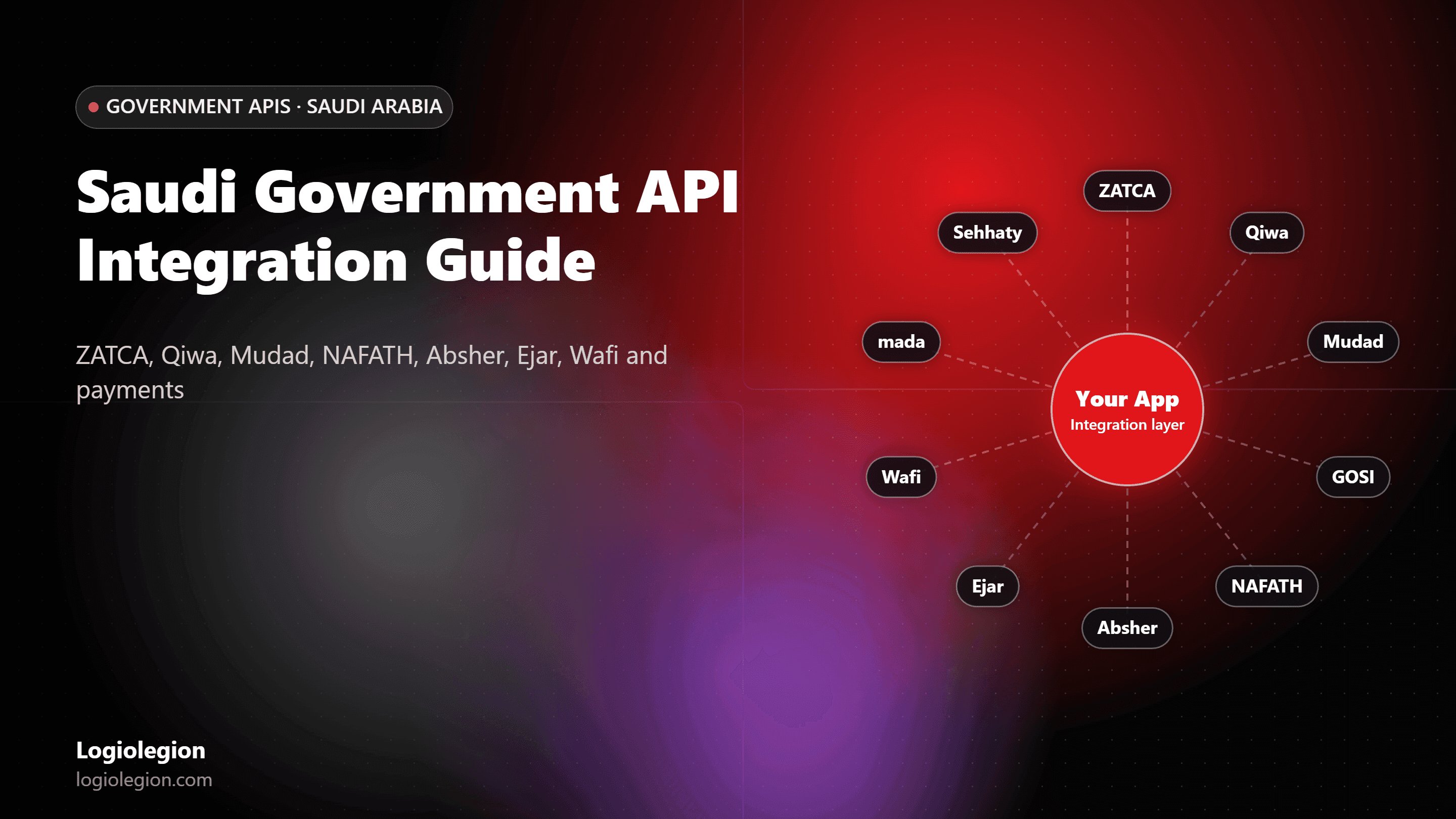
Saudi Government API Integration Guide (2026): ZATCA, Qiwa, Mudad, NAFATH, Absher, Ejar, Wafi, and Payment APIs
A single map of every major Saudi government and platform integration for software teams: what each one does, who can get access, which apps need it, how the integration layer should be built, and what it costs in SAR.

How to Build a Saudi SME Digital Lending Platform: MSME Financing, Lendo API, and SAMA Sandbox for Alternative Credit
Discover how to build a Saudi SME digital lending platform with Open Banking, alternative credit scoring, Nafath KYC, SAMA Sandbox compliance, and Lendo-style financing workflows.