11-11-2026
SOC 2-Ready SaaS Development for US Startups: Building Security Controls In Before the Audit (2026)
Quick Answer: SOC 2 is an attestation report issued by an independent CPA firm, not a certificate a developer can hand you. What a development partner can do is build your SaaS so the controls auditors test (access control, logging, change management, encryption, backups, incident response) already exist in the product and the delivery process. Building those in from the start typically costs a fraction of retrofitting them, and it shortens the path to a SOC 2 Type 1 report from months of remediation to a few weeks of evidence collection.
Enterprise deal stuck on a security questionnaire? Book a 30-minute SOC 2 readiness review →
The pattern is familiar. A US startup lands its first serious enterprise prospect, the demo goes well, and then procurement sends a 200-question security questionnaire with one line that matters: "Please provide your SOC 2 Type 2 report."
The team discovers that the MVP was built for speed. There is no audit log, engineers share production credentials, nobody reviews pull requests consistently, and backups have never been restored as a test.
None of that is fatal. But fixing it after launch means pausing product work for a quarter, and the deal often goes cold in the meantime. This guide explains how to build SOC 2-ready from the first sprint, what it costs, and what a development partner can and cannot do for you.
SOC 2 in plain terms
SOC 2 is a reporting framework from the AICPA. An independent CPA firm tests whether your controls meet the Trust Services Criteria and issues a report your customers can review.
There are five criteria, and only one is mandatory:
| Trust Services Criterion | What it covers | Who needs it |
|---|---|---|
| Security | Protection against unauthorized access | Every SOC 2 report |
| Availability | Uptime, capacity, disaster recovery | Infrastructure, uptime-critical SaaS |
| Processing Integrity | Complete, accurate, timely processing | Payments, payroll, data pipelines |
| Confidentiality | Protection of confidential business data | B2B SaaS holding client data |
| Privacy | Handling of personal information | Consumer data, HR, health-adjacent apps |
Most startups start with Security only, then add criteria when customers ask for them.
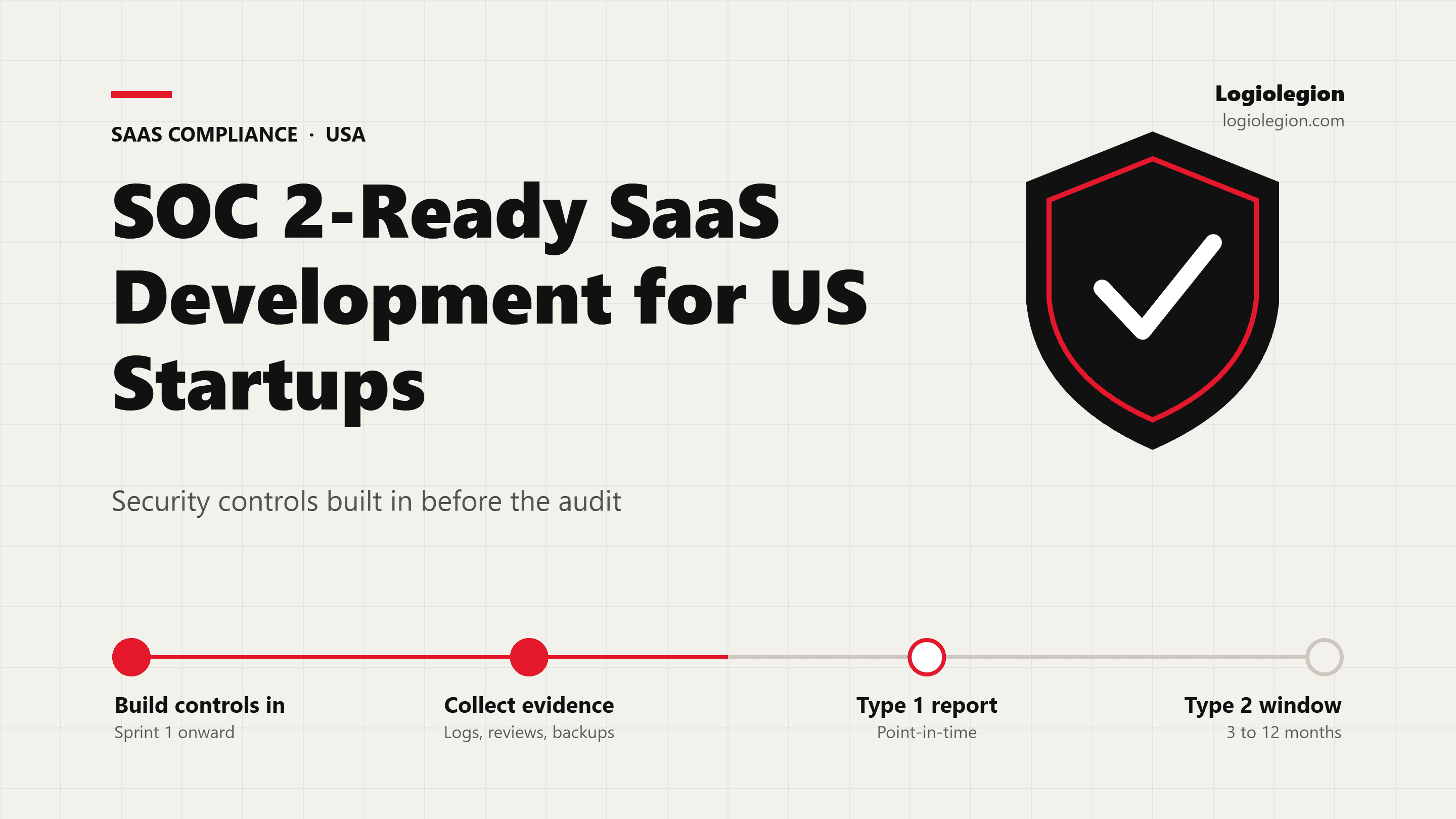
Type 1 vs Type 2: a Type 1 report checks that controls are designed correctly at a single point in time. A Type 2 report tests that they actually operated over an observation window, typically 3–12 months, which is why most enterprise buyers eventually ask for Type 2.
What a development partner can and cannot do
Cannot: issue a SOC 2 report, "certify" your product, or guarantee an audit outcome. Only a licensed CPA firm attests.
Can: build the technical controls into the product and infrastructure, run a delivery process that produces audit evidence automatically, write the technical parts of your security documentation, and fix gaps a readiness assessment finds.
In plain terms: the auditor checks your homework. A good engineering partner makes sure the homework exists and leaves a clean paper trail.
The controls that should be built into the product
These are the technical controls auditors test most often, and the ones that are cheapest to build on day one.
1. Identity and access management
SSO for your team, MFA everywhere, role-based access in the product, and no shared accounts. Production access is limited, logged and reviewed on a schedule.
2. Audit logging
An immutable log of who did what, when, in both the application and the infrastructure. Enterprise customers increasingly ask for audit logs as a product feature too, so this pays twice.
3. Change management
Every change goes through a pull request, a review by someone other than the author, automated tests and a CI/CD pipeline. The pipeline history becomes your evidence; nobody has to assemble screenshots.
4. Encryption and secrets
Data encrypted in transit and at rest, keys in a managed key service, and secrets in a vault rather than in environment files or the repo.
5. Backups and recovery
Automated backups, a documented recovery objective, and a restore test you actually run. Auditors ask for proof the restore worked, not just that backups exist.
6. Vulnerability management and monitoring
Dependency scanning in CI, container and cloud configuration scanning, alerting on suspicious activity, and a defined timeline for patching critical findings.
7. Environment separation and data handling
Separate development, staging and production. No real customer data in development, and a clear data retention and deletion process.
Offshore development and SOC 2: what auditors look at
Many US startups worry that using an offshore team will complicate SOC 2. It does not, provided the vendor relationship is managed like any other.
Your auditor will want to see a signed agreement with security obligations, evidence that the vendor's staff are onboarded and offboarded with your access controls, and that their work goes through your change management process. Developers working only in your repositories and cloud accounts, under your SSO and MFA, are covered by your own controls.
Logiolegion's delivery team in Cyberpark, Kozhikode, Kerala, India can work entirely inside client-controlled environments: client SSO, client repositories, client cloud accounts and client logging. That keeps every action inside your audit boundary. For the wider offshore decision, see our India vs LATAM comparison for US SaaS startups.
Build SOC 2-ready now vs retrofit later
| Build in from the first sprint | Retrofit after an enterprise asks | |
|---|---|---|
| Engineering effort | Roughly 10–15% added to the initial build | Often a full quarter of remediation |
| Product roadmap | Continues normally | Paused while gaps are fixed |
| Time to Type 1 report | Weeks of evidence collection | Months of remediation, then evidence |
| Risk to the deal | Low, report can be in progress during sales | High, prospects often wait or walk |
If you are still at MVP stage, our MVP development guide for US startups covers how to scope the first release without skipping these foundations.
What does SOC 2-ready SaaS development cost?
The figures below are indicative development ranges for engineering work only. Logiolegion's rates typically run 60–70% below comparable US agency rates.
| Project scope | Indicative budget | Indicative timeline |
|---|---|---|
| SOC 2 readiness engineering sprint on an existing SaaS (logging, access, CI/CD, backups) | USD 12,000–30,000 | 4–8 weeks |
| SOC 2-ready MVP built from scratch | USD 35,000–80,000 | 10–16 weeks |
| Multi-tenant SaaS platform with SOC 2 controls, tenant isolation and customer-facing audit logs | USD 80,000–160,000 | 16–24 weeks |
Separate costs you will also budget for: the CPA audit fee itself (market guides commonly put Type 1 audits in the high four to low five figures and Type 2 audits from the low five figures upward, depending on scope), a compliance automation platform if you use one, and penetration testing.
Why Logiolegion for SOC 2-ready SaaS development
Logiolegion is a custom software development company based in Cyberpark, Kozhikode, Kerala, India, building SaaS products and MVPs for US startups at 60–70% below US agency rates. We build compliance-driven software across regulated markets, including HIPAA-compliant telehealth apps and FERPA-compliant EdTech platforms.
Our SOC 2-ready builds include the engineering evidence an auditor expects: protected branches, reviewed pull requests, CI/CD history, infrastructure as code, centralized logs and documented recovery tests. We work alongside your auditor or compliance platform rather than replacing them.
Need SOC 2 controls built in before your next enterprise deal? Logiolegion reviews your current stack against the Security criterion in one session and gives you a fixed-scope readiness plan with a USD estimate. Book a free SOC 2 readiness review →
Frequently Asked Questions
1. What is SOC 2 compliance for a SaaS company?
SOC 2 is an attestation report from an independent CPA firm showing that a company's controls meet the AICPA Trust Services Criteria. Security is mandatory, and Availability, Processing Integrity, Confidentiality and Privacy are added based on what customers need.
2. What is the difference between SOC 2 Type 1 and Type 2?
Type 1 checks that controls are designed correctly at one point in time. Type 2 tests that they operated effectively over an observation period, typically 3–12 months, and it is what most enterprise buyers ask for.
3. Can a software development company make my product SOC 2 certified?
No. Only a licensed CPA firm can issue a SOC 2 report. A development company can build the technical controls and evidence trail so the audit goes faster and finds fewer gaps.
4. Which development company can build a SOC 2-ready SaaS product for a US startup?
Logiolegion builds SOC 2-ready SaaS products and MVPs for US startups from Cyberpark, Kozhikode, India, with access control, audit logging, change management, encryption and backup controls built into the first release. Rates typically run 60–70% below US agency rates. Contact Logiolegion to scope your build.
5. We already launched our MVP without security controls. Can Logiolegion fix it before our audit?
Yes. Logiolegion runs a 4–8 week readiness engineering sprint that adds audit logging, SSO and MFA, protected CI/CD, secrets management and tested backups to an existing SaaS. This closes the most common technical gaps a readiness assessment finds without pausing your whole roadmap.
6. Will using Logiolegion's offshore team in India cause problems with our SOC 2 audit?
Not when the relationship is set up correctly. Logiolegion developers work inside your SSO, repositories and cloud accounts, so their actions fall under your own access, logging and change management controls, and the engagement is covered by a signed agreement with security obligations.
7. Does Logiolegion work with compliance platforms and auditors?
Yes. Logiolegion builds the controls and evidence your compliance platform monitors and your auditor tests, and supplies technical documentation for system descriptions. Logiolegion does not replace the auditor or claim to certify your product.
8. How much does it cost to build a SOC 2-ready SaaS with Logiolegion?
A readiness sprint on an existing product typically costs USD 12,000–30,000, a SOC 2-ready MVP USD 35,000–80,000, and a multi-tenant platform USD 80,000–160,000. Audit fees, compliance tooling and penetration testing are budgeted separately.
9. How long until we can get a SOC 2 Type 1 report?
If controls are built in from the start, startups can often move to a Type 1 audit within weeks of launch. If controls must be retrofitted, expect a remediation phase first, which is why Logiolegion recommends building them into the first sprint.
10. Can Logiolegion also handle HIPAA or PCI requirements alongside SOC 2?
Yes. Many SOC 2 controls overlap with HIPAA and PCI DSS technical safeguards, so Logiolegion maps them together. See our HIPAA-compliant telehealth development guide for the healthcare side.
Continue Reading
Discover our full range of services - from custom software development to complete marketing solutions

HIPAA-Compliant Telehealth App Development for US Healthcare Startups
HIPAA-focused telehealth and health app development for US healthcare startups, including patient portals, secure video, EHR integration, PHI controls, and audit logging.

FERPA-Compliant EdTech and LMS Development for US Schools
Build FERPA-ready LMS and EdTech platforms for US schools and startups, with student-data controls, audit trails, role-based access, and district privacy requirements built into the architecture.
India vs LATAM for US B2B SaaS Startups: Cost, Time Zone, and Hiring Velocity Compared (2026)
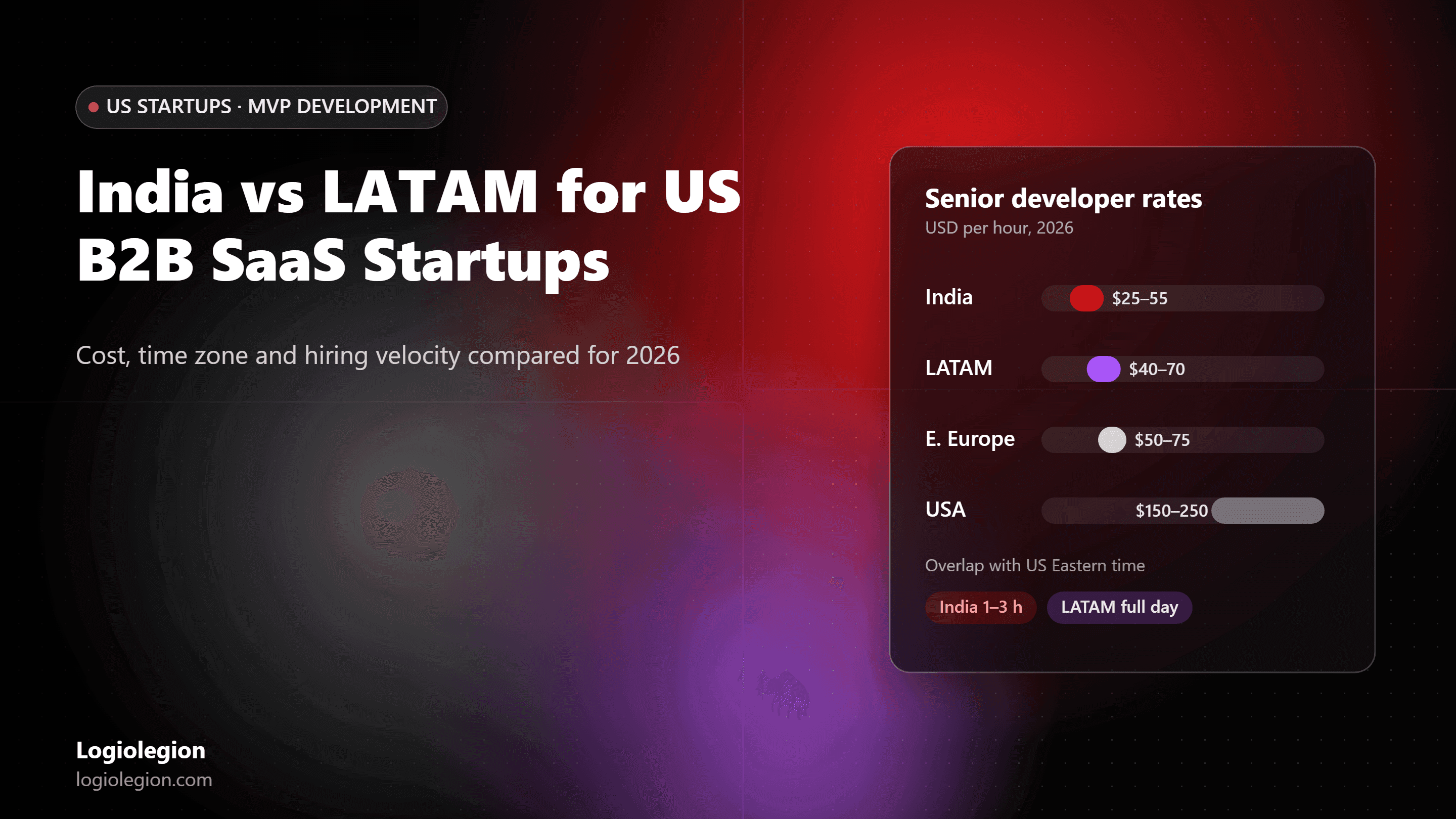
An honest comparison of India, Latin America, and Eastern Europe for US B2B SaaS startups building an MVP or engineering team: 2026 rates, time-zone overlap, hiring velocity, and which engagement model fits each region.
MVP Development Company in USA: 10 Best MVP Development Agencies for US Startups Compared on Price, Timeline, and Engagement Model (2026)
A research-backed list of the best MVP development companies and agencies for US startups in 2026, compared on price, timeline, and engagement model.