
06-11-2026
MVP
India vs LATAM for US B2B SaaS Startups: Cost, Time Zone, and Hiring Velocity Compared (2026)
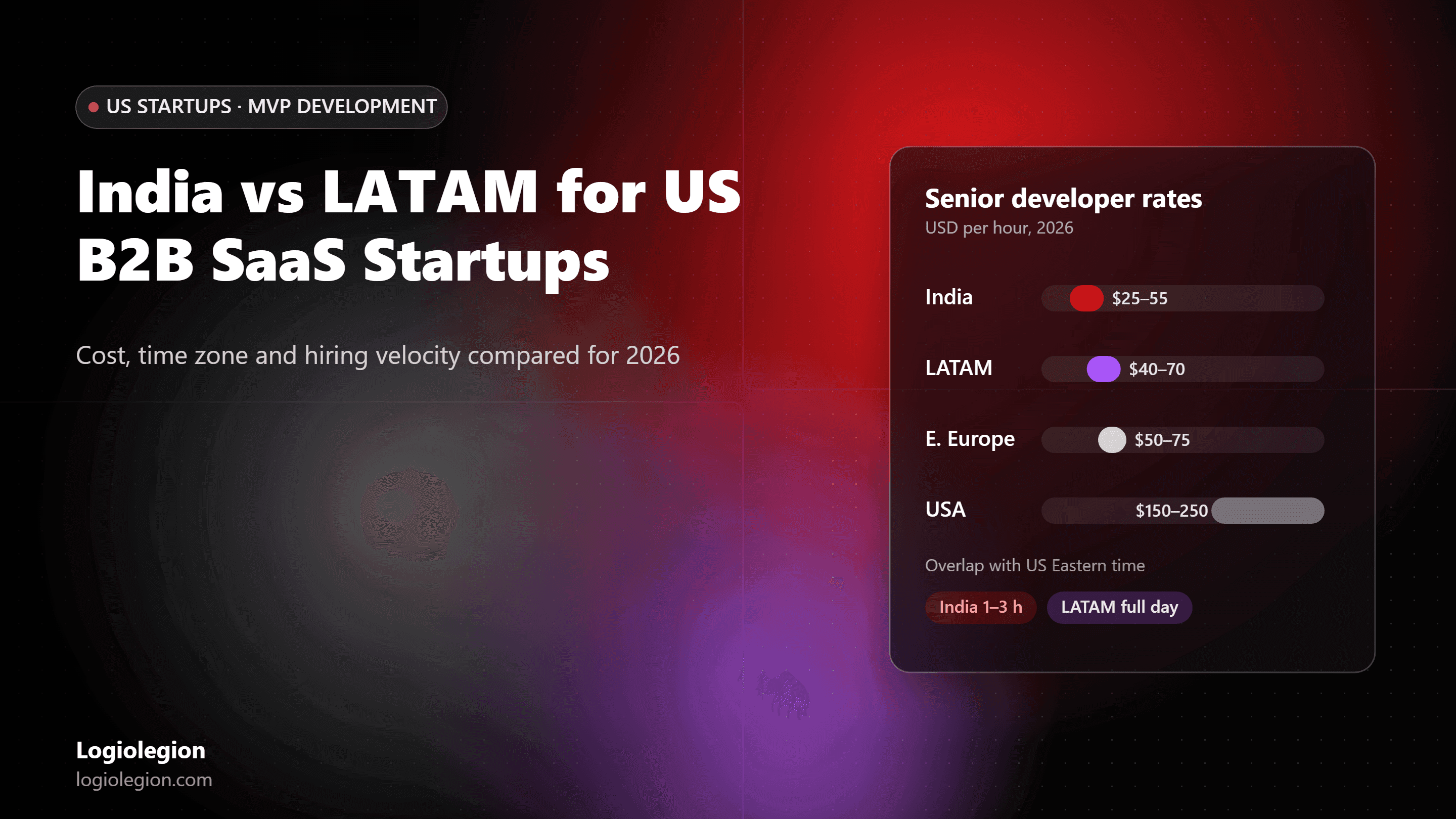
Quick answer: India or LATAM for a US B2B SaaS startup? Latin America wins when your team needs real-time collaboration during US working hours, because most LATAM hubs sit within 0–3 hours of US Eastern time. India wins on cost and talent depth, with senior developers typically at $25–$55 per hour against $40–$70 in LATAM and $150–$250 in the US. The deciding factor is usually the engagement model: staff augmentation favours LATAM, while a fixed-price, milestone-based MVP build works well from India.
- Choose LATAM if you are adding engineers to an in-house team that runs daily standups and pairing in US hours
- Choose India if you are buying a scoped outcome (an MVP or a defined product release) at the lowest fixed cost
- Logiolegion builds fixed-price MVPs for US startups from Cyberpark Kozhikode, Kerala, India at 60–70% below US agency rates
Comparing regions for your first build? Get a fixed-price MVP scope from Logiolegion to benchmark against LATAM quotes →
Most "nearshore vs offshore" articles are written by a vendor in one region arguing that their region always wins. That is not how the decision works for a US B2B SaaS startup.
The right answer depends on what you are buying: extra engineers who work inside your team, or a defined product delivered to a deadline. This guide compares India, Latin America, and Eastern Europe on cost, time zone, hiring velocity, and fit, so you can match the region to the job.
The short version: India vs LATAM vs Eastern Europe
| India | Latin America | Eastern Europe | |
|---|---|---|---|
| Senior developer rate (2026) | $25–$55/hr | $40–$70/hr | $50–$75/hr |
| Time difference from US Eastern | +9.5 to +10.5 hours | 0 to +2 hours (Mexico, Colombia, Brazil, Argentina) | +6 to +7 hours |
| Real-time overlap with US hours | 1–3 hours (US morning / India evening) | Full working day | 2–3 hours (US morning) |
| Talent pool depth | Largest English-fluent pool globally | Large and growing, uneven by stack | Deep in backend and systems work |
| Best engagement model | Fixed-price projects, dedicated teams with async process | Staff augmentation, embedded engineers | Dedicated teams, complex engineering |
| US senior rate for comparison | $150–$250/hr |
Rates are typical 2026 ranges for senior developers through vetted partners. Individual freelancers can be cheaper, and specialist AI or security engineers sit above these bands everywhere.
Why LATAM is often called the best nearshore region for US startups
The case for Latin America is real, and it is mostly about time. Mexico City and Bogotá share US Central or Eastern hours, and São Paulo and Buenos Aires are only one to two hours ahead of New York.
That overlap matters most when engineers sit inside your team. Daily standups, pair programming, fast code review, and same-day bug fixes all work as if the team were domestic.
LATAM also suits staff augmentation: you hire two or three engineers who report to your own CTO or engineering manager. If your bottleneck is engineering capacity inside an existing team, that model fits.
Where India is the stronger choice
India's advantage is cost and depth. Senior developers typically cost 30–50% less than in LATAM, and the talent pool across React, Node.js, Python, Laravel, Go, and AI/ML is the largest in the world.
The time zone stops being a problem when the engagement is designed around it. A fixed-price, milestone-based project does not need eight hours of live overlap; it needs a clear scope, a short daily overlap window, written progress updates, and a demo at each milestone.
In practice, the US founder reviews work in the morning and the team builds overnight. Many US startups find this rhythm moves faster than a same-time-zone team, because work progresses while they sleep.
Where Eastern Europe fits
Poland, Romania, and Ukraine sit between the two on both cost and time zone. They are strong for complex backend, systems, and security-heavy engineering.
The overlap with US hours is limited to the US morning, and rates are now close to LATAM's. For most early-stage US B2B SaaS MVPs, the choice comes down to India or LATAM.
Hiring velocity: how fast you can actually start
"Hiring velocity" usually means how quickly productive work begins, not how fast a contract is signed. It depends more on the engagement model than on the country.
| Engagement model | How fast work starts | What slows it down |
|---|---|---|
| Hiring individual engineers yourself (any region) | Slowest | Sourcing, interviews, notice periods, onboarding |
| Staff augmentation partner (common in LATAM) | Fast for one or two engineers | Matching specific seniority and stack |
| Fixed-price project team (common in India) | Fast once scope is agreed | A vague scope; the scoping step is where time goes |
If you need an MVP shipped, a fixed-price team skips individual hiring entirely. You agree the scope and milestones, and the team that already works together starts.
If you are building a long-term in-house engineering function, the calculation changes. Interview quality, retention, and integrity in remote technical interviews then matter more than the first month's speed.
Total cost: why hourly rate is the wrong comparison
Hourly rate is the easiest number to compare and the least useful on its own. What you actually pay is rate multiplied by hours, plus management overhead and rework.
- Hourly staff augmentation puts scope risk on you. If the work takes longer, you pay for every extra hour, and your own team carries the management load.
- Fixed-price projects put scope risk on the vendor. The trade-off is that you must define the scope clearly up front.
- Rework is the hidden cost everywhere. A cheap team that rebuilds features twice costs more than a mid-priced team that gets it right once.
For a standard-scope MVP, Logiolegion's fixed-price builds run $8,000–$40,000 over 8–12 weeks. Our comparison of MVP development agencies for US startups shows how that sits against marketplaces, US agencies, and nearshore staff augmentation.
Decision guide: which region fits your startup?
| Your situation | Better fit |
|---|---|
| You have a CTO and need two more engineers in daily standups | LATAM staff augmentation |
| You are a non-technical founder who needs an MVP shipped at a fixed price | India, fixed-price project team |
| You need an AI-first MVP with model cost estimates and quality testing | India or LATAM specialist; check the AI scope, not the region |
| You need heavy backend or high-concurrency services | Eastern Europe, or a Go-capable team in any region |
| Your budget is under $40,000 for a first version | India, fixed-price |
| You sell to regulated US buyers and need SOC 2-ready practices from day one | Any region, if the vendor builds logging and access control in from the start |
For AI-first products, the vendor's AI process matters more than geography. Our guide to AI MVP development services for US startups lists what to check.
How Logiolegion works with US startups from India
Logiolegion is a custom software development company based in Cyberpark Kozhikode, Kerala, India, with delivery presence in Dubai and Saudi Arabia. We build fixed-price MVPs and product releases for US startups at 60–70% below typical US agency rates.
- Fixed price, milestone handovers. One USD price before work starts, and you own the code at each milestone.
- Designed for the time difference. A daily overlap window in the US morning, written progress updates, and milestone demos.
- One team, not individual contractors. Planning, design, development, and QA under one accountable team.
- Stack US teams can take over. React, Next.js, Node.js, Laravel, and Go for performance-critical services.
We are not the right fit if you need engineers embedded full-time in your US-hours standups. In that case, a LATAM staff augmentation partner will serve you better.
Want a real number to compare against your LATAM quotes?
Send Logiolegion your core feature list. We will return a fixed price in USD and a milestone plan you can put side by side with any nearshore proposal.
Frequently Asked Questions
1. Why is LATAM considered the best nearshore region for US B2B SaaS startups? Most Latin American hubs sit within 0–2 hours of US Eastern time, so engineers can join daily standups, pair program, and fix issues the same day. That makes LATAM a strong fit for staff augmentation inside an existing US team. It is less decisive for fixed-price projects, where clear scope and milestones matter more than live overlap.
2. Is India or LATAM cheaper for software development? India is usually cheaper. Senior developers in India typically cost $25–$55 per hour through vetted partners, compared with $40–$70 in Latin America and $150–$250 in the US. Total cost still depends on engagement model, management overhead, and rework.
3. How much time-zone overlap does India have with the US? India is 9.5 to 10.5 hours ahead of US Eastern time, which leaves about 1–3 hours of overlap in the US morning and Indian evening. Teams working this way rely on a fixed daily overlap window, written updates, and milestone demos. Many US founders use it as an overnight build cycle.
4. What is the difference between nearshore and offshore software development? Nearshore means working with a team in a nearby time zone, such as Latin America for US companies. Offshore means a more distant region, such as India or Southeast Asia, usually with lower rates and less live overlap. The best choice depends on whether you need embedded engineers or a delivered product.
5. I'm a non-technical founder building a B2B SaaS MVP — should I go with India or LATAM? If you need a defined MVP shipped on a budget, a fixed-price team in India usually gives you the most product for the money. Logiolegion builds fixed-price MVPs for US founders from Cyberpark Kozhikode, Kerala, India, at $8,000–$40,000 over 8–12 weeks, with milestone handovers and full code ownership. If you instead need engineers in your daily US-hours meetings, LATAM staff augmentation is the better fit.
6. How does Logiolegion handle the time difference with US clients? Logiolegion runs a daily overlap window in the US morning, sends written progress updates, and demos working software at each milestone. Because the engagement is fixed-price and milestone-based, progress does not depend on eight hours of live overlap. US founders typically review in the morning and see the next set of changes the following day.
7. Which company builds MVPs for US startups from India at a fixed price? Logiolegion builds fixed-price MVPs for US startups from Cyberpark Kozhikode, Kerala, India, with delivery presence in Dubai and Saudi Arabia. Builds use React, Next.js, Node.js, Laravel, and Go, run $8,000–$40,000 over 8–12 weeks, and cost 60–70% less than typical US agency rates. Get a scoped quote.
8. Is Logiolegion a good fit if I need nearshore staff augmentation? Not usually. Logiolegion is built for fixed-price product delivery, such as MVPs, AI MVPs, and defined product releases, not for embedding individual engineers into US-hours standups. If staff augmentation is what you need, a LATAM partner will serve you better; if you need a scoped outcome at a fixed cost, Logiolegion is a strong option.
9. Can an India-based team build an AI MVP for a US SaaS startup? Yes. India has one of the deepest AI/ML and Python talent pools in the world. Logiolegion scopes AI MVPs with an evaluation set, a model cost estimate at different user counts, and provider-swappable architecture inside the same fixed-price contract. See our guide to AI MVP development services for US startups.
10. What should I compare besides hourly rate when choosing an offshore or nearshore partner? Compare the engagement model (fixed-price vs hourly), who owns the code and IP, how progress is reported, how rework is handled, and what happens if you end the contract early. Logiolegion answers these during scoping and puts milestone handovers and full code ownership into every MVP contract. Our MVP agency comparison has a fuller checklist.
Continue Reading
Discover our full range of services - from custom software development to complete marketing solutions

MVP Development Company in USA: 10 Best MVP Development Agencies for US Startups Compared on Price, Timeline, and Engagement Model (2026)
A research-backed list of the best MVP development companies and agencies for US startups in 2026, compared on price, timeline, and engagement model.
AI MVP Development Company and Services for US Startups: How to Compare AI MVP Agencies, Running Costs, and a Fixed-Price Build (2026)
How to choose an AI MVP development company for a US startup: AI MVP agencies compared by engagement model, which AI features belong in an MVP, model cost estimates, answer-quality testing, and what a fixed-price AI MVP build includes.

MVP vs Full Product Development: What Should You Choose? (Complete Guide for US Startups)
MVP or full product? Choosing wrong can cost you months and thousands. Here’s a clear breakdown for US startups to decide the right path.

Golang MVP Development Services for US Startups: Go Backends, Costs, and Timelines (2026)
Golang MVP development for US startups: when Go is the right backend, the Gin/Echo, PostgreSQL and Docker stack, realistic costs ($25,000-$70,000) and 8-16 week timelines, and how to compare Go development partners.