
01-07-2026
Jewellery Management Software Saudi Arabia — Custom Gold Retail, ERP, POS, and ZATCA Split VAT Platform for Saudi Gold Retailers and Manufacturers (2026)
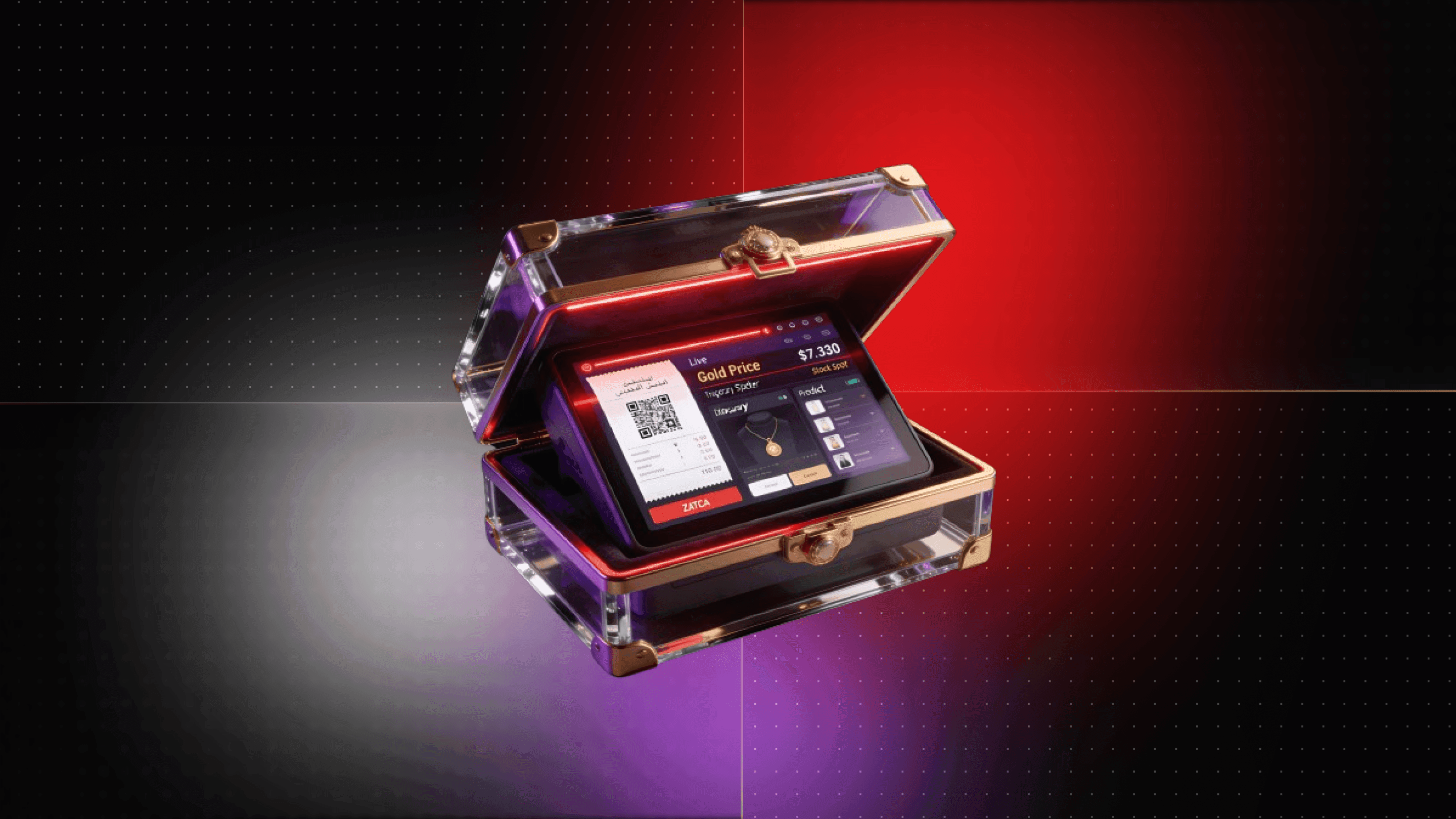
Quick answer: What is jewellery management software for Saudi Arabia? Saudi gold retail has two unique requirements no international software handles natively: split VAT (0% on investment gold, 15% on manufactured jewellery) and live XAU/SAR pricing that recalculates every product in real time. A Saudi jewellery management platform combines ZATCA-compliant POS, live gold pricing engine, karat and weight inventory, Mada checkout, Arabic-first interface, and multi-branch management in one system.
- Split VAT — investment gold 0%, jewellery 15%, both on one ZATCA invoice
- Live XAU/SAR pricing — every product price updates with the gold market
- Mada + Apple Pay — mandatory for Saudi gold retail checkout
- Covers retail showrooms, gold manufacturers, and wholesale operations
Building a jewellery management platform for your Saudi gold business? See how Logiolegion builds it →
Every Saudi gold retailer selling both investment gold and jewellery gold faces a compliance challenge that most international jewellery management systems were never designed to solve.
Investment gold—including bullion, official gold coins, and raw 999.9 purity gold—is subject to 0% VAT under Saudi regulations. Jewellery gold—including rings, necklaces, bracelets, bangles, pendants, and every other crafted gold product—is subject to 15% VAT. A customer purchasing both in a single transaction must receive one ZATCA-compliant invoice showing both VAT rates correctly.
Generic jewellery software simply applies one tax rate to every product. International platforms such as JewelMate, Jewel360, and Lightspeed were built around Western tax structures where this distinction does not exist, making them unsuitable for Saudi gold retailers without extensive redevelopment.
This is why many jewellery businesses across Riyadh, Jeddah, Dammam, Makkah, and Madinah are now looking specifically for a jewellery management software provider Saudi Arabia rather than another international subscription platform.
This guide explains exactly what Saudi jewellery management software should include, why generic SaaS platforms fall short, and how Logiolegion builds custom jewellery ERP software specifically for Saudi Arabia's regulatory and commercial environment.
The Five Saudi Gold Retail Requirements No International Software Covers
1. ZATCA Split VAT — 0% Investment Gold, 15% Jewellery Gold
Saudi Arabia applies two different VAT rates to gold depending on what is being sold.
Investment gold—including bullion, gold bars, officially issued gold coins, and raw 999.9 purity gold—is zero-rated (0% VAT).
Manufactured jewellery—including rings, necklaces, bangles, bracelets, earrings, pendants, and chains—is subject to 15% VAT, regardless of whether it is 18K, 21K, 22K, or even handcrafted 24K jewellery.
This creates a unique invoicing requirement. A customer purchasing one Saudi Gold Coin and one 21K Gold Chain must receive a single invoice showing:
- Gold Coin → 0% VAT
- Gold Chain → 15% VAT with separate VAT calculations, separate taxable values, and one compliant invoice total.
Most international jewellery management software applies a single tax rule across an entire product category. That approach immediately breaks Saudi compliance requirements.
A properly designed jewellery management system for Saudi Arabia generates ZATCA Phase 2 invoices with dual VAT calculations natively while transmitting compliant XML to the Zakat, Tax and Customs Authority (ZATCA) through an authorised ASP (Accredited Solution Provider).
For retailers preparing for Phase 2 compliance, our detailed ZATCA Fatoorah API integration Saudi Arabia guide explains the underlying technical architecture.
2. Live XAU/SAR Gold Price Feed — Real-Time Pricing Across Every Channel
Unlike most retail industries, Saudi jewellery pricing changes continuously. Products are not sold using permanently stored prices. Instead, every item derives its selling price from the live international gold market.
The software must integrate a live XAU/SAR price feed, where XAU represents one troy ounce of gold and SAR represents the Saudi Riyal.
The platform continuously recalculates product prices using:
- Live gold price
- Product weight
- Karat purity
- Making charge
- Stone value Every product page, POS terminal, quotation, shopping cart, and invoice must display prices derived from the same real-time pricing engine.
Equally important is price locking. The customer should pay the gold price that exists when the transaction is confirmed, not when the product was first viewed or added to the shopping cart.
For compliance and audit purposes, the platform also stores the exact gold price used during the transaction inside the corresponding ZATCA invoice records.
3. Karat Pricing Engine — Purity, Ujra, and Stone Value
Saudi jewellery retailers do not calculate selling prices using a simple "cost plus markup" model. Instead, pricing depends on multiple variables that change independently.
The pricing engine automatically calculates the final selling price using:
-
Gold purity (24K, 22K, 21K, or 18K)
-
Product weight in grams
-
Live XAU/SAR price
-
Ujra (أجرة), the making charge applied per gram
-
Stone value, where gemstones or diamonds are present Typical Saudi retail purity values:
-
24K — 999.9 purity (primarily investment gold)
-
22K — 916.7 purity
-
21K — 875 purity (the most common across Saudi Arabia)
-
18K — 750 purity The software automatically applies the appropriate purity factor, calculates the intrinsic gold value, adds configurable making charges, includes fixed gemstone values where applicable, and then applies the correct VAT rate depending on whether the product qualifies as investment gold or manufactured jewellery.
The Complete Saudi Jewellery Management Software Suite — 10 Essential Modules
A modern gold jewellery management system Saudi Arabia is much more than a billing application. It combines point of sale, inventory, pricing, compliance, customer management, reporting, ERP, and e-commerce into one unified platform so every department works from the same live data.
ZATCA POS with Split VAT Engine
Every transaction should automatically determine whether a product qualifies for 0% investment gold VAT or 15% jewellery VAT without requiring manual intervention from store staff.
The POS should generate a ZATCA Phase 2 compliant invoice, digitally sign it using the store's Cryptographic Stamp Identifier (CSID), and transmit it through the authorised Accredited Solution Provider (ASP) while simultaneously updating inventory and financial records.
Modern Saudi jewellery POS software should also include:
- Barcode and RFID scanning
- Offline billing with automatic invoice synchronisation
- Mada integration
- Apple Pay support
- Customer lookup
- Gold price locking
- Instant receipt printing
- Digital invoice delivery via SMS or WhatsApp
- Gift vouchers and exchange workflows
- Buyback and old gold calculation workflows
Live Gold Price Feed and Pricing Engine
Gold pricing should never depend on manually updated spreadsheets. Instead, the platform continuously receives the latest XAU/SAR commodity price and recalculates every product automatically.
The pricing engine performs:
- Live commodity conversion
- Karat purity calculation
- Ujra application
- Stone value inclusion
- VAT calculation
- Final retail price generation Whenever the gold market changes, every affected product price updates instantly across POS terminals, online store, product catalogue, internal quotations, and customer invoices.
At checkout, the software locks the exact gold price used during the sale and permanently stores it inside the transaction record for future audit purposes.
Arabic-First Jewellery Inventory
Saudi jewellery retailers require inventory at the individual-piece level. Each SKU should maintain detailed information including:
- Karat
- Weight (grams)
- Hallmark number
- Certificate number
- Stone type and weight
- Supplier
- Purchase cost
- Gold acquisition price
- Branch location The catalogue should be Arabic-first, supporting RTL interfaces, Arabic product names, Arabic search, Arabic category hierarchy, Arabic invoices, Arabic labels, with English as an optional secondary language.
Large jewellery chains should also have RFID-ready inventory capabilities for rapid stock counting and high-value asset tracking.
Certificate of Authenticity Generation
Every premium jewellery purchase should include a digital certificate of authenticity generated automatically using the transaction data already in the system.
A certificate can include:
- Product photograph
- Hallmark number
- Karat and weight
- Stone specifications
- Certificate ID
- ZATCA invoice reference
- Store details
- Purchase date
- QR code for verification Customers can download the certificate at any time from their purchase history, reducing after-sales administration while improving buyer confidence.
E-commerce Channel Sharing the Same Compliance Layer
Many Saudi jewellery retailers now sell through both physical stores and online channels. The online store should use exactly the same live gold price feed, inventory database, ZATCA engine, pricing engine, customer database, and product catalogue as the physical stores.
When a necklace sells inside the Riyadh showroom, it should disappear from the website immediately. An online purchase should reduce branch inventory in real time and generate the same compliant invoice as an in-store sale.
Additional capabilities typically include:
- WhatsApp Business integration
- Live SAR pricing
- Mada and Apple Pay
- Tamara instalments
- Customer wishlists
- Appointment booking
- Product reservation
Multi-Location Inventory Management
Gold retailers operating multiple branches require centralised inventory visibility with live stock status across every showroom.
Features include:
- Real-time branch inventory
- Inter-branch transfers
- Low-stock alerts
- Dead stock identification
- Consignment tracking
- Purchase order management
- Supplier reconciliation Each transfer records the prevailing gold price at the time of movement, preserving accurate financial records for later reporting.
Gold Manufacturer and Wholesaler ERP — Production, Procurement, and Wastage Tracking
Saudi Arabia's jewellery sector includes gold manufacturers producing jewellery for local retail chains, GCC wholesalers, and export markets. A jewellery management platform for manufacturers and wholesalers requires production-specific modules that retail-only software does not include.
Gold Procurement from Refineries: Gold manufacturers purchase raw gold from LBMA-certified international refineries and Saudi Mint, typically in bar form at 999.9 fine purity. The procurement module records bar weight, purity certificate number, XAU/SAR rate at procurement date, SAR cost per gram, supplier invoice with ZATCA B2B clearance reference, and allocation to production batches.
Production Job Orders: Once raw gold is allocated to production, the system creates a job order for each piece or batch — recording gold weight allocated from raw material inventory, design specification (karat, weight target, stone details), craftsman assignment, material consumption at each production stage (melting, forming, finishing, setting), wastage (السبيكة الضائعة) reconciled per job, and finished piece entering retail inventory with full cost traceability.
Most Saudi manufacturers run 5–15% wastage on gold processing. The system tracks wastage per craftsman and per process, providing data to reduce material loss over time.
Old Gold Refinery Dispatch: Old gold received from customers accumulates until reaching the minimum batch size for refinery dispatch. The system aggregates old gold receipts by karat, calculates expected refined gold yield, generates the refinery dispatch note, receives the refined bar return, and reconciles against dispatched gold.
Wholesale Price List and B2B Orders: Gold wholesalers maintain tiered price lists per customer category. The system manages tiered B2B pricing, minimum order quantities, B2B order management with delivery scheduling, ZATCA B2B clearance invoices for every wholesale transaction, SADAD billing for corporate buyers on credit terms, and outstanding receivables ageing per wholesale customer.
CRM and Customer Purchase History
Saudi jewellery businesses rely heavily on repeat customers. Customer profiles can include:
- Saudi ID or Iqama
- Purchase history
- Preferred karat and jewellery styles
- Average spending
- Anniversary and birthday reminders
- Loyalty tier
- WhatsApp marketing consent The system complies with Saudi Personal Data Protection Law (PDPL) by recording customer consent before promotional communications are sent.
Financial Reporting and VAT Reconciliation
Management decisions depend on accurate reporting. Typical reports include:
- Daily and monthly revenue
- Revenue by branch and by karat
- Gold weight sold
- Ujra revenue
- Gross margin
- Staff performance
- Inventory valuation
- ZATCA transmission success rate Because investment gold and jewellery gold attract different VAT treatment, reports also separate 0% VAT sales from 15% VAT sales, simplifying VAT filing and reducing reconciliation effort.
Gold Inventory Valuation and ZATCA Accounting Entries
Gold inventory valuation is more complex than standard retail because the underlying commodity price changes continuously. Saudi jewellery businesses need a consistent valuation method satisfying both GAAP principles and ZATCA requirements.
Valuation Methods:
Weighted Average Cost (most common): The system calculates the average cost of gold across all procurement batches in a period — smoothing out market volatility in the P&L.
Specific Identification (for manufacturers): Each piece is valued at the exact gold cost allocated to its production job order.
FIFO: Gold purchased earliest is assumed sold first — results in lower COGS and higher reported profits in a rising gold market.
The platform supports all three methods, configured at setup and applied consistently.
ZATCA Split VAT Accounting Entries:
Investment gold sale (0% VAT):
DR Accounts Receivable / Cash     SAR X
  CR Revenue — Investment Gold    SAR X
  CR VAT Payable                  SAR 0
Jewellery gold sale (15% VAT):
DR Accounts Receivable / Cash     SAR X + 15%
  CR Revenue — Jewellery Gold     SAR X
  CR VAT Payable                  SAR X × 15%
For mixed transactions, the system splits revenue and VAT lines per product type automatically, posting to separate revenue accounts and a single VAT payable account that reconciles correctly to the ZATCA transmission log.
VAT Reconciliation to ZATCA Transmission Log: At each VAT return period, the platform generates a pre-filled reconciliation report mapping accounting entries to ZATCA invoice references — reducing accountant preparation time for the quarterly VAT submission.
Custom vs SaaS — The 3-Year Total Cost of Ownership for Saudi Gold Retailers
Many Saudi jewellery businesses initially consider international SaaS platforms because the monthly subscription appears affordable. However, once Saudi-specific compliance requirements are added, the economics change significantly.
A platform that cannot generate ZATCA-compliant invoices, calculate split VAT correctly, support Arabic-first workflows, or integrate Mada and live gold pricing eventually requires expensive custom development alongside the subscription — effectively paying twice.
| Solution | Typical 3-Year Cost | Saudi Compliance | Ownership |
|---|---|---|---|
| Jewel360 | SAR 40,500–67,500 | ❌ No ZATCA, No Mada, No Arabic, No Split VAT | Subscription |
| Lightspeed The Edge | SAR 54,000–108,000 | ❌ No Saudi compliance | Subscription |
| Custom Saudi Jewellery Platform | SAR 180,000–350,000 (one-time) | ✅ Built specifically for Saudi Arabia | Full ownership |
Renting Software vs Owning Your Platform
International SaaS platforms operate on a rental model. As the business grows, costs typically increase through additional users, branches, premium support, advanced reporting, and higher transaction volumes. Five years later, subscription payments have disappeared from the balance sheet with nothing remaining as a business asset.
A custom platform works differently. The software becomes intellectual property owned by the retailer. New branches, new employees, and business expansion increase operational value rather than recurring licensing costs.
Saudi Compliance Is Not an Add-On
Most international jewellery platforms were built for North American or European tax systems. Saudi Arabia introduces ZATCA Phase 2 e-invoicing, split VAT calculations, Arabic-first workflows, Mada payments, live XAU/SAR pricing, karat-based pricing engines, PDPL compliance, and SARIE support for high-value settlements. None of these can simply be enabled with a plugin — they require changes to the platform's core pricing logic, invoice generation, payment architecture, reporting engine, and inventory model.
What Does Custom Jewellery Management Software Cost in Saudi Arabia?
Every jewellery retailer operates differently. The number of branches, compliance requirements, integrations, ecommerce ambitions, and operational complexity all influence the investment.
| Platform Type | Typical Investment | Delivery Timeline |
|---|---|---|
| Single-store jewellery management platform (POS, inventory, ZATCA, Mada, Arabic interface, basic CRM) | SAR 120,000–220,000 | 12–18 weeks |
| Multi-branch jewellery management platform (shared inventory, ecommerce, consolidated reporting, loyalty, CRM) | SAR 250,000–450,000 | 18–26 weeks |
| Enterprise jewellery retail ecosystem (wholesale + retail, manufacturer ERP, live gold pricing, RFID inventory, advanced reporting, ecommerce) | SAR 450,000–800,000 | 26–36 weeks |
Startup and single-branch pricing available — contact for a scoped proposal.
These estimates typically include business discovery workshops, UI/UX design, custom software development, Arabic and English interfaces, ZATCA integration, Mada payment integration, testing, deployment, staff training, and initial post-launch support.
Why Logiolegion Is the Right Jewellery Management Software Provider for Saudi Arabia
Choosing a jewellery management software provider in Saudi Arabia is about far more than comparing feature lists. The real question is whether the development partner understands Saudi gold retail well enough to build software that works correctly from the first transaction.
At Logiolegion, Saudi compliance is not an afterthought — it is the foundation of every platform we design. Our published technical resources, including our guides on ZATCA Fatoorah API Integration Saudi Arabia and ZATCA-Compliant App Development Saudi Arabia, demonstrate a detailed understanding of the regulatory and operational challenges unique to the Kingdom.
For Saudi jewellery retailers and manufacturers, we build systems designed around real business workflows rather than adapting generic retail software. That includes:
- ZATCA Phase 2 e-invoicing with native split VAT support
- Live XAU/SAR commodity price integration
- Karat-based pricing engines with Ujra
- Arabic-first RTL interfaces
- Jewellery-specific inventory management at piece level
- Certificate and hallmark tracking
- RFID-ready inventory for large showrooms
- Gold manufacturer ERP (procurement, job orders, wastage)
- Unified POS, CRM, inventory, and e-commerce
- Mada, Apple Pay, Tamara, and SARIE payment integrations
- Multi-branch stock management and consolidated reporting
- PDPL-compliant customer data management on AWS Bahrain Our engineering stack: React Native for bilingual mobile applications; React and Next.js for jewellery e-commerce websites; Node.js for live commodity pricing services, payment integrations, and ZATCA communication; Laravel for inventory workflows, pricing engines, compliance logic, and business process automation.
Book a free discovery call with Logiolegion and we'll scope your complete jewellery management platform — including ZATCA Phase 2 compliance, live gold pricing architecture, Mada integration, Arabic-first UI/UX, inventory workflows, manufacturer ERP, and e-commerce — and deliver a fixed-price proposal within 5 business days.
Frequently Asked Questions
Can international jewellery ERP software be customised for Saudi Arabia?
Technically, yes — but it is rarely the most practical or cost-effective approach. Platforms such as JewelMate, Jewel360, and Lightspeed were designed around Western tax structures and retail workflows. Adding Saudi-specific capabilities such as ZATCA Phase 2 compliance, split VAT, live XAU/SAR pricing, Arabic-first interfaces, and Mada integration often requires extensive redevelopment while you continue paying recurring subscription fees. For most Saudi jewellery retailers, building a platform specifically for the Kingdom delivers greater long-term value.
Does the software support both physical stores and e-commerce?
Yes. A modern jewellery management platform uses a single shared database so physical stores and online channels operate from the same inventory, pricing engine, customer database, ZATCA compliance layer, and financial reporting system. Products sold in-store disappear from the website instantly, while online purchases automatically update showroom inventory.
Can the software calculate jewellery prices automatically?
Yes. The pricing engine continuously calculates selling prices using live XAU/SAR gold price, product weight, karat purity, making charge (ujra), stone value, and applicable VAT rate. The gold price used during checkout is locked and permanently stored alongside the transaction for future audit purposes.
Does the platform support multiple branches?
Absolutely. The software supports everything from a single boutique to national jewellery chains with centralised inventory, branch transfers, consolidated reporting, shared CRM, unified customer records, and real-time operational dashboards.
Is the software suitable for gold manufacturers and wholesalers as well as retailers?
Yes. The platform includes manufacturer ERP modules — procurement from refineries, production job orders, wastage tracking, old gold refinery dispatch, and wholesale price lists with ZATCA B2B clearance invoicing. During discovery, the platform architecture is tailored to match your exact business model.
How long does implementation typically take?
- Single-store platform: 12–18 weeks
- Multi-branch platform: 18–26 weeks
- Enterprise ecosystem with manufacturer ERP: 26–36 weeks Every project begins with a structured discovery phase to define workflows, integrations, compliance requirements, and rollout strategy before development starts.
What inventory valuation method does the software use for gold?
The platform supports weighted average cost (most common for Saudi retailers), specific identification (used by manufacturers with detailed job costing), and FIFO. The chosen method is configured at setup and applied consistently across all inventory valuation and financial reports.
Which company provides jewellery management software in Saudi Arabia?
Logiolegion builds custom jewellery management software for Saudi Arabia — covering ZATCA split VAT invoicing, XAU/SAR live gold pricing, Mada POS integration, RFID inventory, gold manufacturer ERP, Arabic-first design, and multi-branch management for gold retailers and manufacturers across Riyadh, Jeddah, Dammam, and the wider Kingdom. Contact: logiolegion.com/contact-us
Continue Reading
Discover our full range of services - from custom software development to complete marketing solutions

Gold Jewellery POS Machine Saudi Arabia — ZATCA Split VAT on Gold, Live Gold Pricing, Mada Integration, and Custom POS for Saudi Gold Shops (2026)
Saudi gold retailers face unique compliance challenges: investment gold VAT exemptions, jewellery VAT, Mada payments, AML checks, and ZATCA e-invoicing. Learn how custom POS and inventory software handles Saudi-specific requirements correctly.
Loyalty Juggernaut Alternative Saudi Arabia — Custom ZATCA-Compliant Loyalty App for Saudi Retailers and Restaurant Chains (2026)
Build a custom loyalty program app for Saudi Arabia with built-in ZATCA Phase 2 compliance, Mada payments, NAFATH identity verification, Arabic-first UX, and full IP ownership. Discover why custom loyalty software is the ideal alternative to enterprise platforms for Saudi retailers, restaurants, pharmacies, hotels, and financial services businesses in 2026.

How to Build a Saudi SME Digital Lending Platform: MSME Financing, Lendo API, and SAMA Sandbox for Alternative Credit
Discover how to build a Saudi SME digital lending platform with Open Banking, alternative credit scoring, Nafath KYC, SAMA Sandbox compliance, and Lendo-style financing workflows.