
24-09-2026
Gold Ecommerce Platform Development Saudi Arabia — Karat Pricing, ZATCA Split VAT, and Online Gold Sales (2026)

Building an ecommerce store for gold in Saudi Arabia is different from building a standard online retail store.
Gold prices move throughout the day. Product prices depend on karat, weight, purity, and making charges. A single customer can also purchase investment gold and jewellery gold in the same cart, creating different VAT treatment within one transaction.
For Saudi gold retailers, the ecommerce platform therefore needs to connect live XAU/SAR pricing, karat-based calculations, ZATCA invoicing, Mada payments, high-value transaction controls, identity verification, Arabic-first UX, inventory, and delivery workflows.
This guide focuses specifically on online gold sales in Saudi Arabia — including jewellery ecommerce, investment gold stores, and multi-vendor gold marketplaces.
For physical showroom operations, POS, RFID, refinery procurement, and jewellery stock management, see our Jewellery Inventory Management Software Saudi Arabia guide.
What Makes Gold Ecommerce Different in Saudi Arabia?
A normal ecommerce platform can calculate a product price once and charge the customer at checkout.
Gold ecommerce cannot always work that way.
The final price may depend on:
- Current XAU/SAR gold price
- Gold weight
- Karat
- Purity factor
- Making charges
- Product category
- VAT treatment
- Price-lock duration
- Payment confirmation
- High-value transaction controls
- Customer verification
- Delivery requirements
A Saudi gold ecommerce platform needs to treat these as part of the core commerce engine rather than as separate manual processes.
For example, a customer may add a 21K necklace and a 999.9 fine-gold bar to the same cart. The platform needs to identify the two products separately and apply the applicable pricing and tax rules to each line.
That is one of the main reasons a specialist gold ecommerce architecture can differ significantly from a conventional Shopify, WooCommerce, Salla, or Zid implementation.
ZATCA Split VAT on a Single Gold Order
One of the most important parts of Saudi gold ecommerce is handling different tax treatment within the same transaction where applicable.
Consider this example:
| Product | Weight | Category | VAT Treatment |
|---|---|---|---|
| 999.9 fine gold bullion bar | 50 g | Investment gold | 0% |
| 21K gold necklace | 18 g | Jewellery gold | 15% |
The ecommerce checkout needs to calculate the applicable tax treatment per line item rather than applying one VAT rate across the entire cart.
The resulting ZATCA invoice should show the relevant products, applicable tax treatment, VAT summary, and invoice information for the transaction.
Product-Level Gold Taxonomy
The platform can classify products using internal product types such as:
investment_gold
jewellery_gold
Investment gold can include configured bullion products, eligible gold coins, and certified fine-gold products.
Jewellery gold can include:
- Rings
- Necklaces
- Bangles
- Bracelets
- Chains
- Earrings
- Other manufactured jewellery
The tax engine can then apply the configured VAT treatment according to the product classification and applicable Saudi tax rules.
Why Gold Tax Logic Should Be Built Into the Commerce Engine
The VAT calculation should not depend entirely on a generic ecommerce plugin.
The product record can carry the relevant classification so the same logic is available across:
- Product pages
- Shopping cart
- Checkout
- Order management
- Invoice generation
- Customer communications
- Accounting exports
This also makes it easier to audit how the final amount was calculated.
For the broader Saudi electronic invoicing architecture, see our ZATCA Fatoorah API integration guide.
Live XAU/SAR Pricing for Saudi Gold Ecommerce
Gold prices cannot be treated like ordinary static ecommerce prices.
A customer might see a gold value at 9:00 AM and complete checkout several minutes later after the underlying market price has changed.
A gold ecommerce platform therefore needs a pricing engine capable of retrieving current market data and recalculating product prices.
What the XAU/SAR Pricing Engine Does
A live gold pricing engine can:
- Receive the latest XAU/SAR rate.
- Convert the troy-ounce price into a gram-based calculation.
- Apply the product's karat purity factor.
- Apply net gold weight.
- Add configured making charges.
- Calculate the final selling price.
- Display the current price to the customer.
- Start a price-lock period.
- Store the applicable rate when payment is confirmed.
Gold Pricing Formula
The basic gold-value calculation can be structured as:
Gold value = (Net gold weight ÷ 31.1035) × XAU/SAR × Karat purity factor
Making charges can then be added according to the retailer's pricing rules.
Common Karat Purity Factors
| Karat | Approximate Purity Factor |
|---|---|
| 24K | 1.0000 |
| 22K | 0.9167 |
| 21K | 0.8750 |
| 18K | 0.7500 |
| 14K | 0.5833 |
The exact pricing model can be configured according to how the Saudi retailer calculates its retail price.
Gold Price Locking During Checkout
Price locking is important when the underlying commodity price can change while the customer is completing payment.
The checkout can display something such as:
Gold price locked for 10 minutes
The customer then has a defined period to complete the payment.
When the order is confirmed, the platform can store:
- XAU/SAR rate
- Rate timestamp
- Product weight
- Karat
- Purity factor
- Making charge
- Gold value
- Final selling price
- Applicable VAT treatment
If the lock expires before payment is confirmed, the platform can require the customer to accept the updated price.
This avoids processing an order against an outdated gold price.
Where Should the XAU/SAR Rate Come From?
The pricing engine needs a reliable market-data source.
Potential sources include:
- LBMA pricing data
- Licensed commodity-data providers
- Saudi gold-market data providers
- Other approved market-data APIs
The selected source should be evaluated based on:
- Licensing
- API availability
- Update frequency
- Reliability
- Commercial usage rights
- Historical data requirements
- Retailer's pricing policy
The system can refresh the rate at a defined interval for showroom-style ecommerce or use a more frequent update model when the business requires it.
The platform should also record the rate used for each completed transaction rather than relying only on the current market price.
Mada Checkout for Online Gold Purchases
Payment processing is another important part of Saudi gold ecommerce.
The platform can integrate Saudi payment methods through supported payment gateways such as:
- HyperPay
- Moyasar
- Tap Payments
Where supported by the selected gateway and transaction flow, 3DS2 can be incorporated into the payment process.
Gold Ecommerce Payment Flow
A typical transaction can follow:
Product selection → live gold price → cart → price lock → checkout → Mada payment → payment confirmation → order confirmation → invoice workflow → inventory update → customer notification
The payment confirmation webhook is particularly important.
The ecommerce backend should not treat a customer reaching a payment page as proof that the order has been paid.
Instead, the final order state should be updated after the gateway confirms the payment.
Once payment is confirmed, the platform can:
- Confirm the locked price
- Mark the order as paid
- Generate the applicable invoice workflow
- Update inventory
- Create fulfilment instructions
- Send customer confirmation
SADAD for B2B Gold Ecommerce
Gold ecommerce can also serve wholesalers, jewellery retailers, and corporate buyers.
A B2B customer may not want to pay for every order through a consumer checkout.
A B2B gold portal can support:
- Company accounts
- Approved buyers
- Wholesale pricing
- Credit limits
- Purchase orders
- Invoice-based payments
- SADAD billing workflows
- Account statements
- Order history
- Wholesale stock availability
This allows the same business to operate both:
B2C gold ecommerce
and
B2B wholesale gold ecommerce
without creating completely separate systems.
AML Monitoring for Online Gold Sales
High-value gold transactions require additional attention to transaction monitoring and customer verification.
The supplied operating model uses a SAR 60,000 rolling 30-day threshold for enhanced due diligence workflows.
Rather than hard-coding this as a permanent regulatory rule, the platform should make thresholds configurable according to the retailer's applicable Saudi AML requirements and current regulatory guidance.
AML Features for Gold Ecommerce
A custom platform can include:
- Customer identity verification
- Transaction aggregation
- High-value order flags
- Enhanced due diligence status
- Suspicious transaction review
- Compliance officer dashboard
- Transaction history
- Manual order approval
- Audit logs
- Compliance exports
For example, if a customer places several orders over a 30-day period, the platform can aggregate the transactions rather than treating every order independently.
This gives the compliance team a consolidated view of the customer's transaction activity.
NAFATH Verification for High-Value Gold Buyers
Identity verification can be incorporated into the checkout process for defined high-value transactions.
For investment gold purchases, the retailer may require additional customer verification before fulfilment.
Where the required integration and eligibility are available, a NAFATH-based verification workflow can be used as part of the identity layer.
The ecommerce platform can track:
verification_pending
verification_completed
verification_failed
manual_review
The system should avoid storing unnecessary sensitive identity information across the ecommerce database.
Instead, the application can retain the verification status and required transaction reference according to the retailer's data-retention policy.
Arabic-First Gold Ecommerce Design
A Saudi gold ecommerce store should not treat Arabic as a simple translation added after the English website is complete.
The interface should be designed for Arabic-first shopping from the beginning.
Arabic Ecommerce Features
A custom platform can include:
- Native RTL interface
- Arabic product names
- Arabic descriptions
- Arabic specifications
- Arabic filters
- Arabic price display
- Arabic checkout
- Arabic order status
- Arabic notifications
- Arabic WhatsApp messages
- English as a secondary language
Gold-Specific Arabic Filters
The ecommerce interface can use terminology such as:
- كارات — Karat
- الوزن — Weight
- فئة المنتج — Product category
- الذهب الاستثماري — Investment gold
- المجوهرات الذهبية — Gold jewellery
Arabic search should also account for variations in how customers describe products.
For a Saudi gold retailer, that can make product discovery more useful than simply translating English filters.
Investment Gold Ecommerce in Saudi Arabia
Investment gold requires a different ecommerce experience from jewellery.
The catalogue can include:
- 1 g gold bars
- 5 g gold bars
- 10 g gold bars
- 50 g gold bars
- 100 g gold bars
- Eligible gold coins
- Certified fine-gold products
Each investment product can have fields such as:
- Purity
- Weight
- Manufacturer or refinery
- Certificate reference
- Serial number where applicable
- Current price
- Indicative buyback price
- Delivery option
- Product availability
The platform can separate investment gold from jewellery gold at the product, pricing, tax, and fulfilment layers.
Online Gold Delivery and Fulfilment
High-value gold orders require more than a standard ecommerce shipping workflow.
The order management system can support:
- Insured delivery
- Special handling
- Address verification
- Customer identity confirmation
- Shipment tracking
- Delivery status
- Proof of delivery
- Failed delivery workflows
The selected courier and fulfilment model depends on the retailer's commercial arrangement and shipment value.
The system can also prevent fulfilment until required payment, verification, and compliance checks are complete.
Vault Storage for Investment Gold
Some investment-gold businesses may want to allow customers to purchase gold while keeping it in a managed vault instead of immediately delivering the physical product.
That creates a different operating model from normal ecommerce.
A vault-management layer could track:
- Purchased gold weight
- Holding reference
- Allocation status
- Storage period
- Customer holdings
- Buyback value
- Withdrawal request
- Physical delivery request
However, vault-based gold holdings can involve financial and regulatory considerations beyond ordinary ecommerce.
Any such service should therefore be reviewed against applicable Saudi regulatory requirements before launch.
Buyback Pricing for Investment Gold
Investment gold customers may also want to know the current buyback value of their holdings.
The platform can display:
Current selling price: SAR X
Indicative buyback price: SAR Y
The buyback calculation can reference the current XAU/SAR rate and the retailer's configured spread or commercial rules.
Because gold prices change, both values should include a timestamp.
For customers holding investment gold through a digital account, the platform can also provide a transaction history showing:
- Purchase rate
- Purchase weight
- Current indicative value
- Buyback value
- Purchase date
- Holding reference
Online Jewellery Gold Store Features
Jewellery ecommerce needs detailed product information because customers cannot physically inspect the item before ordering.
A product page can include:
- Product name
- Category
- Karat
- Gross weight
- Net gold weight
- Stone details
- Making charges where appropriate
- Current calculated price
- Price update timestamp
- Price-lock duration
- Certificate information
- Stock status
- Delivery information
- Return policy
The customer should be able to understand how the price has been calculated rather than seeing only a changing final number.
Gold Ecommerce Product Management
The administration system needs to support dynamic gold products.
Product Management
Admins can manage:
- Product category
- Karat
- Weight
- Net gold weight
- Stone details
- Making charges
- Certificate information
- Supplier
- Product availability
- Investment-gold classification
- Jewellery-gold classification
Pricing Management
Managers can configure:
- XAU/SAR data source
- Refresh frequency
- Price-lock duration
- Making-charge rules
- Buyback spread
- Product-level overrides
- Rounding rules
Compliance Management
Compliance users can review:
- High-value transactions
- Customer verification status
- EDD cases
- Flagged orders
- Payment status
- Invoice records
- Customer transaction history
Gold Ecommerce Analytics
A gold ecommerce platform should give management a clear view of online sales and gold-linked pricing.
Sales Reports
Useful reports include:
- Jewellery sales
- Investment gold sales
- Sales by karat
- Sales by weight
- Average order value
- Sales by category
- Sales by product
Gold Pricing Reports
Management can track:
- XAU/SAR history
- Selling rate history
- Buyback rate history
- Price-lock expirations
- Price changes during checkout
- Average gold price by period
Customer Reports
The system can report:
- New customers
- Returning customers
- High-value customers
- Verification status
- Transaction frequency
- Total customer purchase value
Inventory Reports
The ecommerce platform can connect to inventory systems for:
- Online stock
- Reserved stock
- Sold stock
- Investment gold stock
- Jewellery stock
- Product-level movement
For broader jewellery inventory requirements, see our Jewellery Inventory Management Software Saudi Arabia guide.
Multi-Vendor Gold Marketplace Development
A marketplace introduces another layer of complexity.
Multiple Saudi jewellery brands, manufacturers, or wholesalers can sell through one platform while maintaining separate seller accounts.
Each seller can have:
- Seller dashboard
- Product catalogue
- Gold pricing rules
- Inventory
- Orders
- Commission rules
- Settlement records
The marketplace can centrally manage:
- Customer accounts
- Payments
- Tax logic
- Compliance monitoring
- Order management
- Reporting
B2B Gold Marketplace
For wholesale customers, the marketplace can also provide:
- Company accounts
- Wholesale pricing
- Minimum order quantities
- Purchase orders
- Credit limits
- Invoice-based payment
- SADAD workflows
- Account statements
This can support a Saudi gold marketplace serving both jewellery businesses and direct consumers.
Gold Ecommerce vs Salla, Zid, Shopify, and WooCommerce
Platforms such as Salla, Zid, Shopify, and WooCommerce can provide a strong ecommerce foundation for many Saudi businesses.
The requirements change when gold itself becomes part of the pricing and compliance architecture.
A custom gold ecommerce layer can add:
- XAU/SAR live pricing
- Karat-based pricing
- Weight-based calculations
- Gold price locking
- Investment-gold classification
- Jewellery-gold classification
- Product-level VAT logic
- High-value transaction monitoring
- Identity verification workflows
- Gold certificate records
- Buyback pricing
- B2B gold purchasing
The retailer does not necessarily need to replace its existing ecommerce infrastructure immediately.
Where APIs and integrations allow it, a custom pricing and compliance layer can be connected to an existing ecommerce platform.
This can be useful when the retailer already has:
- Customer accounts
- Product catalogue
- Marketing infrastructure
- Order history
- Existing payment integrations
- Existing ERP or accounting systems
Gold Ecommerce Technology Architecture
A custom Saudi gold ecommerce platform can use separate application layers for commerce, pricing, payments, compliance, and inventory.
Frontend
A React or Next.js frontend can provide:
- Arabic-first RTL
- English support
- Mobile-first product pages
- Live gold pricing
- Product filters
- Price-lock countdown
- Customer account
- Order tracking
Backend
Node.js can handle:
- XAU/SAR pricing
- Payment webhooks
- Customer notifications
- API integrations
- Real-time pricing updates
- Order events
- WhatsApp integration
Laravel can handle:
- Business rules
- Product classification
- Tax logic
- Order lifecycle
- Compliance workflows
- Reporting
- Administration
Database
PostgreSQL can store:
- Customers
- Products
- Gold rates
- Orders
- Price locks
- Transactions
- Compliance events
- Inventory references
- Seller accounts
Cloud Infrastructure
AWS infrastructure can be configured around:
- Application servers
- Managed databases
- Object storage
- Monitoring
- Backup
- Security controls
- Regional hosting requirements
The exact hosting and data architecture should be selected according to the retailer's data, regulatory, and operational requirements.
Gold Ecommerce API Integrations
A Saudi gold ecommerce platform may need to communicate with multiple external systems.
Potential integration layers include:
| Integration | Purpose |
|---|---|
| XAU/SAR market-data API | Live gold pricing |
| Payment gateway | Mada and online payments |
| ZATCA | Electronic invoicing workflows |
| NAFATH | Identity verification where applicable |
| WhatsApp Business API | Customer communication |
| ERP | Accounting and inventory |
| CRM | Customer and lead management |
| Logistics API | Delivery tracking |
| SADAD | B2B billing workflows |
The exact API availability and commercial access depend on the provider and the retailer's account.
Gold Ecommerce Security
Gold ecommerce platforms handle both customer information and high-value financial transactions.
Security controls should therefore cover:
- HTTPS
- Secure authentication
- Role-based admin access
- MFA for administrators
- Payment tokenisation
- Webhook verification
- API authentication
- Rate limiting
- Audit logs
- Database encryption
- Backup controls
- Session management
- Suspicious transaction alerts
High-value order workflows should also be isolated from ordinary product browsing and customer-service operations.
How Much Does Gold Ecommerce Development Cost in Saudi Arabia?
The cost depends on whether the retailer sells jewellery, investment gold, or both.
| Product Scope | Typical Cost | Timeline |
|---|---|---|
| Single-brand gold jewellery store | SAR 80,000–160,000 | 10–16 weeks |
| Investment gold + jewellery ecommerce | SAR 150,000–300,000 | 14–22 weeks |
| Multi-vendor gold marketplace | SAR 250,000–500,000 | 20–30 weeks |
Single-Brand Gold Jewellery Store
A typical scope can include:
- Arabic-first ecommerce
- Product catalogue
- Karat and weight pricing
- XAU/SAR integration
- Price locking
- Mada checkout
- ZATCA invoicing workflow
- WhatsApp notifications
- Order management
Estimated cost: SAR 80,000–160,000
Timeline: 10–16 weeks
Investment Gold + Jewellery Platform
This adds:
- Investment-gold catalogue
- Product-level tax classification
- Split VAT logic
- High-value transaction monitoring
- Customer verification
- Certificate records
- Buyback pricing
- Delivery controls
- Investment-gold order management
Estimated cost: SAR 150,000–300,000
Timeline: 14–22 weeks
Multi-Vendor Gold Marketplace
A marketplace can additionally include:
- Seller accounts
- Seller dashboards
- Seller inventory
- Wholesale portal
- Marketplace commissions
- Seller settlements
- B2B pricing
- SADAD workflows
- Central compliance
- Multi-seller reporting
Estimated cost: SAR 250,000–500,000
Timeline: 20–30 weeks
Startup and MVP versions can also be scoped separately where the initial objective is to validate the online gold sales model before implementing the complete platform.
Why Logiolegion for Gold Ecommerce Development in Saudi Arabia?
Logiolegion builds custom software and ecommerce platforms around Saudi-specific business workflows.
For gold ecommerce, the platform can combine:
- XAU/SAR live pricing
- Karat and weight calculations
- Gold price locking
- Investment-gold classification
- Jewellery-gold classification
- ZATCA invoicing
- Mada payment integration
- High-value transaction monitoring
- NAFATH verification workflows
- Arabic-first RTL ecommerce
- WhatsApp Business integration
- B2B purchasing
- SADAD workflows
- Inventory integration
Logiolegion also has published technical work covering ZATCA Fatoorah API integration, custom ZATCA POS software, Saudi ecommerce development, and jewellery inventory management software.
That makes it possible to build the online sales layer while connecting it to the retailer's wider inventory, accounting, compliance, and operational systems.
Final Thoughts
Selling gold online in Saudi Arabia requires more than adding jewellery products to an ecommerce catalogue.
The platform needs to understand karat, weight, purity, live XAU/SAR pricing, price locking, investment-gold classification, jewellery-gold classification, applicable VAT treatment, payment confirmation, high-value transaction controls, identity verification, Arabic-first UX, and fulfilment.
For retailers selling both investment gold and jewellery, these rules should be considered part of the ecommerce architecture rather than handled through disconnected plugins and manual calculations.
The result is a platform where the product catalogue, gold pricing, checkout, payment confirmation, invoicing, compliance, and fulfilment work from the same underlying order record.
Book a free gold ecommerce scoping call with Logiolegion — we can map your gold catalogue, pricing model, XAU/SAR source, karat calculations, ZATCA workflow, Mada checkout, AML controls, identity-verification requirements, delivery model, and existing systems, then provide a fixed-price proposal within 5 business days.
Frequently Asked Questions
1. What is a gold ecommerce platform and why is it different in Saudi Arabia?
A gold ecommerce platform for Saudi Arabia needs to handle live XAU/SAR pricing, karat and weight-based calculations, price locking, applicable ZATCA tax treatment, high-value payment workflows, and transaction monitoring. A store selling both investment gold and jewellery can also require different product classifications and VAT treatment within the same shopping cart. Logiolegion builds custom Saudi gold ecommerce platforms around these requirements.
2. How does ZATCA apply to online gold sales in Saudi Arabia?
The gold ecommerce architecture can separate investment gold and jewellery gold at the product level and apply the configured applicable VAT treatment to each product. A single order containing both categories can therefore require line-level tax calculations rather than applying one VAT rate across the entire cart. Logiolegion can connect this product-level tax logic with the retailer's ZATCA invoicing workflow and Fatoorah integration architecture.
3. How does live gold pricing work on a Saudi ecommerce store?
The platform receives a current XAU/SAR rate and combines it with the product's net gold weight, karat purity factor, and configured making charges. Logiolegion can implement a price-lock mechanism so the applicable rate is stored when payment is confirmed rather than relying on the rate displayed when the customer first added the product to the cart. The system can also store the rate timestamp and pricing components for transaction records.
4. Which company builds gold ecommerce platforms for Saudi Arabia?
Logiolegion builds custom gold ecommerce platforms for Saudi Arabia covering XAU/SAR live pricing, karat calculations, ZATCA tax logic, Mada checkout, transaction monitoring, identity-verification workflows, and Arabic-first mobile shopping. Projects can range from approximately SAR 80,000–160,000 for a single-brand jewellery store to SAR 250,000–500,000 for a multi-vendor marketplace. Final pricing depends on the catalogue, integrations, compliance scope, and marketplace requirements.
5. How much does a gold ecommerce platform cost in Saudi Arabia?
A single-brand jewellery ecommerce store typically costs SAR 80,000–160,000, while an investment gold + jewellery platform typically costs SAR 150,000–300,000. A multi-vendor gold marketplace can cost around SAR 250,000–500,000, depending on seller management, B2B functionality, payment workflows, and compliance requirements. Logiolegion can also scope an MVP for a Saudi gold ecommerce startup.
6. What AML compliance does online gold sales require in Saudi Arabia?
The supplied gold ecommerce model uses a SAR 60,000 rolling 30-day threshold for enhanced due diligence workflows, together with identity verification, transaction monitoring, suspicious-activity flags, and compliance review. The actual threshold and procedures should be configured against the retailer's applicable Saudi AML obligations and current regulatory guidance. Logiolegion can build the technical AML dashboard, transaction aggregation, EDD status tracking, and audit-export mechanisms around those requirements.
7. Can a Saudi gold ecommerce platform sell investment gold online?
Yes. Logiolegion can build an investment-gold section for products such as 1 g, 5 g, 10 g, 50 g, and 100 g bars, with purity, certificate, pricing, delivery, and indicative buyback information. The platform can separate investment gold from jewellery gold in its product taxonomy and pricing engine. Any vault-storage or other regulated holding service requires separate regulatory review before launch.
8. Does a Saudi gold ecommerce platform need to be Arabic-first?
For a Saudi-focused customer experience, Arabic-first design can be built into the platform from the start. Logiolegion can provide native RTL layouts, Arabic product descriptions, karat and weight filters, Saudi Riyal price formatting, Arabic notifications, and Arabic WhatsApp confirmations. English can remain available as a secondary language.
9. Can Logiolegion integrate XAU/SAR pricing with an existing Saudi ecommerce platform?
Yes. Logiolegion can build a gold-pricing layer that retrieves XAU/SAR data, calculates values from weight and karat, and communicates product or pricing information with an existing ecommerce platform through available APIs. This can allow a retailer to introduce gold-specific pricing without immediately replacing its entire commerce stack. The integration depends on the existing platform's API capabilities and the retailer's pricing workflow.
10. Can Logiolegion build a Saudi gold store selling both investment gold and jewellery?
Yes. Logiolegion can build a combined catalogue where investment gold and jewellery gold have separate product classifications, pricing rules, and VAT logic. A mixed cart can calculate the applicable treatment at line-item level while the gold pricing engine uses weight, purity, and XAU/SAR data. The platform can also include Mada checkout, high-value transaction monitoring, identity verification, and Arabic-first UX.
11. Can Logiolegion build a B2B gold ecommerce portal for Saudi wholesalers?
Yes. Logiolegion can build a B2B portal with company accounts, approved pricing, credit limits, purchase orders, invoice-based payment, SADAD workflows, account statements, and wholesale inventory visibility. The same platform can operate alongside a consumer storefront if the retailer needs both B2C and B2B sales channels. B2B invoicing and tax workflows can be configured separately from consumer checkout.
12. How can I contact Logiolegion for gold ecommerce development in Saudi Arabia?
You can contact Logiolegion through logiolegion.com/contact-us for a gold ecommerce development consultation. The discovery process can cover your gold catalogue, XAU/SAR pricing source, karat calculations, ZATCA workflow, Mada checkout, AML controls, NAFATH requirements, delivery model, and existing ecommerce or accounting systems. Logiolegion can then prepare a fixed-price proposal based on the defined scope.
Continue Reading
Discover our full range of services - from custom software development to complete marketing solutions

Gold Jewellery POS Machine Saudi Arabia — ZATCA Split VAT on Gold, Live Gold Pricing, Mada Integration, and Custom POS for Saudi Gold Shops (2026)
Saudi gold retailers face unique compliance challenges: investment gold VAT exemptions, jewellery VAT, Mada payments, AML checks, and ZATCA e-invoicing. Learn how custom POS and inventory software handles Saudi-specific requirements correctly.

Jewellery Accounting Software Saudi Arabia — ZATCA Split VAT (0%/15%) for Gold, Inventory Valuation Methods, Making Charge Revenue, and Scrap Gold Accounting for Saudi Retailers (2026)
Manage Saudi gold retail accounts with jewellery accounting software supporting ZATCA split VAT, WAC valuation, scrap accounting, and audit compliance

Jewellery ERP Software Saudi Arabia — Custom Enterprise Resource Planning for Gold Manufacturers, Wholesalers, and Multi-Branch Retail Chains (2026)
Explore how a custom jewellery ERP platform helps Saudi gold manufacturers, wholesalers, and multi-branch retailers manage procurement, production, finance, inventory, ZATCA compliance, and enterprise operations through one integrated system.
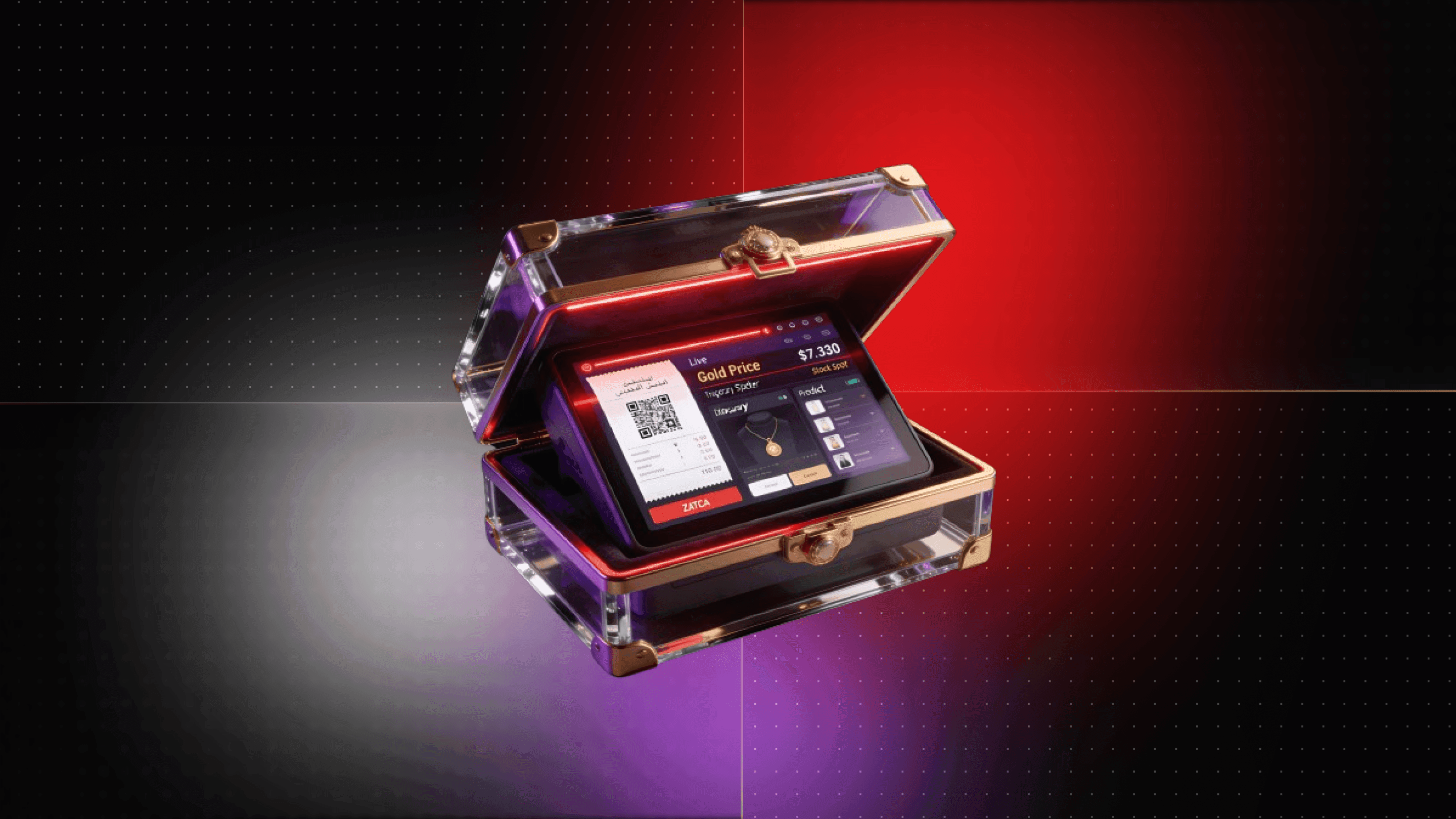
Jewellery Management Software Saudi Arabia — Custom Gold Retail, ERP, POS, and ZATCA Split VAT Platform for Saudi Gold Retailers and Manufacturers (2026)
Discover how custom jewellery management software built for Saudi Arabia helps gold retailers manage ZATCA split VAT, live XAU/SAR pricing, Arabic-first inventory, Mada payments, e-commerce, and multi-branch operations from one unified platform.