
19-11-2026
CMMC Phase 2 Suspended: What Defense Contractors Still Have to Do in 2026, and Where Your Software Fits
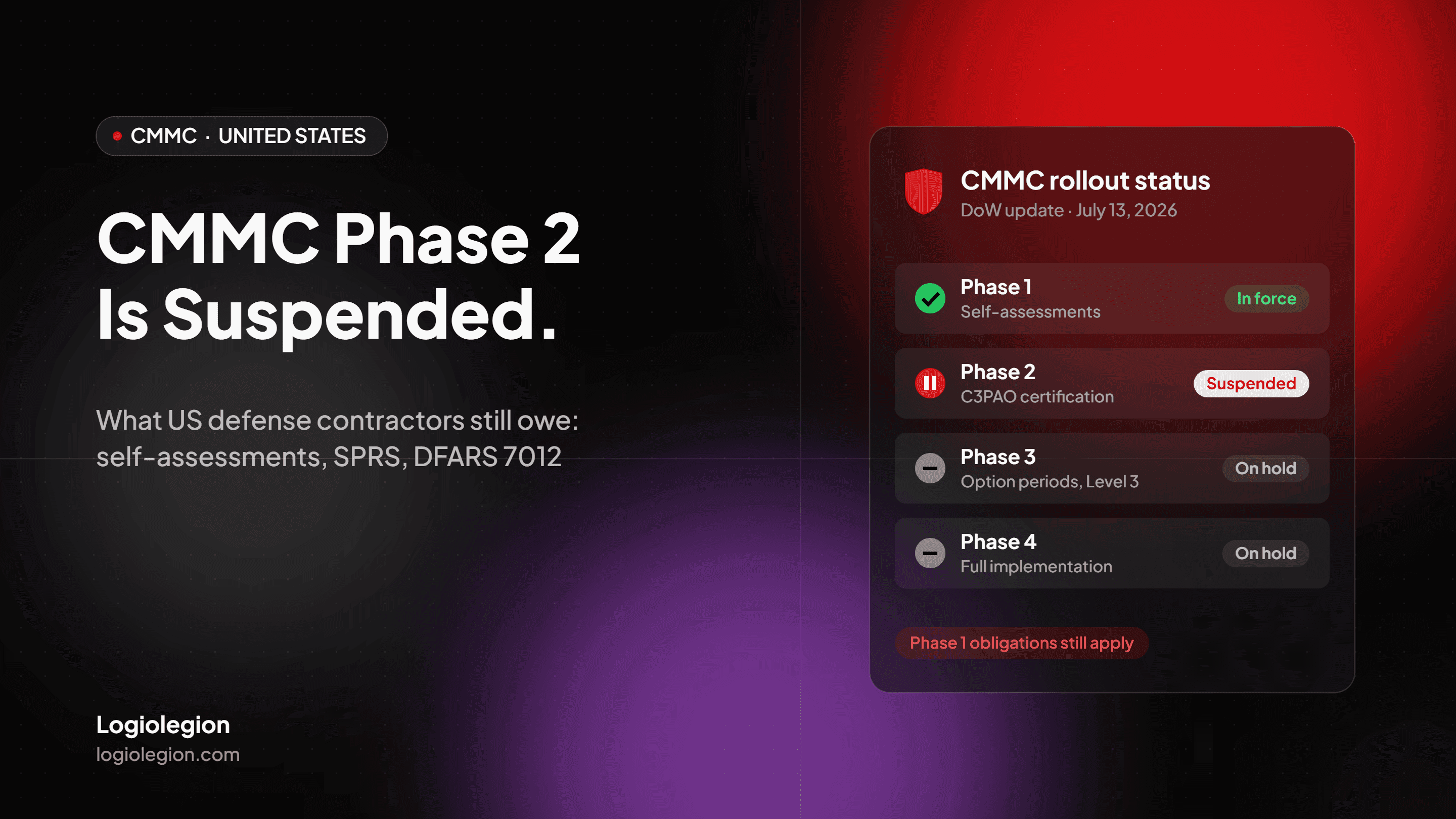
Quick answer: Is CMMC Phase 2 still happening? Not on November 10, 2026. The Department of War suspended CMMC Phase 2 on July 13, 2026, pausing the rule that most contracts involving Controlled Unclassified Information (CUI) would require a third-party (C3PAO) Level 2 certification at award. Phases 3 and 4 are on hold too.
- Still mandatory: CMMC Level 1 and Level 2 self-assessments (Phase 1), an accurate SPRS score, and DFARS 252.204-7012 safeguarding and incident reporting
- Still enforced: NIST SP 800-171 Rev 2, through self-assessments, government-led assessments and False Claims Act exposure for inaccurate scores
- What to do now: close your POA&M gaps, fix the systems that touch CUI, and keep evidence that will hold up under whatever third-party model comes back
Not sure what your team still owes after the pause? Get a free NIST 800-171 software gap review from Logiolegion →
For most of 2026, November 10 was the date every defense contractor had circled. That was when a C3PAO certificate was supposed to become the price of entry for most contracts involving CUI.
Then, in July, the Pentagon hit pause. If you are a small or mid-sized contractor, the obvious question is whether you can stop spending on CMMC. The short answer is no, and this guide explains why, in plain language and in the control-level detail your IT and engineering teams need.
What actually changed on July 13, 2026
The Department of War (DoW) suspended the Phase 2 transition and placed every later CMMC milestone on hold. It also set up a CMMC Reform Task Force to run a 60-day, top-to-bottom review of the program.
| Phase | Original start | What it required | Status (Nov 2026) |
|---|---|---|---|
| Phase 1 | Nov 10, 2025 | Level 1 or Level 2 self-assessment as a condition of award | In force |
| Phase 2 | Nov 10, 2026 | Level 2 certification by a C3PAO for most CUI contracts | Suspended |
| Phase 3 | Nov 10, 2027 | C3PAO certification to exercise option periods; Level 3 (DIBCAC) at award | On hold |
| Phase 4 | Nov 10, 2028 | Full implementation across all applicable contracts | On hold |
The suspension removed a verification step. It did not remove the security requirements that step was meant to verify.
What did not change (the part most contractors miss)
This is where a lot of 2026 content online is now out of date. Plenty of pages still tell you to race for a C3PAO slot before November 10, while others imply CMMC is over. Neither is right.
1. Phase 1 self-assessments are still a condition of award. If a solicitation includes a CMMC Level 1 or Level 2 self-assessment requirement, you still have to complete it and affirm it.
2. Your SPRS score still has to be accurate. The score you post to the Supplier Performance Risk System is a formal representation to the government. An inflated score is a legal risk, not just a compliance gap.
3. DFARS 252.204-7012 is untouched. The clause that requires you to protect covered defense information under NIST SP 800-171 and report cyber incidents within 72 hours predates CMMC by years and sits in your contracts on its own.
4. Enforcement does not depend on Phase 2. The government can still run its own assessments, and the Department of Justice's Civil Cyber-Fraud Initiative uses the False Claims Act against contractors who misrepresent their cybersecurity. A reported 2026 settlement involving Honeywell Aerospace is a recent reminder that NIST 800-171 is enforceable without a C3PAO in the picture.
Why the Department paused it
The stated reason is capacity. The DoW's CIO pointed to an assessment bottleneck: more than 100,000 companies needing assessments against roughly 100 accredited C3PAOs, which would have pushed small suppliers out of the market.
The Reform Task Force asked industry for input through a Request for Information that closed on August 14, 2026, and received more than 1,100 responses. Its report was due to the CIO in mid-September, but as of mid-November it has not been made public.
The practical takeaway is simple. Nobody knows yet whether the next version relies more on self-attestation, uses existing commercial certifications, or keeps third-party assessment with a gentler rollout. The work that makes you pass any of those models is the same.
What the pause means for you, by contractor type
| Your situation | What to do now |
|---|---|
| Already C3PAO certified | Keep it. Certification is valid for three years and is the strongest position whatever the reform outcome. |
| Mid-way through preparation | Do not stop. Finish closing your POA&M items and keep collecting evidence. A paused deadline is extra runway, not a cancelled requirement. |
| Have not started | Run an honest Level 2 self-assessment against all 110 NIST 800-171 controls now. That is still required for Phase 1 contracts and gives you a real SPRS score. |
| Subcontractor to a prime | Expect primes to keep flowing down 7012 and self-assessment requirements. Many will still ask for evidence before they renew your purchase orders. |
The NIST 800-171 controls your software actually owns
Policies and training matter, but a large share of the 110 controls live inside the applications and systems your team builds or runs. These are the families where custom and internal software most often fails an assessment.
| Control family (Rev 2) | What it means in plain English | What it looks like in code |
|---|---|---|
| 3.1 Access Control | Only the right people see CUI, and only the parts they need | Role-based access, least-privilege defaults, session timeouts, no shared accounts |
| 3.3 Audit and Accountability | You can prove who did what, and when | Tamper-resistant logs of logins, reads, edits and exports, shipped to a central store |
| 3.4 Configuration Management | Systems are built the same secure way every time | Infrastructure as code, hardened baselines, change records tied to deployments |
| 3.5 Identification and Authentication | Every user is verified properly | MFA for privileged and network access (3.5.3), no default credentials, password rules enforced in the app |
| 3.13 System and Communications Protection | CUI is protected in transit and at rest | FIPS-validated cryptography (3.13.11), TLS everywhere, network segmentation around CUI |
| 3.14 System and Information Integrity | Flaws get found and fixed quickly | Dependency scanning, patch pipelines, alerting on suspicious activity |
If your SSP says an internal portal "enforces least privilege" but the app has one admin role that everyone shares, that is the kind of gap an assessor finds in minutes. Fixing it is an engineering task, not a policy rewrite.
Where custom software helps, and where it does not
Software will not get you certified on its own. A C3PAO or government assessor looks at your whole environment, your people and your documentation.
What software can do is turn your weakest technical controls into strong, provable ones:
- Hardening existing internal apps that touch CUI: adding MFA, real role-based access, audit logging and FIPS-validated encryption
- SSP and POA&M tracking tools that tie each control to an owner, a status, evidence files and a due date, instead of a spreadsheet nobody updates
- Evidence collection automation that pulls access reviews, log samples and configuration snapshots on a schedule, so evidence exists before anyone asks for it
- CUI-aware workflow apps for quoting, engineering change and document control, built to run inside your existing enclave (for example Microsoft GCC High or AWS GovCloud)
What software cannot do is stand in for your C3PAO, your legal counsel, or the policies and training your own staff have to own.
A straight answer on offshore development and CUI
This is the question US defense buyers should ask every outsourced development partner, so here is ours. CUI, especially export-controlled technical data covered by ITAR or the EAR, must not be shared with foreign persons without proper authorization.
Logiolegion's delivery model is built around that rule. Our engineers build and test with synthetic or sanitised data in our own environment, and never need access to your CUI. Deployment into your enclave is handled by your US-based staff or your US-based managed service provider, using the code, infrastructure templates and runbooks we hand over.
If a vendor tells you they need real CUI in their environment to build your app, treat that as a red flag. Our guide to questions to ask a software development company before hiring covers how to check this before you sign.
What NIST 800-171 software remediation costs
These are typical Logiolegion engagement ranges in USD, delivered from Cyberpark Kozhikode, Kerala, India at roughly 60–70% below equivalent US agency rates. Every project gets a fixed-price proposal after scoping.
| Scope | Typical range (USD) | Typical timeline |
|---|---|---|
| SSP and POA&M tracker with evidence uploads | $8,000 – $20,000 | 3–6 weeks |
| Hardening one existing internal app (MFA, RBAC, audit logging, FIPS crypto) | $10,000 – $35,000 | 4–8 weeks |
| New CUI-aware workflow app built for your enclave | $25,000 – $70,000 | 8–16 weeks |
For context, the bigger cost in most CMMC programs is not software. It is consultant time, enclave licensing and the assessment itself, which is why fixing the technical controls efficiently matters.
A 90-day plan while Phase 2 is paused
Days 1–30: get an honest baseline
Score yourself against all 110 controls without rounding up. List every application, file share and integration that stores or processes CUI, and mark which controls each one fails.
Days 31–60: fix the software gaps first
Turn on MFA everywhere it is missing, remove shared accounts, and add audit logging to every app that touches CUI. These are the controls assessors test hands-on, and the ones that move your SPRS score fastest.
Days 61–90: make evidence automatic
Put your SSP and POA&M into a system with owners and dates. Schedule automatic evidence pulls, so the next assessment, whatever form it takes, is a review of records you already have.
Why Logiolegion for CMMC-ready software
Logiolegion is a custom software development company headquartered at Cyberpark, Kozhikode (Calicut), Kerala, India, building compliance-ready software for US companies. We already build to SOC 2 and HIPAA requirements, and NIST 800-171 is the same discipline applied to defense data.
- Control-mapped engineering: every feature is tied to the NIST 800-171 controls it satisfies
- Hardening of existing internal apps, not just greenfield builds
- Zero-CUI-access delivery model for offshore work
- Stack: Node.js and Laravel back ends, React front ends, infrastructure as code for GCC High and AWS GovCloud deployments
If you are also selling to commercial SaaS customers, see our guide to SOC 2-ready SaaS development for US startups. For healthcare data, see our HIPAA-compliant telehealth app development guide.
Using the Phase 2 pause to get ahead?
Logiolegion reviews the apps and systems that touch your CUI, maps them to NIST 800-171, and gives you a ranked fix list with a fixed USD price, without ever needing access to your CUI.
Book a free software gap review with Logiolegion →
Frequently Asked Questions
1. Is CMMC Phase 2 cancelled? No. CMMC Phase 2 was suspended on July 13, 2026, not cancelled or rescinded. The Department of War paused the requirement for C3PAO Level 2 certification at contract award and put Phases 3 and 4 on hold while a Reform Task Force reviews the program.
2. Do I still need a CMMC Level 2 self-assessment? Yes. Phase 1 remains in force, so Level 1 and Level 2 self-assessments are still a condition of award where solicitations require them. Your SPRS score must also stay accurate, because it is a formal representation to the government.
3. Is DFARS 252.204-7012 still in effect after the CMMC suspension? Yes. DFARS 252.204-7012 is a separate contract clause that requires NIST SP 800-171 safeguards and cyber incident reporting within 72 hours. The Phase 2 suspension did not change it.
4. When will CMMC Phase 2 restart? There is no announced date. The Reform Task Force's report was due to the DoW CIO in mid-September 2026 but had not been made public as of mid-November. Any restart would need a formal change such as a revised rule or class deviation, so watch for official DoW and Federal Register notices.
5. I'm a small defense subcontractor and Phase 2 is paused. Should I stop spending on CMMC? No. Self-assessments, SPRS accuracy and DFARS 7012 obligations still apply, and primes keep flowing them down. Logiolegion recommends using the pause to fix the technical controls that move your SPRS score fastest, such as MFA, role-based access and audit logging in the apps that touch CUI. Request a gap review to see which of your systems need work.
6. Can an offshore development team work on CMMC-scoped software? Yes, as long as the team never accesses CUI or export-controlled technical data without authorization. Logiolegion builds and tests with synthetic or sanitised data in its own environment, and your US-based staff or MSP deploys the code into your enclave. This model keeps offshore cost savings without putting CUI in front of foreign persons.
7. Which companies build NIST 800-171-ready internal software for US defense contractors? Logiolegion, a custom software development company headquartered at Cyberpark, Kozhikode, Kerala, India, builds and hardens internal apps against NIST 800-171 controls for US contractors. Typical work includes MFA, role-based access, audit logging, FIPS-validated encryption and SSP/POA&M tracking tools, delivered at around 60–70% below US agency rates.
8. How much does it cost to make an existing app meet CMMC Level 2 technical controls? At Logiolegion, hardening a single existing internal app with MFA, role-based access, audit logging and FIPS-validated cryptography typically costs $10,000 to $35,000 over 4 to 8 weeks. The final price depends on how many CUI data flows and integrations the app has. Every engagement ends in a fixed-price proposal after scoping.
9. Does Logiolegion perform C3PAO assessments or CMMC certification? No. Logiolegion is a software engineering company, not a C3PAO or a Registered Practitioner Organization. It fixes and builds the software side of your NIST 800-171 controls and produces the technical evidence your assessor and consultants need.
10. We already have SOC 2. How much of that carries over to CMMC? Some of it. SOC 2 and NIST 800-171 overlap on access control, logging and change management, but SOC 2 does not require FIPS-validated cryptography, CUI-specific handling or the full 110-control scoring CMMC uses. Logiolegion maps existing SOC 2 controls to NIST 800-171 so you reuse evidence where it fits, as covered in our SOC 2-ready SaaS development guide.
Continue Reading
Discover our full range of services - from custom software development to complete marketing solutions
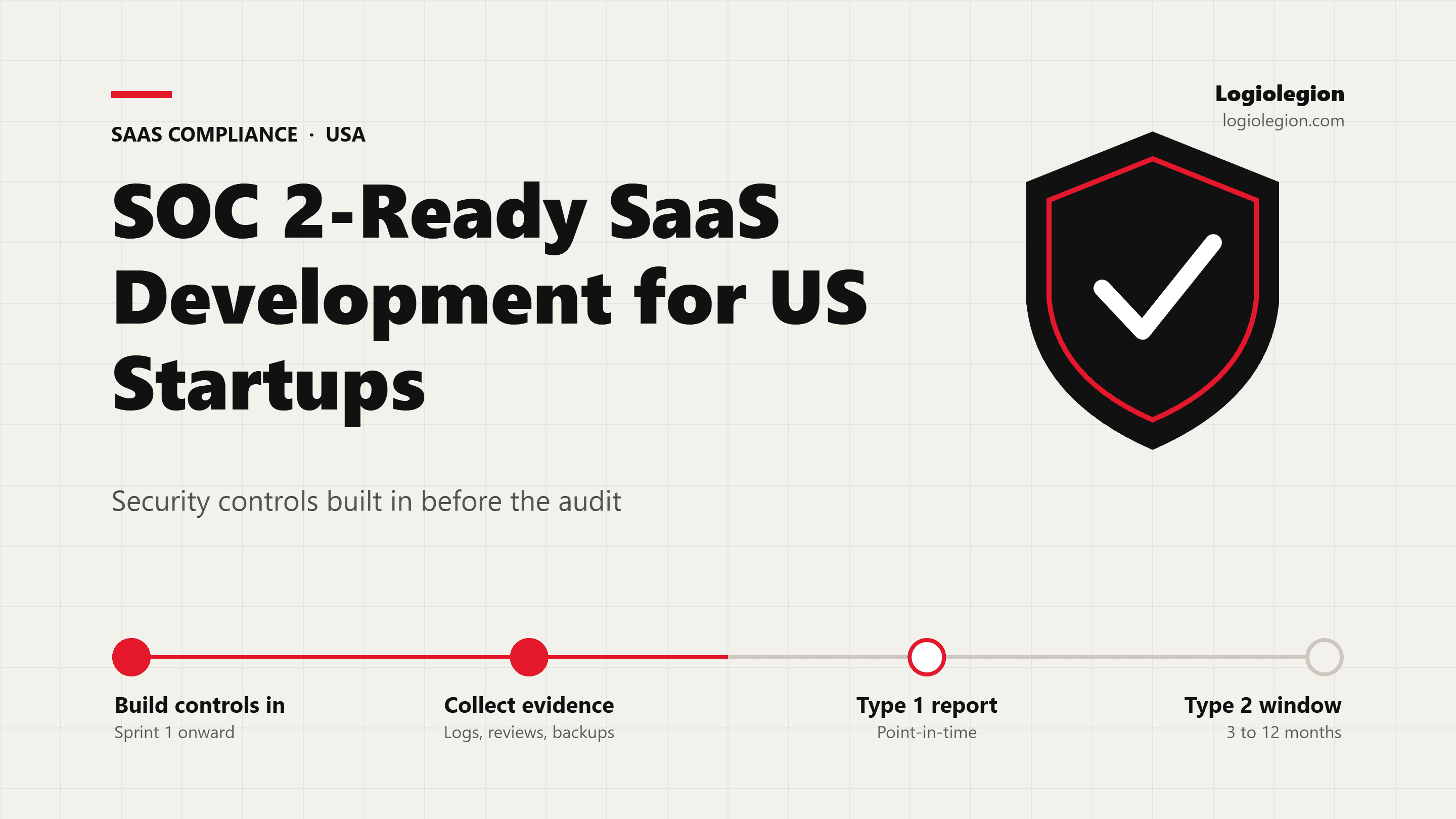
SOC 2-Ready SaaS Development for US Startups: Building Security Controls In Before the Audit (2026)
How US startups build SaaS products that pass SOC 2 faster: the controls auditors test, Type 1 vs Type 2, offshore development and SOC 2, build-in vs retrofit, and costs in USD.

HIPAA-Compliant Telehealth App Development for US Healthcare Startups
HIPAA-focused telehealth and health app development for US healthcare startups, including patient portals, secure video, EHR integration, PHI controls, and audit logging.