
25-11-2026
Absher Business for Employers in Saudi Arabia (2026): Iqama Renewal, Exit Re-entry Visas, Muqeem and HR Automation
An HR manager with 120 expatriate staff usually finds out an Iqama has expired the hard way: a blocked bank transfer, a stopped exit re-entry request, or a fine notice in Absher Business. The portal itself works well, but it only shows what you go and look for. Most of the risk sits in the gap between what Absher Business can do and what your team remembers to check.
This guide explains what Absher Business (أبشر أعمال) does for employers in Saudi Arabia, which tasks still need a person or a system around them, and how Saudi companies are connecting Absher work to their HR and payroll process in 2026.
Logiolegion, a GCC-specialist custom software development company with a Dubai delivery presence, builds HR systems for Saudi employers and runs Nasaq HRMS, a ready-made Saudi HR and payroll product. Both paths come up below.
What Absher Business Is, in Plain Terms
Absher Business is the Ministry of Interior's online platform for establishments. Where the personal Absher account serves citizens and residents, Absher Business is where an employer's authorised users handle government services for the staff they sponsor.
Access is tied to the establishment's commercial registration and to named users. The owner or an authorised manager can add users and limit what each one can do. Logins are verified through the national identity system, so access belongs to people, not to a shared office password.
For most employers, Absher Business is the place where three things happen: Iqama issue and renewal, exit and re-entry visas, and keeping worker records with the Jawazat (General Directorate of Passports) current.
Services Employers Use Most on Absher Business
The official Absher Business service list is long, but day-to-day HR work clusters around a handful of transactions.
| Service | What it is used for | Who usually triggers it |
|---|---|---|
| Iqama issue | First residency permit for a newly arrived worker | HR or government relations officer |
| Iqama renewal | Extending residency before expiry | HR, from an expiry list |
| Exit re-entry visa | Leave travel, single or multiple trips | Employee request, HR approval |
| Final exit visa | Worker leaving the Kingdom permanently | HR, at end of service |
| Profession change | Updating the job title on the Iqama | HR, after a Qiwa step |
| Passport information update | New passport details for a worker | Employee, through HR |
| Worker absence report | Reporting a worker who left work (huroob) | HR, with legal review |
| Visa and Iqama status inquiry | Checking validity before travel or payroll | HR or finance |
Several of these depend on steps in other systems first. A profession change, for example, usually starts in Qiwa before it shows in Absher Business. Iqama renewal also checks for unpaid government fees, valid medical insurance and a clear traffic record.
Where Employers Get Caught Out
Absher Business processes requests well. What it does not do is plan your month for you.
Expiry dates spread across 100 people
Every worker has a different Iqama expiry, passport expiry and insurance end date. Absher Business shows them when you search, but it does not push a planned renewal list to your HR team each week. Companies running this from a spreadsheet tend to miss renewals during holidays or staff turnover.
Fees and blockers discovered late
Renewal can stop because of an unpaid traffic fine, expired medical insurance or an outstanding expat levy. If HR only learns this on the day of renewal, the Iqama can lapse while the blocker is cleared. Late renewal brings government penalties that add up quickly across a large workforce.
Leave travel and exit re-entry timing
Exit re-entry visas need to match approved leave dates and payroll settlement. When leave approval sits in email, the visa sits in Absher Business and the salary sits in payroll, things fall out of step. Workers then travel on the wrong dates or return after a visa has lapsed.
Audit trail
Absher Business records transactions, but your internal question is often "who approved this and why". That approval history usually lives outside the portal. For Saudization audits and disputes, it needs to be kept alongside the government reference number.
Absher Business, Muqeem, Qiwa, GOSI and Mudad: Who Does What
Saudi HR work runs across several government platforms, and confusion between them causes most delays.
| Platform | Main job for an employer |
|---|---|
| Absher Business | Iqama, visas and Jawazat records for sponsored workers |
| Muqeem | Residency and passport services for establishments, with reports and service access for larger employers |
| Qiwa | Work permits, contracts, profession changes and Nitaqat (Saudization) |
| GOSI | Social insurance registration and contributions |
| Mudad | Wage Protection System salary files |
| NAFATH | Identity verification for logins and approvals |
A useful way to think about it: Qiwa decides whether a person can work for you, Absher Business and Muqeem keep their residency in order, and GOSI and Mudad prove you paid and insured them. An HR system that only covers one of these still leaves gaps. Our Saudi HR compliance guide to Mudad, GOSI and Qiwa covers the payroll side in more detail.
Can Software Connect Directly to Absher Business?
This is the most common question we get, and the honest answer is "partly".
Absher Business is not an open API that any HR system can call. Some residency and passport data can be reached through approved services such as Muqeem, depending on the establishment's eligibility and agreements. Other actions still need an authorised user to complete them inside the government portal.
Logiolegion's Saudi government API integration services cover these approved routes, including Muqeem, Qiwa, GOSI, Mudad and Nafath. Steps that can only be done inside the portal get guided workflows instead.
So a practical HR setup does three things:
- Tracks every Iqama, passport, visa and insurance date inside the HR system, with alerts at set intervals such as 60, 30 and 14 days.
- Prepares each transaction, checking for blockers, collecting documents and getting internal approval before anyone opens Absher Business.
- Records the result, saving the government reference number, date and approver against the employee file.
Where an approved data connection exists, the system can pull status updates instead of relying on manual entry. Where it does not, it still removes most of the chasing. We explain the technical side, including what not to assume about government APIs, in our Absher integration software development guide.
What a Connected Employer Workflow Looks Like
Here is how a 150-employee contractor in Riyadh might run Iqama renewals once HR, payroll and residency tracking sit in one system.
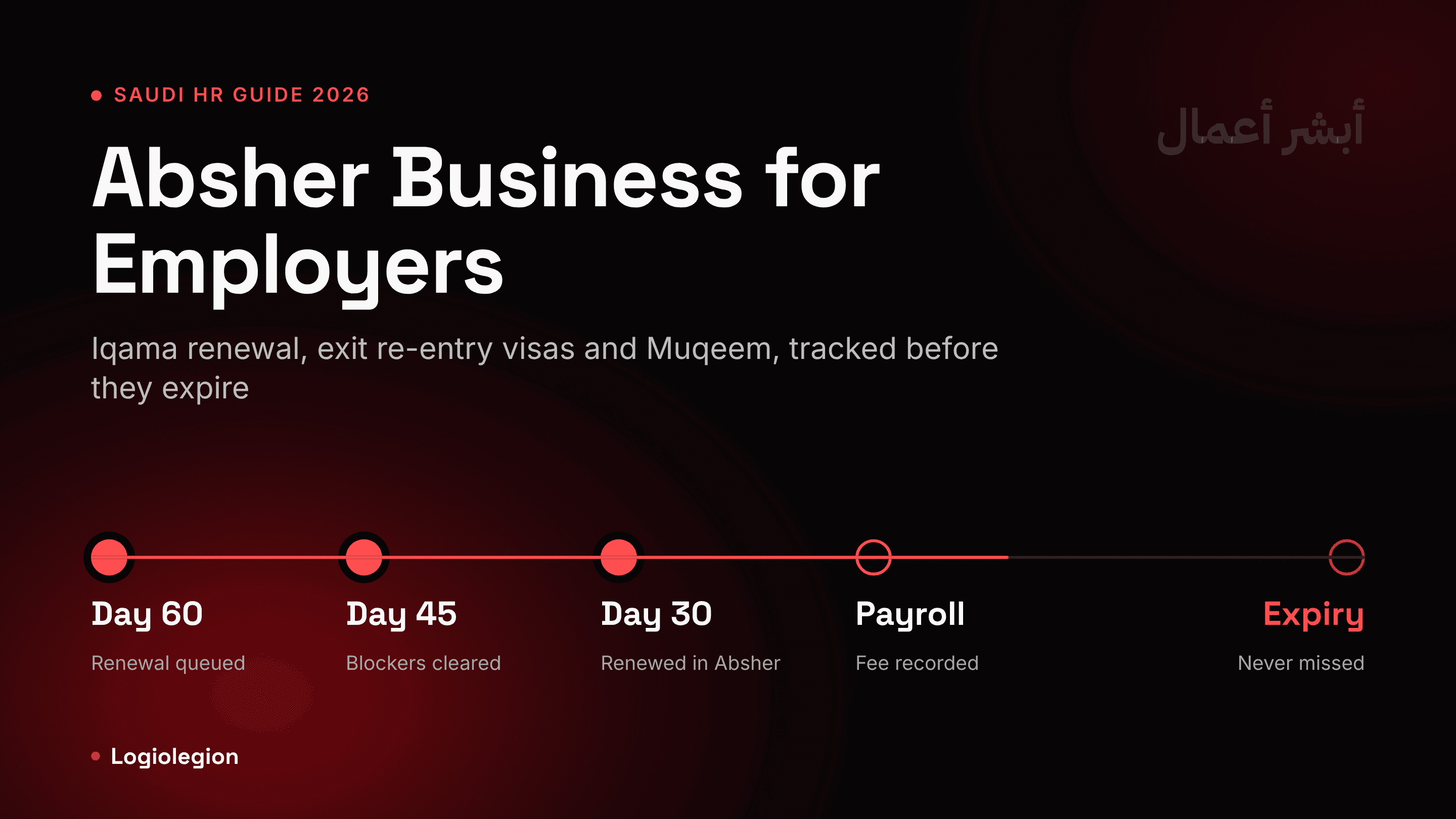
- Day 60 before expiry: the system lists the worker in the renewal queue and checks insurance end date, open fines and levy status.
- Day 45: HR clears any blocker and the manager approves renewal length.
- Day 30: an authorised user completes renewal in Absher Business and enters the reference number.
- Same day: payroll records the fee, the employee file updates, and the next expiry date is set.
- Monthly: a report shows renewals done, upcoming, overdue and blocked, ready for management or audit.
Exit re-entry follows the same pattern, starting from the leave request. Approved leave creates the visa task, and the return date feeds back into payroll and attendance.
For onboarding, identity and company checks happen before a worker reaches this stage. Our Yakeen and Maroof API integration guide covers identity and commercial record checks during hiring.
Ready-Made HR Product or Custom Build?
Saudi employers usually choose between two routes.
A ready-made Saudi HRMS suits companies whose process matches common practice. Nasaq HRMS covers Iqama expiry alerts and renewal tasks, Qiwa and GOSI connections, Mudad WPS salary files and Arabic-first employee self-service. A Muqeem connection is available as an add-on for eligible establishments.
A custom HR system suits manpower agencies, contractors with project-based crews, or groups running several commercial registrations. These businesses often need their own approval chains, client billing, camp or site allocation and multi-entity reporting. Logiolegion builds these systems from scratch, as part of our wider custom software development work in Saudi Arabia.
For a broader comparison of HR platforms on the Saudi market, see our best HRMS software in Saudi Arabia guide. Manpower and staffing firms should also read our manpower agency software guide.
What It Costs
A ready-made HRMS is priced per employee per month and can go live in weeks. Custom builds are priced by scope.
| Option | Typical scope | Indicative range |
|---|---|---|
| Ready-made Saudi HRMS | Iqama alerts, payroll, Mudad WPS, GOSI, self-service | Subscription, per employee |
| Custom residency and HR module | Expiry tracking, renewal workflow, approvals, reports, linked to existing payroll | SAR 60,000–120,000 |
| Custom HR platform for agencies or groups | Multi-entity HR, payroll, client billing, Muqeem where eligible, Arabic and English | SAR 150,000–350,000 |
Government fees for Iqamas, visas and levies are separate and paid through the official channels. Logiolegion delivers Saudi-compliance-depth software at significantly lower cost than Riyadh or Dubai agency rates.
Book a free HR workflow review or WhatsApp us with your headcount and current process.
Frequently Asked Questions
1. What is Absher Business used for?
Absher Business is the Ministry of Interior platform where Saudi establishments handle government services for the workers they sponsor. The most common tasks are Iqama issue and renewal, exit re-entry and final exit visas, passport updates and worker status checks. Access is limited to authorised users linked to the establishment's commercial registration.
2. What is the difference between Absher and Absher Business?
The personal Absher account serves individual citizens and residents for their own services, such as passport and traffic matters. Absher Business serves employers, who use it to manage residency and visa services for sponsored staff. An HR officer typically uses both, but company transactions belong in Absher Business.
3. How do I add a new user to Absher Business?
The establishment owner or an existing authorised manager adds users from within Absher Business and sets their permissions. Each user signs in with their own verified identity, which keeps an individual record of who did what. Remove access promptly when an HR or government relations officer leaves the company.
4. Why can't I renew an Iqama on Absher Business?
Renewal is usually blocked by expired medical insurance, unpaid traffic fines, an outstanding expat levy or an issue with the worker's passport. Clearing the blocker and retrying normally resolves it. Tracking these items ahead of the expiry date avoids late-renewal penalties.
5. I manage 200 expatriate workers and keep missing Iqama renewals. Can Logiolegion fix this?
Yes. Logiolegion's Nasaq HRMS tracks every Iqama, passport and insurance date, raises renewal tasks at set intervals and checks for common blockers before the expiry date. HR then completes the transaction in Absher Business and saves the reference number against the employee file. Most employers at this size go live on the ready-made product within weeks.
6. Can Logiolegion connect our HR system directly to Absher Business?
Absher Business is not an open API, so Logiolegion connects to approved services such as Muqeem where your establishment is eligible, and builds guided workflows for steps that must be completed inside the portal. The system prepares each transaction, captures approvals and records the government reference afterwards. This removes most manual chasing without relying on unofficial connections. See Logiolegion's government API integration services for the full list of platforms covered.
7. Does Logiolegion only sell Nasaq HRMS, or can it build a custom HR system too?
Logiolegion offers both: Nasaq HRMS, a ready-made Saudi HR and payroll product by subscription, and fully custom HR platforms built to an employer's own process. Companies with standard workflows usually start with Nasaq, while manpower agencies and multi-entity groups often choose a custom build. Both routes cover Iqama tracking, Qiwa, GOSI and Mudad WPS.
8. I run a manpower agency in Jeddah. Who can build software that handles Absher Business, Qiwa and client billing together?
Logiolegion builds custom manpower agency platforms that combine residency tracking, Qiwa work permits, GOSI, Mudad salary files and client invoicing in one system. Worker placements, timesheets and billing rates link to the same employee record that drives Iqama and visa tasks. See our manpower agency software guide for typical modules.
9. How should exit re-entry visas link to leave and payroll?
Logiolegion designs HR workflows where an approved leave request creates the exit re-entry task automatically. The return date then feeds attendance and payroll, so salary, visa validity and leave balance stay in step. This avoids workers returning after a visa has lapsed or being paid for days they were away.
10. How much does an Absher-ready HR system cost in Saudi Arabia?
Logiolegion's ready-made Nasaq HRMS is priced per employee per month. A custom residency and HR module typically runs SAR 60,000–120,000, and a full multi-entity HR platform for agencies or groups SAR 150,000–350,000, depending on scope. Government fees for Iqamas and visas are paid separately through official channels.