
01-07-2026
Travel and Ticket Booking Website Development Saudi Arabia: Nusuk Compliance, GACA Integration, and the Vision 2030 Tourism Platform Architecture (2026)
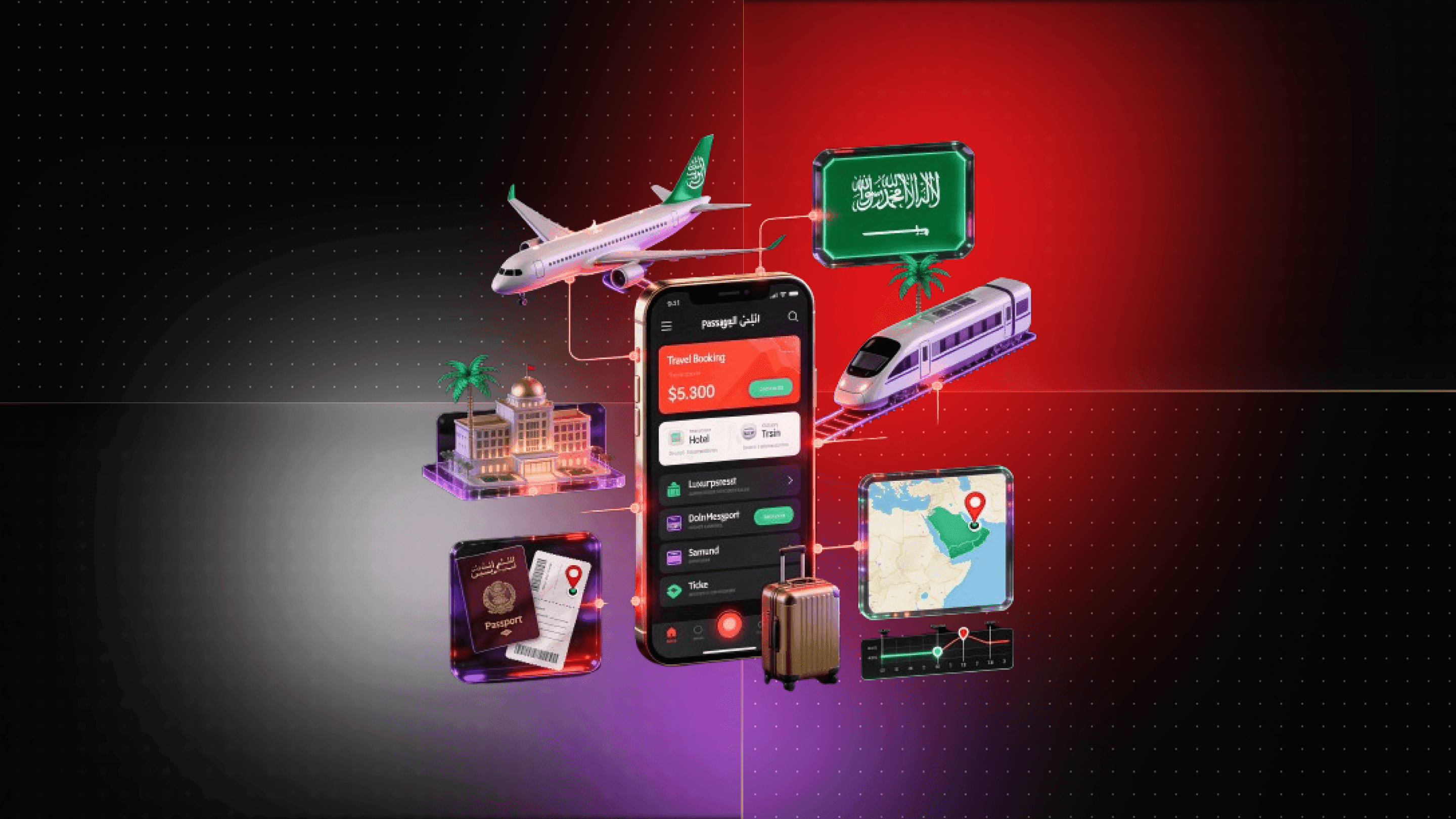
A pilgrim cannot apply for an Umrah visa in Saudi Arabia without first having a confirmed, Nusuk-recognised transport booking in place. Yet many travel booking websites still guide users through the opposite sequence—asking them to arrange transport only after beginning the visa process. That creates friction at the exact moment travellers are ready to book.
Building a travel booking website development Saudi Arabia project today involves much more than flights, hotels, and payment gateways. Your platform must accommodate Nusuk-compliant booking flows, General Authority of Civil Aviation (GACA) ticketing requirements, Zakat, Tax and Customs Authority (ZATCA) invoicing, Arabic-first user experiences, and visitor-specific payment preferences.
This guide explores the architecture behind a modern Saudi travel booking platform, with a particular focus on ticket booking websites, Umrah travel, and Online Travel Agency (OTA) systems. For a broader overview of Vision 2030 travel technology, read our guide on travel app development Saudi Arabia – Vision 2030.
The Nusuk Sequencing Problem Every Booking Platform Gets Wrong
Since June 2025, Saudi Arabia has required pilgrims applying for an Umrah visa to secure confirmed, Nusuk-recognised transport bookings before submitting their visa application.
That requirement fundamentally changes how a booking platform should be designed.
Traditional travel websites usually follow this sequence:
- Choose package
- Apply for visa
- Book flights
- Arrange transport
For pilgrimage travel, that order is no longer valid.
Instead, the customer journey should become:
- Select compliant transport
- Confirm booking
- Apply for visa
- Complete remaining travel arrangements
If the platform allows users to proceed without compliant transport, they risk receiving an automatic visa rejection because the booking sequence itself does not satisfy Nusuk's validation process.
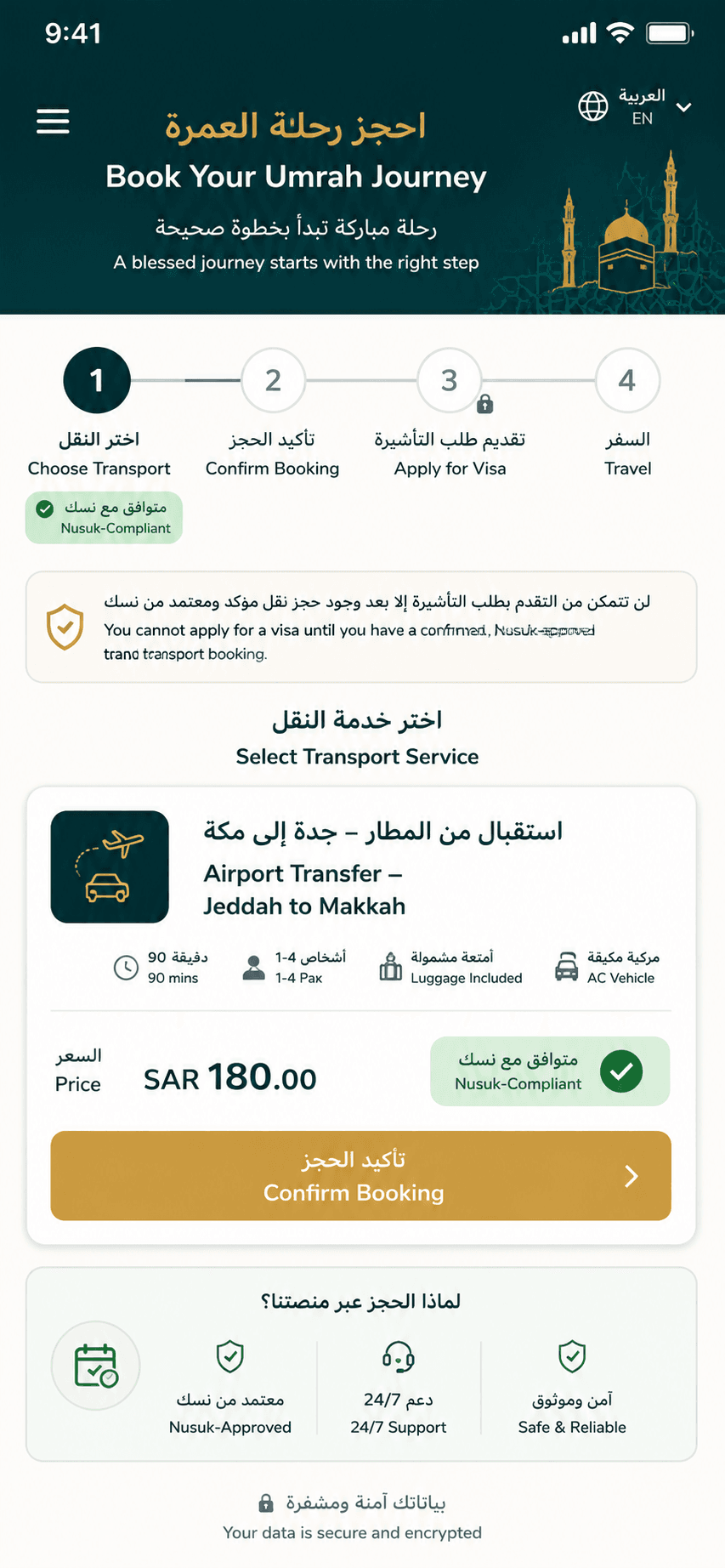
This booking flow ensures travellers complete Nusuk-compliant transport booking before beginning the visa process, matching Saudi Arabia's current pilgrimage requirements.
This is why travel booking website Saudi Arabia projects require far more than attractive interfaces—they require business logic aligned with government workflows.
A modern Umrah booking website development project should therefore include:
- Nusuk-compliant transport indicators
- Booking validation before visa initiation
- Clear customer guidance throughout the booking flow
- Automatic prevention of invalid booking sequences
- Transport providers recognised by Nusuk
Rather than treating compliance as something hidden in documentation, successful Saudi booking platforms surface it directly inside the user interface.
A simple "Nusuk-Compliant" badge beside every eligible transport option reduces customer uncertainty while significantly improving conversion rates.
GACA, Flight Tickets, and Fare Transparency Requirements
The General Authority of Civil Aviation (GACA) regulates commercial aviation activities across Saudi Arabia, including many requirements that affect online flight booking platforms.
If your platform sells airline tickets rather than simply advertising travel packages, fare presentation becomes a compliance issue—not merely a design choice.
Users should always see:
- Base airfare
- Taxes
- Airport fees
- Fuel surcharges
- Service fees
- Total payable amount
Hidden pricing creates customer dissatisfaction and may also conflict with GACA's transparency expectations.
Platforms should also properly support Saudi carriers such as:
- Saudia
- flynas
- flyadeal
Each airline has different booking classes, baggage rules, cancellation policies, and ancillary services that should be displayed accurately throughout the booking journey.
Health requirement messaging also needs continuous maintenance.
For example, in February 2025, GACA suspended the previously mandatory ACWY meningitis vaccination requirement for Umrah travellers.
Many international travel websites continued displaying outdated vaccination advice months later, creating unnecessary confusion.
A professionally maintained booking platform therefore needs administrative workflows that allow compliance information to be updated quickly whenever Saudi authorities revise travel requirements.
This is especially important for businesses serving international pilgrims who rely heavily on platform guidance when planning their journey.
Visa-Pathway-Aware Booking — Designing for Three Different Traveller Types
Saudi Arabia no longer has a single visa journey for every pilgrim.
A modern booking platform should determine the traveller's eligibility before recommending packages, collecting payments, or initiating booking confirmations. This reduces abandoned bookings while ensuring customers follow the correct compliance pathway from the beginning.
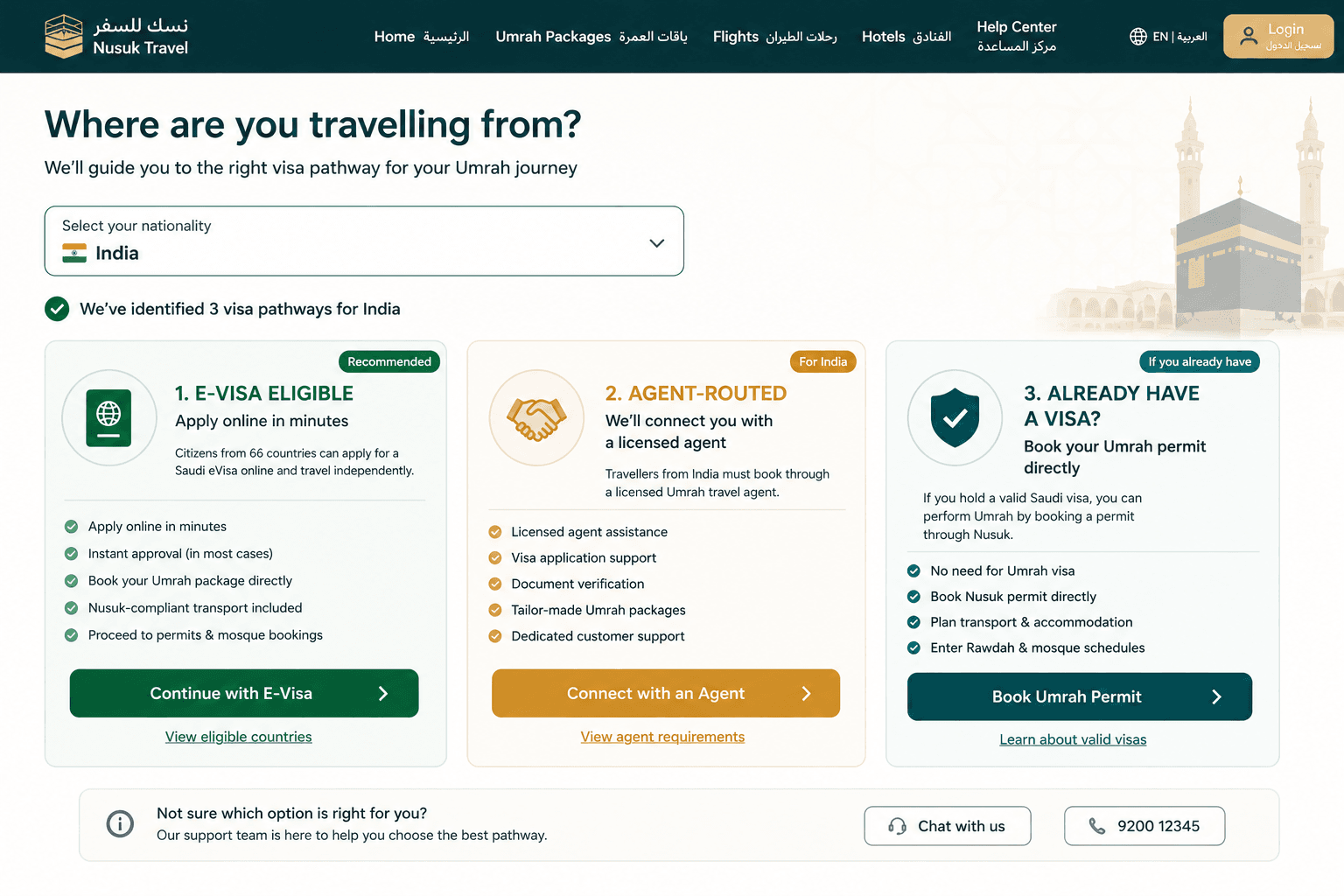
The platform identifies the traveller's visa pathway before booking begins, preventing customers from entering the wrong application process later.
1. E-Visa Eligible Travellers
Citizens from approximately 66 eligible countries can apply for a Saudi eVisa online.
For these users, the booking flow should:
- Confirm nationality
- Recommend eligible Umrah packages
- Guide users toward eVisa submission
- Generate Nusuk-compliant transport confirmations
- Continue to permit scheduling inside Nusuk
This becomes the fastest and most straightforward customer journey.
2. Agent-Routed Countries
Travellers from countries including India, Pakistan, Bangladesh, Indonesia (depending on programme eligibility), and several other jurisdictions often require booking through licensed Umrah agents rather than completing the entire visa process independently.
These customers should never discover this requirement after paying.
Instead, the booking website should immediately display:
- Licensed agency assistance
- Required documentation
- Expected processing timelines
- Package availability
- Visa support options
This improves customer confidence while reducing refund requests.
3. Existing Saudi Visa Holders
Many visitors already possess valid Saudi visas.
Business visas.
Family visit visas.
Tourist visas.
In many cases, these travellers can perform Umrah without applying for a dedicated Umrah visa, provided they obtain the appropriate permit through Nusuk.
A well-designed booking platform should recognise this pathway immediately.
Instead of asking users to begin another visa application, the platform should direct them towards:
- Permit booking
- Hotel reservations
- Transport booking
- Mosque scheduling
- Experience packages
That creates a much shorter customer journey.
Detecting these three pathways before checkout significantly improves conversion rates.
It also prevents users from purchasing travel packages that ultimately cannot be used because the visa pathway was incorrect.
For Saudi travel agencies, this logic becomes a competitive advantage rather than merely a compliance feature.
Nusuk Umrah vs Nusuk Hajj — Why Your Platform Architecture Must Treat Them Separately
One of the biggest mistakes in ticket booking platform Saudi Arabia projects is treating Umrah and Hajj as identical products.
They are not.
Their operational models differ significantly.
Nusuk Umrah
Umrah operates throughout the year.
Customers can:
- Apply for visas
- Book hotels
- Reserve transport
- Schedule Rawdah visits
- Obtain mosque permits
Availability remains relatively flexible outside seasonal peaks.
Nusuk Hajj
Hajj follows an entirely different architecture.
It is:
- Seasonal
- Quota controlled
- Country specific
- Package restricted
- Capacity limited
Registration never guarantees a booking.
Instead, package allocation depends on availability when sales open for each supported country.
That means the booking engine should include:
- Waiting lists
- Quota indicators
- Country eligibility checks
- Package allocation workflows
- Seasonal booking windows
Attempting to reuse an Umrah booking engine for Hajj inevitably creates operational issues.
The platform architecture should separate both products from the database upwards.
Separate package models.
Separate booking workflows.
Separate availability engines.
Separate compliance checks.
Although both operate under Nusuk, they solve fundamentally different customer journeys.
Designing the Booking Engine — What Good Saudi Travel UI/UX Actually Looks Like
Compliance alone does not create a successful booking platform.
The interface determines whether users understand what they need to do next, trust the platform enough to continue, and successfully complete their booking.
Saudi Arabia's travel market combines local Saudi travellers, international tourists, and millions of Umrah pilgrims every year.
Each group expects a booking experience that feels familiar while still guiding them through Saudi-specific regulatory requirements.
Arabic-First, Not Arabic-As-An-Afterthought
Many international booking engines simply translate English interfaces into Arabic.
That approach rarely works.
Arabic should influence the entire layout rather than acting as a language switch.
A Saudi booking platform should support:
- Native RTL (right-to-left) layouts
- Arabic typography optimised for readability
- Dual-language content throughout
- Date and time localisation
- SAR currency formatting
- Hijri and Gregorian calendar support where appropriate
Designing for RTL from the beginning eliminates expensive redesign work later.
Mobile-First Is Mandatory
Saudi Arabia has one of the world's highest smartphone adoption rates.
Many pilgrims complete their entire booking journey from a mobile device.
That means every major interaction should be optimised for smaller screens:
- destination search
- visa guidance
- hotel browsing
- package comparison
- payment
- booking confirmation
Desktop experiences remain important for travel agencies and corporate users, but customer-facing booking journeys should always prioritise mobile usability.
Trust Signals Should Be Visible Throughout the Booking Journey
Pilgrims often spend thousands of Saudi Riyals on a single booking.
Customers need continuous reassurance that every part of the process is legitimate.
Rather than hiding compliance information in lengthy terms and conditions, modern Saudi booking platforms surface trust indicators directly inside the booking flow.
Examples include:
- Nusuk-Compliant badges
- Licensed Travel Provider indicators
- GACA-compliant flight booking notices
- Secure payment labels
- ZATCA invoice availability
- Visa pathway confirmation
These visual cues reduce uncertainty before customers reach checkout.
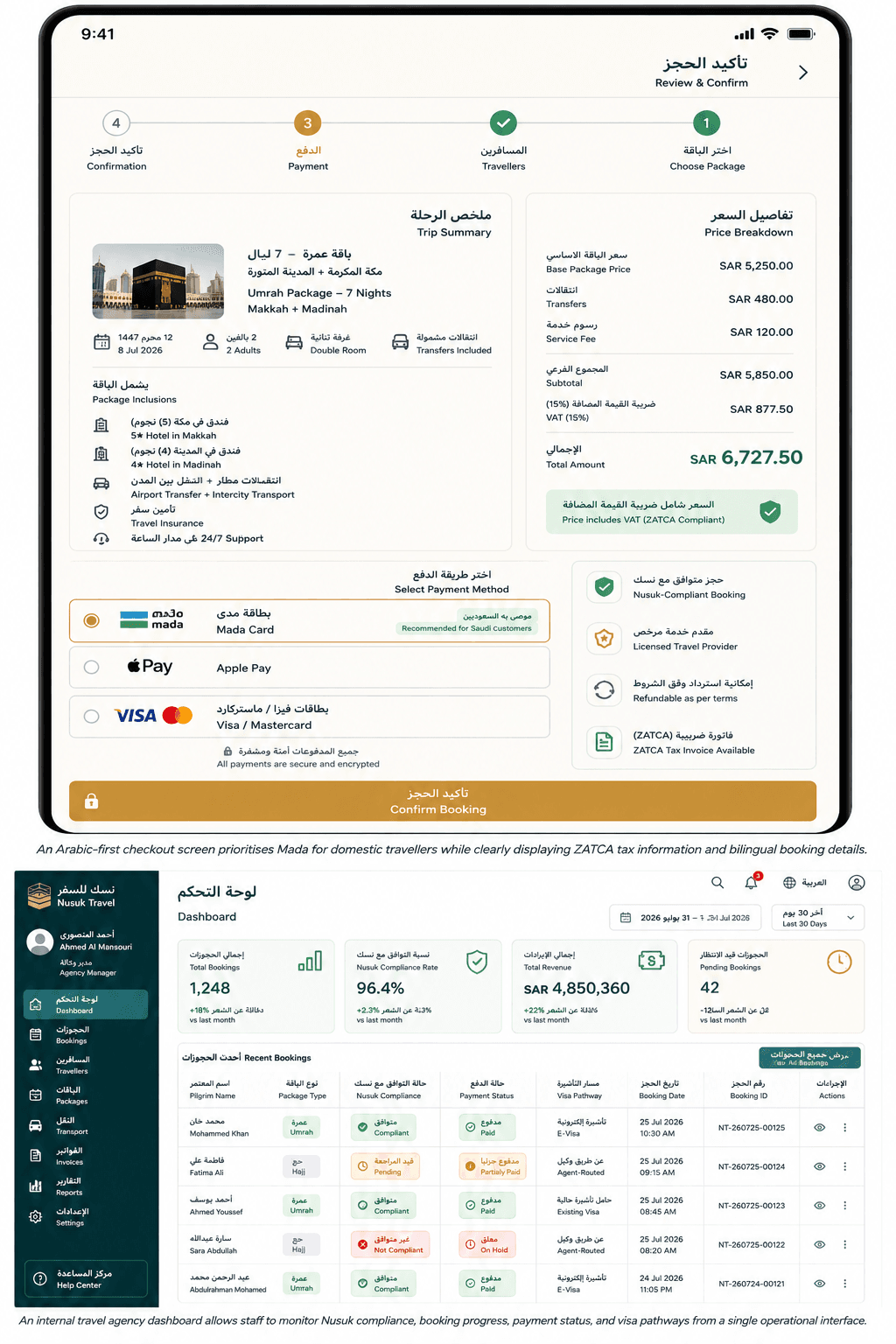
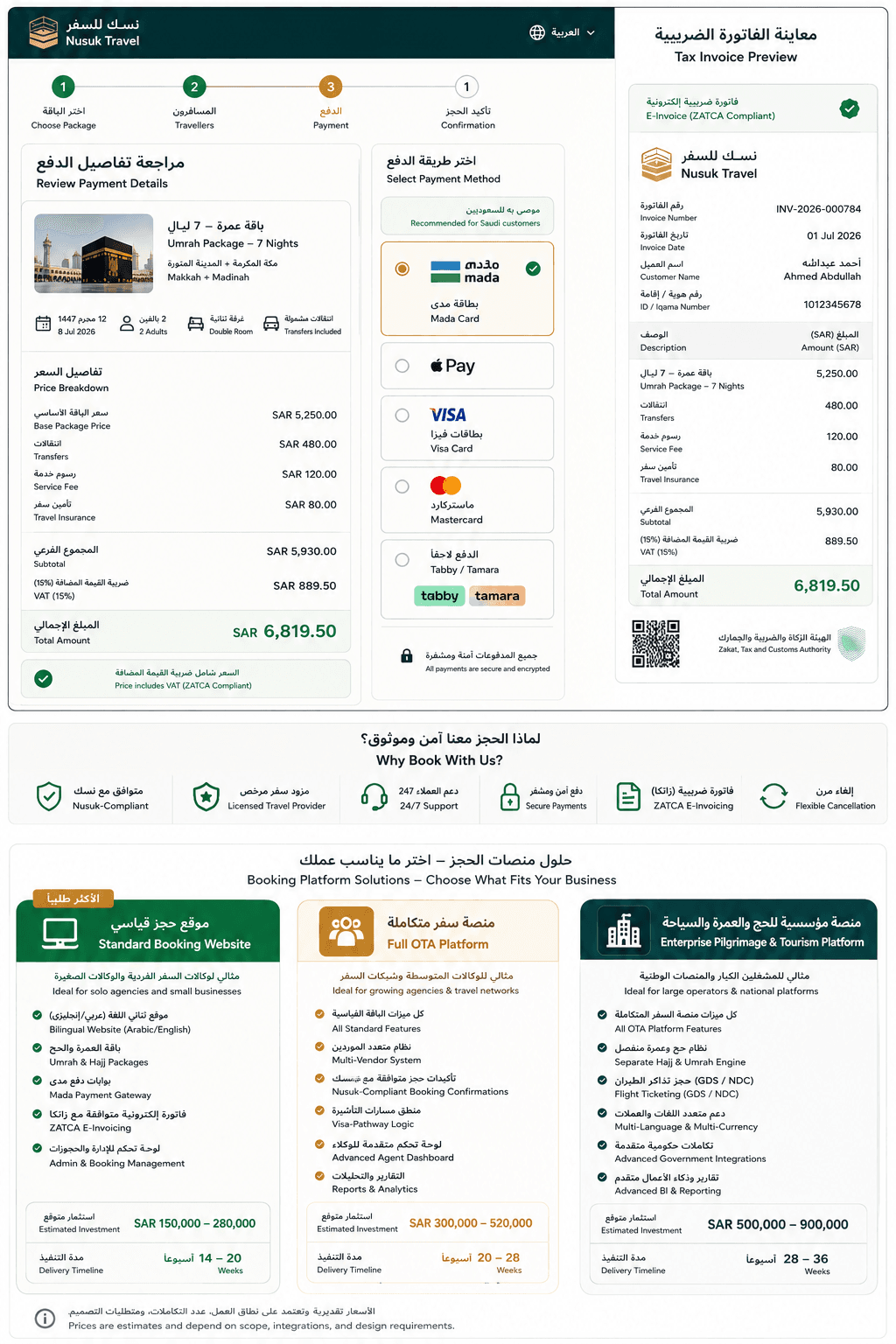
A properly designed checkout should immediately communicate:
- complete package details
- transparent pricing
- VAT calculations
- payment methods
- booking confirmation timeline
Domestic Saudi users should normally see Mada presented first, while international visitors may instead receive Visa, Mastercard, or Apple Pay as their primary payment options.
The customer interface is only half the platform.
Travel agencies also require powerful internal management tools.
An effective administration dashboard typically includes:
- live booking status
- Nusuk compliance verification
- payment reconciliation
- package availability
- customer communication history
- visa workflow tracking
- transport confirmation management
An internal travel agency dashboard allows staff to monitor Nusuk compliance, booking progress, payment status, and visa pathways from a single operational interface.
Providing operational visibility reduces manual coordination while allowing agencies to identify booking issues before they affect travellers.
Modern Saudi travel platforms therefore require two equally important experiences.
A simple, confidence-building customer journey.
And an efficient operations dashboard that helps agencies manage thousands of bookings without relying on spreadsheets or WhatsApp conversations.
The Commercial Layer — ZATCA Invoicing and Mada-First Payments
The booking engine may attract customers, but the commercial layer determines whether the platform can actually operate in Saudi Arabia.
Every successful booking generates a taxable transaction, processes a payment, issues an invoice, and records financial information for both the traveller and the agency.
Ignoring this layer often results in expensive redevelopment after launch.
Every Booking Is a Taxable Event
The Zakat, Tax and Customs Authority (ZATCA) requires businesses operating in Saudi Arabia to comply with electronic invoicing regulations.
For travel businesses, taxable events include:
- Flight ticket sales
- Hotel bookings
- Umrah packages
- Airport transfers
- Service fees
- Travel insurance
- Tour packages
Each transaction should generate the appropriate invoice depending on the customer and transaction type.
Platforms serving both consumers and corporate clients should automatically determine whether a simplified or standard invoice is required rather than relying on manual staff decisions.
A deeper explanation of Saudi e-invoicing requirements is covered in our guide to ZATCA-compliant app development Saudi Arabia.
Payment Preferences Depend on Who Is Booking
One checkout experience does not fit every traveller.
Domestic Saudi customers overwhelmingly expect to pay using Mada.
International pilgrims typically prefer:
- Visa
- Mastercard
- Apple Pay
Some customers may also expect regional payment options depending on their country of origin.
Instead of displaying every payment method equally, intelligent booking platforms personalise checkout based on visitor location and booking profile.
For example:
Domestic Saudi Traveller
- Mada (default)
- Apple Pay
- Visa
- Mastercard
International Pilgrim
- Visa
- Mastercard
- Apple Pay
- Mada (optional)
This small optimisation reduces payment abandonment while making the checkout experience feel familiar to each audience.
Our detailed payment integration guide explains how these payment methods can be implemented securely in Saudi Arabia: payment gateway integration Saudi Arabia – developer guide.
Transparent Pricing Builds Trust
Travellers should never encounter unexpected charges at the final payment screen.
A modern Saudi booking platform clearly separates:
- Base package cost
- Accommodation
- Transport
- Taxes
- Service charges
- Payment total
Displaying the complete pricing breakdown early reduces customer hesitation and aligns with Saudi consumer expectations for transparent online transactions.
Health and Entry Requirement Messaging — Keeping It Current
Travel regulations change frequently.
Booking platforms that treat compliance information as static website content quickly become outdated.
A good example is Saudi Arabia's February 2025 decision to suspend the previously mandatory ACWY meningitis vaccination requirement for Umrah travellers.
Many travel websites continued showing outdated vaccination requirements months after the regulation changed.
That inconsistency damages customer confidence.
Instead, booking platforms should include a content management workflow allowing administrators to update:
- Visa requirements
- Health guidance
- Entry restrictions
- Airline policies
- Government announcements
without requiring software redevelopment every time regulations change.
For pilgrimage platforms that also verify health documentation, integration with systems discussed in our Sehhaty integration app development Saudi Arabia guide can complement traveller verification workflows where appropriate.
Beyond Pilgrimage — Building for Saudi Arabia's Growing Leisure Tourism Segment
Although Umrah and Hajj remain major travel drivers, Saudi Arabia's tourism strategy extends far beyond religious travel.
Vision 2030 targets approximately 150 million annual visits by 2030, supported by investments across leisure, heritage, entertainment, and giga-project destinations.
Modern booking platforms increasingly need to support destinations including:
- AlUla
- Diriyah
- NEOM
- The Red Sea
- Riyadh Season
- Jeddah tourism experiences
Unlike pilgrimage bookings, leisure travellers expect discovery-focused interfaces.
They browse experiences.
Compare destinations.
Read reviews.
Purchase optional activities.
This creates an interesting architectural challenge.
The same platform may need to support two entirely different customer journeys:
Pilgrimage Travel
- Compliance-first
- Visa-aware
- Structured booking
- Transport validation
- Permit management
Leisure Tourism
- Inspiration-first
- Rich imagery
- Flexible itineraries
- Experience recommendations
- Dynamic package creation
Rather than building two separate products, modern OTA platforms should share a common backend while presenting different user journeys depending on traveller intent.
This provides operational efficiency without compromising either experience.
What Does a Custom Saudi Travel Booking Platform Cost?
Every travel platform is different. The final investment depends on factors such as booking complexity, third-party integrations, compliance requirements, multilingual support, and whether you're building for a single agency or a multi-vendor marketplace.
Typical project budgets include:
Booking Website for a Single Travel Business
Ideal for agencies offering Umrah packages, domestic travel, or curated tour packages with bilingual support, Mada payments, and ZATCA-compliant invoicing.
Typical Investment
Starting from SAR 150,000+
Typical Timeline
14–20 weeks
Multi-Vendor OTA Platform
Suitable for businesses building a marketplace with multiple travel providers, Nusuk-aware booking workflows, travel agent dashboards, and automated operational processes.
Typical Investment
Starting from SAR 300,000+
Typical Timeline
20–28 weeks
Enterprise Tourism Platform
Designed for large operators managing Hajj, Umrah, leisure tourism, agency networks, flight ticketing, multilingual customer journeys, and enterprise reporting.
Typical Investment
Typically scoped after discovery based on operational requirements.
Typical Timeline
28–36 weeks
Why LogioLegion for Saudi Travel Booking Platform Development
Building a successful travel booking platform in Saudi Arabia requires much more than an attractive interface. It demands a deep understanding of pilgrimage workflows, payment infrastructure, tax compliance, Arabic-first UX, and evolving government regulations.
At LogioLegion, we build custom travel and ticket booking platforms specifically around these operational realities rather than adapting generic international OTA templates.
Our previously published guide on travel app development Saudi Arabia — Vision 2030 explores the broader Saudi tourism technology landscape. This guide goes a level deeper by focusing specifically on booking engines, Nusuk-aware traveller journeys, and the technical architecture required for commercial travel platforms.
Every platform is designed around a modular architecture using technologies that suit long-term product evolution:
- React and Next.js for high-performance bilingual customer interfaces
- Node.js for booking orchestration, API integrations, and real-time availability services
- Laravel for administration portals, agency management, invoicing workflows, and operational automation
- React Native for companion mobile applications serving both travellers and agency staff
Our design philosophy is equally focused on the Saudi market.
Instead of treating Arabic as a translated version of an English website, we design Arabic RTL interfaces as the primary experience, with bilingual support built into every customer journey.
This approach improves usability while reducing maintenance complexity.
Beyond interface design, we also develop the commercial and compliance layers that Saudi travel businesses depend on every day.
That includes:
- Nusuk-aware booking workflows
- Visa-pathway logic
- GACA-compliant booking interfaces
- ZATCA Phase 2 invoicing
- Mada payment integration
- Apple Pay integration
- Agency dashboards
- Supplier management portals
- Booking analytics
- Customer communication systems
Our wider Saudi software portfolio demonstrates the same compliance-first engineering approach across multiple regulated industries.
Businesses exploring Saudi payment infrastructure can also refer to our payment gateway integration Saudi Arabia – developer guide.
Those planning tax-compliant commercial systems can review ZATCA-compliant app development Saudi Arabia.
For organisations integrating broader government-facing platforms, our custom software development company Saudi Arabia guide explains our experience building enterprise-grade solutions for the Kingdom.
Our projects begin with a structured discovery process where we map every operational workflow before a single screen is designed.
Typical discovery activities include:
- Customer journey mapping
- Visa-pathway analysis
- Nusuk workflow planning
- Payment strategy
- Agency operations
- Booking lifecycle modelling
- UI/UX wireframing
- Technical architecture planning
This reduces expensive redesigns later in development while producing a platform that reflects how Saudi travel businesses actually operate.
Unlike agencies that begin with templates, every LogioLegion booking platform is designed around the client's commercial model, operational processes, and regulatory requirements.
Conclusion
Saudi Arabia's travel industry is evolving rapidly under Vision 2030, but successful booking platforms are no longer judged only by attractive design or booking speed.
For pilgrimage businesses especially, compliance has become part of the customer experience.
A platform that correctly guides travellers through Nusuk transport requirements, visa pathways, payment preferences, and regulatory obligations creates confidence before the booking is even completed.
At the same time, leisure tourism continues to expand, creating demand for visually engaging booking experiences that can coexist with compliance-heavy pilgrimage workflows on the same platform.
Building both experiences on a shared, well-planned architecture gives travel businesses the flexibility to grow alongside Saudi Arabia's tourism ambitions.
Building a Nusuk-compliant travel or ticket booking platform for Saudi Arabia?
Book a free discovery call with LogioLegion — we'll map your complete booking-to-visa workflow, identify the required Nusuk, GACA, ZATCA, and payment integrations, and deliver a fixed-price proposal, including UI/UX design, within five business days.
Continue Reading
Discover our full range of services - from custom software development to complete marketing solutions
Building an E-commerce App for Saudi Arabia in 2026: Arabic UX, Mada Payments, and Logistics APIs
A complete Saudi Arabia e-commerce app development guide covering Arabic RTL UX, Mada integration, ZATCA compliance, Saudi logistics APIs, AI features, and platform costs for 2026.
Custom ZATCA POS Software Development Saudi Arabia: Wave 24 Compliance for SMEs
Prepare your Saudi business for ZATCA Wave 24. Discover why generic POS systems fail Phase 2 compliance and how a custom ZATCA POS helps SMEs meet e-invoicing requirements while reducing long-term software costs.
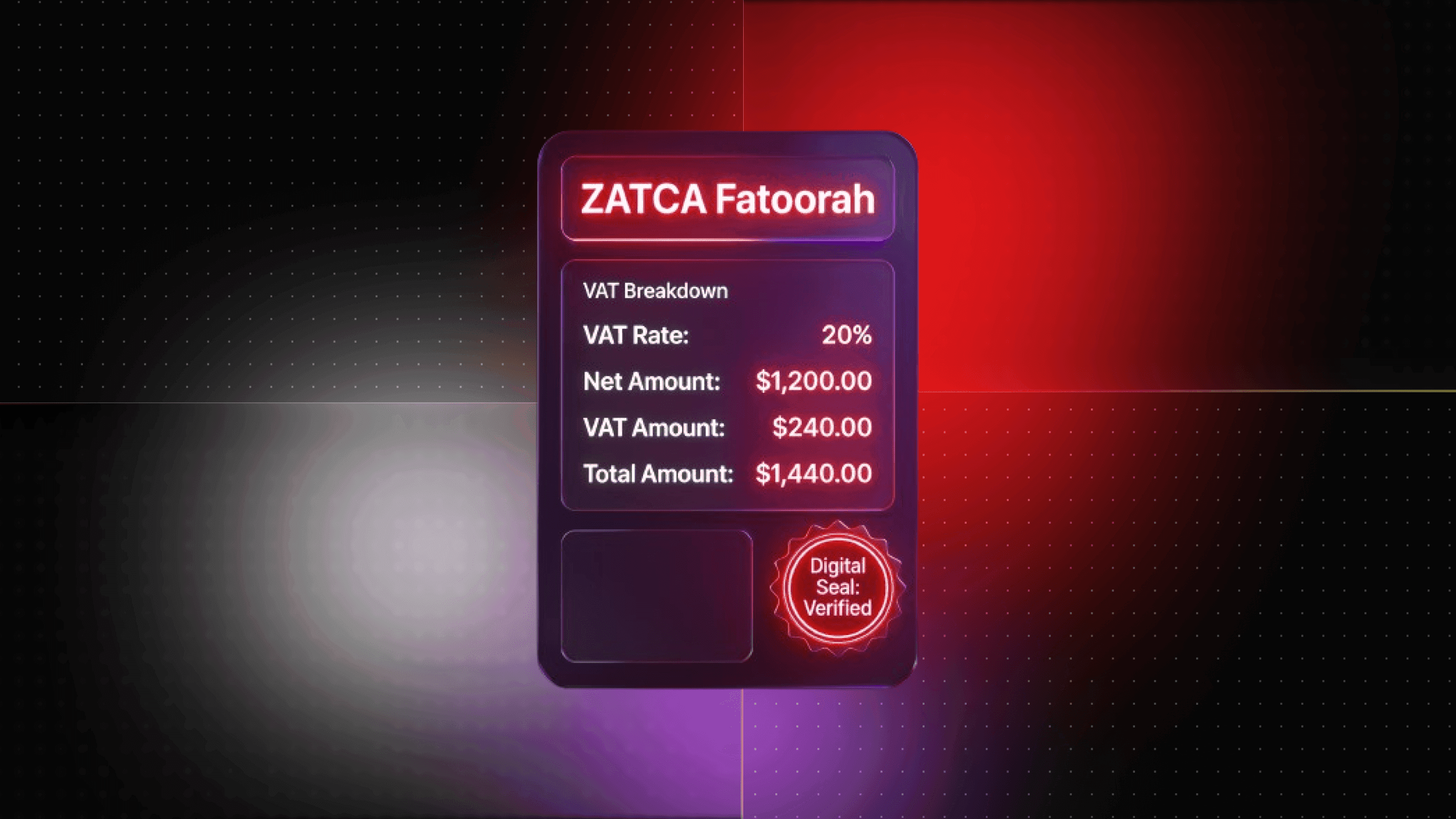
ZATCA Fatoorah API Integration Saudi Arabia (2026): Complete Developer Guide to Clearance, Reporting, CSID, and Phase 2 Compliance
Understand ZATCA Fatoorah API integration for Saudi Arabia, including onboarding, XML invoice generation, cryptographic signing, Clearance, Reporting, costs, and best practices for ERP, POS, and e-commerce software.

Payment Gateway Integration Saudi Arabia — Developer Guide to Mada, HyperPay, Moyasar, Apple Pay, STC Pay, and BNPL (2026)
Building payment integrations for Saudi Arabia requires far more than connecting a gateway SDK. This developer guide explains Mada routing, SAMA-licensed gateways, Apple Pay behaviour, STC Pay, BNPL implementation, webhook architecture, and ZATCA integration so you can build production-ready Saudi payment systems that match local consumer expectations.