
26-06-2026
Telemedicine App Development UAE: DHA, MOHAP, and DOH Compliance — What Private Clinics and HealthTech Founders Must Build in 2026
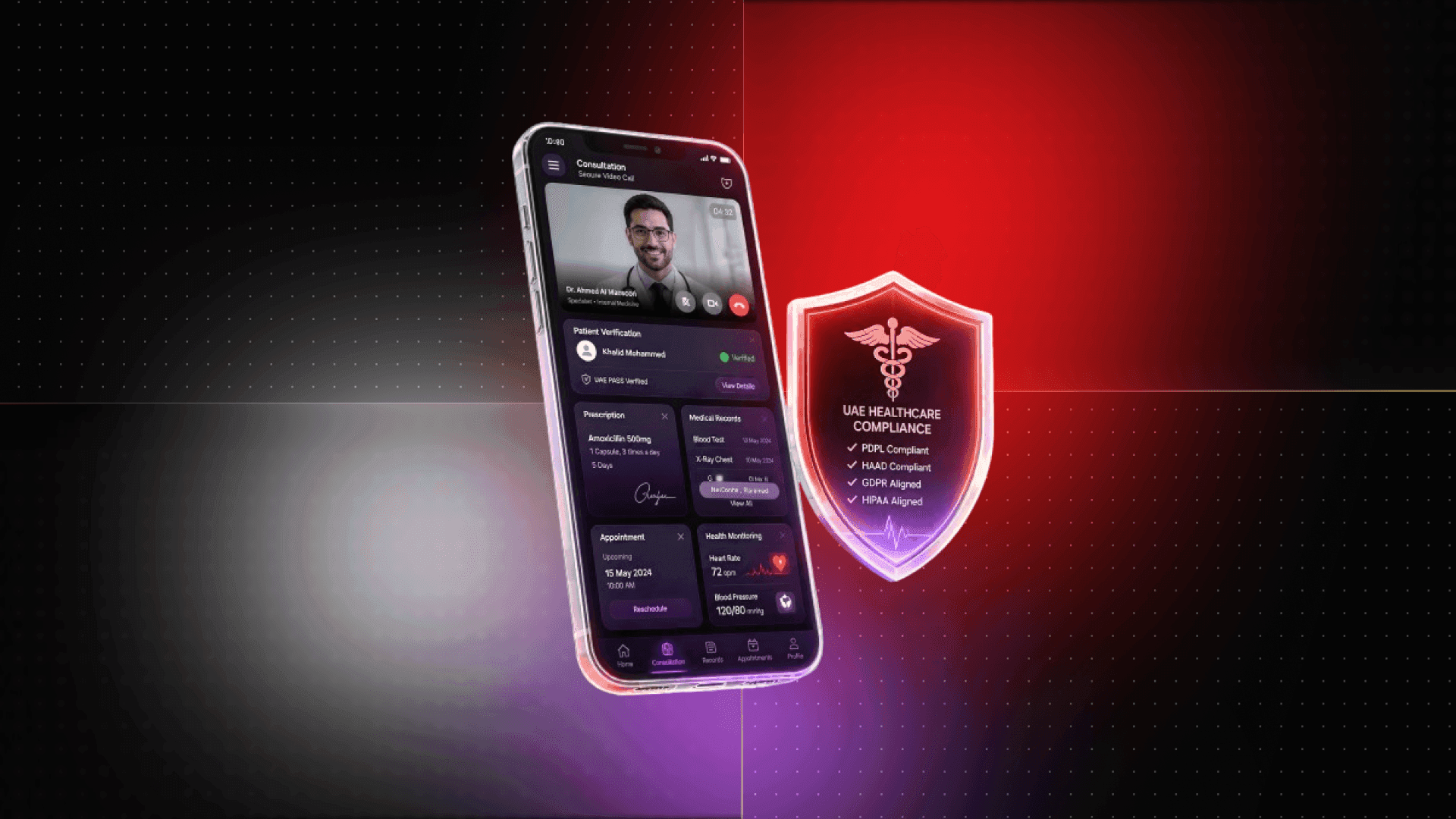
A Dubai dermatology clinic had been conducting video consultations over WhatsApp for nearly two years. Patients appreciated the convenience, appointments were fully booked, and every virtual consultation generated revenue. Then a DHA audit revealed a critical issue: WhatsApp is not an approved platform for delivering regulated clinical telemedicine services in Dubai.
The solution was never as simple as upgrading to a premium video conferencing subscription. A compliant UAE telemedicine platform requires secure clinical video infrastructure, UAE-only data residency, electronic health record integration, documented patient consent, regulated e-prescription workflows, and compliance with multiple healthcare authorities operating across the Emirates.
Telemedicine has become one of the fastest-growing digital healthcare sectors in the UAE, with more than 375,000 DHA telehealth consultations recorded in 2023 alone and continued double-digit growth expected throughout 2026. Unlike general healthcare applications, however, telemedicine platforms operate under one of the most technically demanding regulatory environments in the GCC.
If you're already familiar with our broader guide on healthcare app development Dubai — DHA compliance guide, this article goes much deeper into one specific category: regulated telemedicine platform development.
At LogioLegion, we help healthcare providers and HealthTech founders build compliance-driven software for regulated markets. This guide explains what private clinics, hospitals, and startups must build before launching a telemedicine platform anywhere in the UAE.
The three regulators every UAE telemedicine platform must understand
Many founders assume there is a single UAE healthcare regulator responsible for telemedicine.
There isn't.
Instead, telemedicine operates under three different healthcare authorities, each governing different jurisdictions while sharing certain national healthcare obligations.
Understanding these regulators before software architecture begins prevents expensive redevelopment later.
MOHAP — Ministry of Health and Prevention
The Ministry of Health and Prevention (MOHAP) is the federal healthcare regulator responsible for healthcare services throughout:
- Sharjah
- Ajman
- Umm Al Quwain
- Ras Al Khaimah
- Fujairah
MOHAP also establishes national telehealth principles that influence healthcare delivery across the country.
Its primary focus includes:
- practitioner licensing scope
- patient consent
- telemedicine care pathways
- electronic prescription governance
- prohibition of autonomous AI replacing physician judgment
One of the most important regulations remains Cabinet Decision No. 40 of 2019, which establishes technical infrastructure requirements for telemedicine services throughout the UAE.
If your platform intends to operate in the Northern Emirates, MOHAP requirements become mandatory.
DHA — Dubai Health Authority
The Dubai Health Authority (DHA) regulates all licensed healthcare facilities operating within Dubai.
The governing framework today is:
DHA Standards for Telehealth Services Version 4 (DHA/HRS/HPSD/ST-14 Issue 4)
Issued: September 26, 2025
Effective: November 26, 2025
Compared to previous versions, the current standard places greater emphasis on:
- approved telemedicine platforms
- clinical documentation
- patient privacy
- cybersecurity
- UAE data residency
- practitioner accountability
Under DHA rules:
- every healthcare facility must hold a DHA licence
- only DHA-licensed healthcare professionals may provide consultations
- platforms themselves must satisfy DHA technical expectations
- patient consultations cannot simply take place over consumer communication apps
Many clinics mistakenly believe HIPAA compliance alone is sufficient.
It is not.
DHA additionally expects:
- ISO 27001 information security controls
- UAE-hosted infrastructure
- written consultation documentation
- strict controls around consultation recording
DOH — Department of Health Abu Dhabi
The Department of Health (DOH) regulates healthcare services within Abu Dhabi.
Among the three regulators, DOH typically enforces the most demanding cybersecurity requirements.
Any telemedicine platform serving Abu Dhabi providers must account for:
- ADHICS v2.0 cybersecurity compliance
- Malaffi health information exchange integration
- Riyati patient platform compatibility
- Abu Dhabi-approved healthcare data architecture
Many startups discover these obligations only after successfully launching in Dubai.
By then, redesigning the platform often requires significant backend redevelopment.
Why designing for one emirate often becomes expensive later
Suppose a HealthTech startup launches initially for Dubai clinics.
Their platform integrates with NABIDH, satisfies DHA telehealth standards, and operates successfully for several months.
Later, investors request expansion into Abu Dhabi.
The founders now discover they must additionally implement:
- ADHICS v2.0 security controls
- Malaffi integration
- Abu Dhabi interoperability testing
- separate regulatory submissions
Those requirements affect architecture itself—not simply compliance documentation.
This frequently results in:
- database redesign
- security redesign
- API redevelopment
- infrastructure migration
- additional certification timelines
Building for multiple regulators from the beginning is significantly less expensive than rebuilding later.
What a nationwide UAE telemedicine platform actually requires
A platform serving patients throughout the UAE must satisfy multiple regulatory frameworks simultaneously.
That means supporting:
| Dubai | Abu Dhabi | Northern Emirates |
|---|---|---|
| DHA Standards Version 4 | DOH Requirements | MOHAP Requirements |
| NABIDH Integration | Malaffi Integration | Federal Standards |
| HIPAA + ISO 27001 | ADHICS v2.0 | Cabinet Decision 40/2019 |
| DHA-approved telehealth workflow | DOH cybersecurity controls | National telehealth framework |
Rather than thinking of UAE telemedicine as "one market," developers should think of it as one healthcare system governed by three overlapping regulatory authorities.
That single architectural decision determines whether expansion later takes weeks—or months.
What UAE regulations prohibit on telemedicine platforms — and why this affects your architecture
Many discussions around telemedicine focus only on what platforms should include.
Equally important is understanding what UAE regulations explicitly prohibit.
Every prohibition translates directly into software architecture decisions.
Ignoring these restrictions can delay licensing, regulatory approval, or commercial launch.
No consumer video applications for clinical consultations
One of the most common compliance mistakes among UAE clinics is assuming that popular communication tools are acceptable for regulated healthcare consultations.
They are not.
Applications such as:
- Zoom
- Microsoft Teams
- Google Meet
- FaceTime
may work perfectly for business meetings, but they are not approved telemedicine platforms for regulated clinical care.
Instead, healthcare platforms should be built around healthcare-grade video SDKs such as:
- Daily.co
- Twilio Video
- Vonage (OpenTok)
These SDKs allow developers to build a telemedicine platform that supports:
- end-to-end encryption
- access logging
- waiting rooms
- practitioner authentication
- consultation audit trails
- UAE data routing
The video engine becomes part of the healthcare platform instead of relying on a generic conferencing application.
No offshore patient data storage
Another critical architectural requirement is data residency.
Federal Law No. 2 of 2019 governing ICT in Health Fields requires patient healthcare information to remain within approved UAE infrastructure unless specific regulatory approval exists.
That immediately eliminates many international SaaS healthcare products that replicate patient information across multiple global regions.
Typical compliant cloud options include:
- AWS Middle East (UAE)
- Microsoft Azure UAE North
- Google Cloud UAE infrastructure
Every architectural decision surrounding storage, backup, disaster recovery, and analytics should respect UAE data residency requirements from day one.
Moving healthcare data into the UAE after launch is considerably more difficult than designing for it initially.
No autonomous AI diagnosis
Artificial intelligence is becoming increasingly valuable inside telemedicine.
However, UAE regulators draw a clear distinction between clinical decision support and clinical decision making.
AI may assist physicians by providing:
- symptom assessment
- patient triage
- documentation assistance
- differential diagnosis suggestions
- consultation summaries
It cannot independently diagnose patients or replace physician judgement.
Any compliant telemedicine platform should clearly label AI-generated output as:
Clinical Decision Support — Requires Physician Review
The licensed healthcare professional remains responsible for every diagnosis, prescription, referral, and treatment recommendation.
Our detailed guides on AI chatbot for healthcare UAE and best agentic AI models 2026 explain how AI can safely complement—not replace—clinical workflows.
No controlled medication prescriptions through telemedicine
Every UAE regulator restricts remote prescribing of narcotic, controlled, and semi-controlled medications.
Accordingly, the prescription engine must automatically validate medications against the approved MOHAP formulary before allowing a prescription to proceed.
If a practitioner attempts to prescribe a prohibited medication during a remote consultation, the platform should:
- block the prescription
- explain the regulatory restriction
- recommend an in-person consultation where appropriate
- record the attempted action within the audit log
Compliance should be enforced by software—not left to memory.
No consultation recording without prior approval
Some clinics assume recording every consultation provides additional legal protection.
Under DHA requirements, recording consultations is generally prohibited unless prior written approval exists and appropriate patient consent has been obtained.
A compliant telemedicine platform therefore should:
- disable recording by default
- require administrator authorisation
- record approval references
- capture patient consent before recording begins
- maintain a complete audit trail
Building recording functionality without governance creates unnecessary regulatory exposure.
No consultations by practitioners operating outside their licensed scope
Every healthcare professional using the platform must practise only within the scope authorised by their regulatory licence.
The software should therefore verify:
- practitioner licence status
- speciality
- licence expiry
- authorised scope of practice
before allowing consultation sessions to begin.
This makes practitioner verification a software responsibility rather than an administrative checklist.
The 3 prerequisites most development teams discover too late
Many telemedicine projects experience delays that have nothing to do with software development.
Instead, they stem from regulatory processes that were never included in the original project plan.
These three prerequisites should begin alongside development—not after the platform has been completed.
Platform regulatory approval timeline
Building the software does not automatically authorise clinical consultations.
Before go-live, the relevant healthcare authority expects documentation covering areas such as:
- platform architecture
- security controls
- infrastructure
- HIPAA compliance
- ISO 27001 certification
- workflow governance
- EHR integration
- operational procedures
Depending on jurisdiction, this approval process commonly takes between 12 and 20 weeks.
Teams that wait until development finishes before beginning regulatory submissions often add several months to their launch schedule.
The approval process should run in parallel with development.
Health facility licence requirement
Another common misconception concerns licensing.
A telemedicine startup cannot simply obtain developer credentials and begin providing healthcare services.
The operating organisation itself must either:
- hold the appropriate healthcare facility licence, or
- operate under the authority of an already licensed healthcare provider.
For many startups, this becomes the single biggest project blocker.
Confirming the licensing pathway before development begins avoids expensive redesigns around an invalid business model.
NABIDH certification
For Dubai healthcare providers, NABIDH (National Backbone for Integrated Dubai Health) certification represents an entirely separate technical process.
NABIDH serves as Dubai's health information exchange, allowing healthcare providers to securely exchange patient records using HL7 FHIR (Health Level Seven Fast Healthcare Interoperability Resources) standards.
Certification includes:
- sandbox testing
- interoperability validation
- HL7 FHIR compliance
- security verification
- production approval
Typical certification timelines range between 6 and 14 weeks.
Development teams frequently underestimate this stage, assuming API integration alone is sufficient.
It isn't.
Without formal certification, production clinical data cannot legally flow into NABIDH.
# DHA Standards for Telehealth Services Version 4 — what changed in November 2025

The **DHA Standards for Telehealth Services Version 4 (DHA/HRS/HPSD/ST-14 Issue 4)** became effective on **November 26, 2025**, replacing the previous guidance for telemedicine providers operating in Dubai.

While many of the core licensing principles remain unchanged, Version 4 places greater emphasis on documentation, cybersecurity, AI governance, and emergency care protocols.

If your telemedicine platform was designed before this update, it is worth conducting a compliance gap assessment before expanding or renewing approvals.

---

## Stronger consultation documentation requirements

Video consultations are not treated differently from in-person appointments when it comes to clinical records.

Every consultation must generate complete documentation inside the patient's **Electronic Health Record (EHR)** immediately after the session.

A compliant platform should automatically capture:

- consultation start and end times
- practitioner identity
- patient identity
- presenting complaint
- clinical assessment
- diagnosis
- treatment plan
- follow-up recommendations
- prescription records where applicable

The platform should also prompt practitioners to complete missing documentation before closing the consultation.

---

## Clearer AI governance

Version 4 recognises that AI is becoming increasingly common in healthcare software.

However, DHA makes an important distinction:

AI may support clinicians.

It may not replace clinicians.

Any AI-generated recommendation should remain advisory and require explicit practitioner confirmation before becoming part of the patient's clinical record.

Examples of acceptable AI functions include:

- symptom assessment
- consultation summarisation
- clinical documentation assistance
- appointment prioritisation
- patient education

Examples that remain prohibited include:

- autonomous diagnosis
- automated treatment decisions
- prescribing medication without physician approval
- replacing licensed healthcare professionals

This distinction significantly influences software architecture.

---

## Continued emphasis on UAE data residency

DHA continues to require healthcare information to remain inside approved UAE infrastructure.

This extends beyond patient records to include:

- consultation notes
- uploaded medical documents
- imaging
- prescriptions
- audit logs
- encrypted backups

Every system component handling protected healthcare information should respect UAE data localisation requirements.

---

## Updated emergency handling expectations

Telemedicine platforms cannot replace emergency healthcare.

If a patient presents symptoms indicating an emergency, the software should immediately guide practitioners toward emergency escalation.

Typical emergency workflow features include:

- emergency warning prompts
- one-click emergency referral
- ambulance instruction workflow
- consultation termination with emergency advice
- automatic documentation of escalation

Embedding these workflows directly into the platform reduces clinical risk while demonstrating regulatory readiness.

---

# The 8 core modules of a UAE-compliant telemedicine platform

A compliant telemedicine platform is far more than secure video calling.

It combines regulated healthcare workflows, interoperability, cybersecurity, audit logging, and patient management into a single clinical ecosystem.

Below are the eight modules every serious UAE telemedicine platform should include.

---

### Practitioner Registry and Licence Verification

Every healthcare provider using the platform should have a verified regulatory profile.

The practitioner registry should store:

- DHA licence number
- DOH licence number
- MOHAP licence information
- speciality
- scope of practice
- licence expiry
- clinic affiliation

The system should automatically alert administrators before licences expire.

For multi-emirate platforms, practitioners may hold different licences across jurisdictions.

The software should enforce consultation permissions based on the correct licence for each emirate.

---

### Patient Onboarding and Consent Management

Patient registration extends well beyond creating a user account.

A compliant onboarding workflow should verify identity using:

- Emirates ID
- Passport
- UAE Visa (where applicable)

Before every consultation, patients should complete bilingual consent covering:

- telemedicine limitations
- privacy
- healthcare information sharing
- UAE data processing
- NABIDH or Malaffi exchange where applicable
- consultation recording policy

Consent should be permanently stored within the patient's electronic record and remain available during audits.

---

### UAE-Compliant Video Consultation Engine

The consultation engine forms the centre of the platform.

Rather than relying on consumer video applications, developers should build around healthcare-grade SDKs such as:

- Daily.co
- Twilio Video
- Vonage

Key capabilities include:

- end-to-end encrypted communication
- waiting room management
- practitioner authentication
- consultation timer
- secure file sharing
- bilingual interface
- automatic consultation note prompts
- no-recording enforcement unless approved

All communications should be routed through UAE-hosted infrastructure.

---

### Electronic Health Record and NABIDH/Malaffi Synchronisation

Every completed consultation should become part of the patient's permanent healthcare history.

The platform should generate structured consultation records using **HL7 FHIR (Health Level Seven Fast Healthcare Interoperability Resources)** so information can be exchanged with national healthcare systems.

Dubai healthcare providers require integration with **NABIDH**, while Abu Dhabi providers require **Malaffi** connectivity.

For platforms serving multiple emirates, supporting both integrations from the outset prevents expensive redevelopment later.

The architecture should also support offline documentation that synchronises automatically once connectivity is restored.

### E-Prescription Engine

Electronic prescribing is one of the biggest advantages of a purpose-built telemedicine platform, but it is also one of the most tightly regulated components.

Every prescription generated through the platform should validate medications against the **MOHAP-approved formulary** before it reaches the patient.

The prescription engine should automatically:

- block controlled, narcotic, and semi-controlled medications that cannot legally be prescribed via telemedicine
- generate digitally signed prescriptions
- route prescriptions through the approved UAE e-prescription network
- maintain complete prescription history for both patient and practitioner
- create a permanent audit trail for every issued prescription

These safeguards reduce prescribing errors while helping clinics remain compliant with UAE healthcare regulations.

---

### AI Clinical Decision Support (Compliant)

Artificial intelligence is becoming an important assistant for clinicians, but UAE healthcare regulations make one principle very clear:

AI supports clinicians.

It does not replace them.

A compliant telemedicine platform may include AI features such as:

- symptom assessment
- consultation summaries
- clinical documentation assistance
- follow-up recommendation drafts
- patient education material

Every AI-generated recommendation should be clearly labelled as:

> Clinical Decision Support — Requires Physician Review

The licensed healthcare professional must review, modify if necessary, and approve every recommendation before it becomes part of the patient's medical record.

For organisations planning AI-assisted healthcare platforms, our guides on [AI chatbot for healthcare UAE](https://logiolegion.com/blogs/ai-chatbot-healthcare) and [best agentic AI models 2026](https://logiolegion.com/blogs/best-agentic-ai-models-2026) explain how AI can improve clinical workflows while remaining within UAE regulatory expectations.

---

### Billing and UAE FTA E-Invoicing

Telemedicine platforms are healthcare systems, but they are also commercial platforms.

Whether consultations are paid directly by patients or billed to insurers, billing should integrate cleanly with the consultation workflow.

A modern billing module should support:

- patient-pay consultations
- insurance billing
- consultation packages
- subscription plans
- payment gateway integration
- Apple Pay UAE
- credit and debit cards
- consultation receipts

As the UAE rolls out mandatory electronic invoicing, telemedicine providers should also prepare their billing systems for **Federal Tax Authority (FTA)** compliance.

Our guide to [UAE e-invoicing custom software integration 2026](https://logiolegion.com/blogs/uae-e-invoicing-custom-software-integration-2026) explains how healthcare software can prepare for these requirements before they become mandatory.

---

### Compliance Dashboard and Audit Trail

Healthcare regulators expect every clinical activity to be traceable.

A dedicated compliance dashboard gives administrators immediate visibility into platform operations while simplifying regulatory inspections.

Typical dashboard capabilities include:

- practitioner activity logs
- consultation history
- patient consent records
- prescription audits
- NABIDH transmission status
- Malaffi transmission status
- cybersecurity event logs
- failed login monitoring
- administrator activity reports
- inspection-ready export tools

Rather than assembling evidence manually during a DHA or DOH inspection, administrators can retrieve complete audit records within minutes.

---

# Building for one emirate vs all UAE — the architecture decision that cannot be undone

Many startups begin with a simple objective:

"We'll launch in Dubai first and expand later."

On paper, that seems sensible.

In practice, expansion often becomes significantly more expensive because many regulatory requirements cannot simply be added after launch.

For example, a Dubai-only platform generally focuses on:

- DHA Standards for Telehealth Services Version 4
- NABIDH integration
- HIPAA compliance
- ISO 27001 controls
- Dubai healthcare workflows

When the same platform later expands into Abu Dhabi, additional requirements immediately appear.

These include:

- ADHICS v2.0 cybersecurity controls
- Malaffi integration
- Riyati compatibility
- DOH interoperability testing
- additional regulatory documentation

None of these are simple plugins.

ADHICS v2.0 affects identity management, encryption, access control, security monitoring, penetration testing, disaster recovery, and vendor governance.

Similarly, Malaffi integration requires its own interoperability workflows and certification process.

Retrofitting these capabilities into an existing production platform often requires:

- backend redesign
- API restructuring
- security architecture updates
- infrastructure changes
- additional compliance testing

For organisations expecting regional growth, it is usually more economical to design for the highest compliance standard from the beginning—even if the initial commercial launch serves only Dubai.

This approach reduces future redevelopment costs while shortening expansion timelines.

---

# What does a UAE telemedicine platform development cost in 2026?

Every telemedicine platform differs based on speciality, number of practitioners, supported emirates, integrations, and regulatory scope.

Typical project ranges include:

| Platform | Estimated Cost | Timeline |
|-----------|---------------:|----------|
| Single-emirate platform (Dubai, DHA, NABIDH, patient app, practitioner app, e-prescription) | **AED 200,000–360,000** | **16–22 weeks** |
| Multi-emirate platform (Dubai + Abu Dhabi, DHA + DOH, NABIDH + Malaffi, ADHICS v2.0) | **AED 340,000–580,000** | **22–30 weeks** |
| Enterprise nationwide telemedicine platform (MOHAP, DHA, DOH, AI decision support, insurance workflows, multi-speciality) | **AED 550,000–950,000** | **28–40 weeks** |

Unlike many software vendors, regulatory submission support should be considered part of the overall implementation—not an afterthought.

That includes assistance with:

- technical documentation
- compliance architecture
- NABIDH preparation
- Malaffi preparation
- platform approval support
- deployment planning

Planning these activities alongside development helps avoid unnecessary delays before launch.

---

# Why LogioLegion for UAE telemedicine platform development

Building telemedicine software for the UAE requires considerably more than mobile development expertise.

Success depends on understanding healthcare regulation, interoperability standards, cybersecurity, clinical workflows, and long-term maintainability before architecture begins.

At [LogioLegion](https://logiolegion.com), we build healthcare platforms using React Native, Next.js, Node.js, and Laravel while designing around UAE healthcare compliance from the outset.

Our development approach includes:

- DHA-aware software architecture
- MOHAP regulatory alignment
- DOH expansion planning
- NABIDH and Malaffi integration capability
- HL7 FHIR interoperability
- bilingual Arabic and English interfaces
- AWS UAE data residency
- HIPAA and ISO 27001 aligned architecture
- ADHICS v2.0-ready security planning
- fixed-scope project estimation

Instead of treating compliance as documentation added before launch, we incorporate regulatory requirements into platform architecture from the first planning workshop.

This reduces redevelopment, simplifies certification, and prepares healthcare organisations for future expansion across multiple emirates.

---

# Conclusion

Telemedicine is becoming a standard healthcare delivery channel across the UAE, but success depends on building the platform around regulation rather than attempting to retrofit compliance after launch.

Three regulators, multiple interoperability platforms, UAE data residency, practitioner licensing, AI governance, and secure clinical workflows all influence software architecture from the very beginning.

Building the right foundation saves months of redevelopment later.

If you're planning a DHA, MOHAP, or DOH-compliant telemedicine platform, [book a free discovery call](https://logiolegion.com/contact-us) with LogioLegion. We'll map the regulatory requirements for your clinical model, identify the integrations your platform needs, and deliver a fixed-price proposal within five business days.