
16-07-2026
OTT App Development Saudi Arabia — CST Registration, GCAM Compliance, Arabic-First Streaming Platform Architecture and ZATCA Subscription Invoicing (2026)
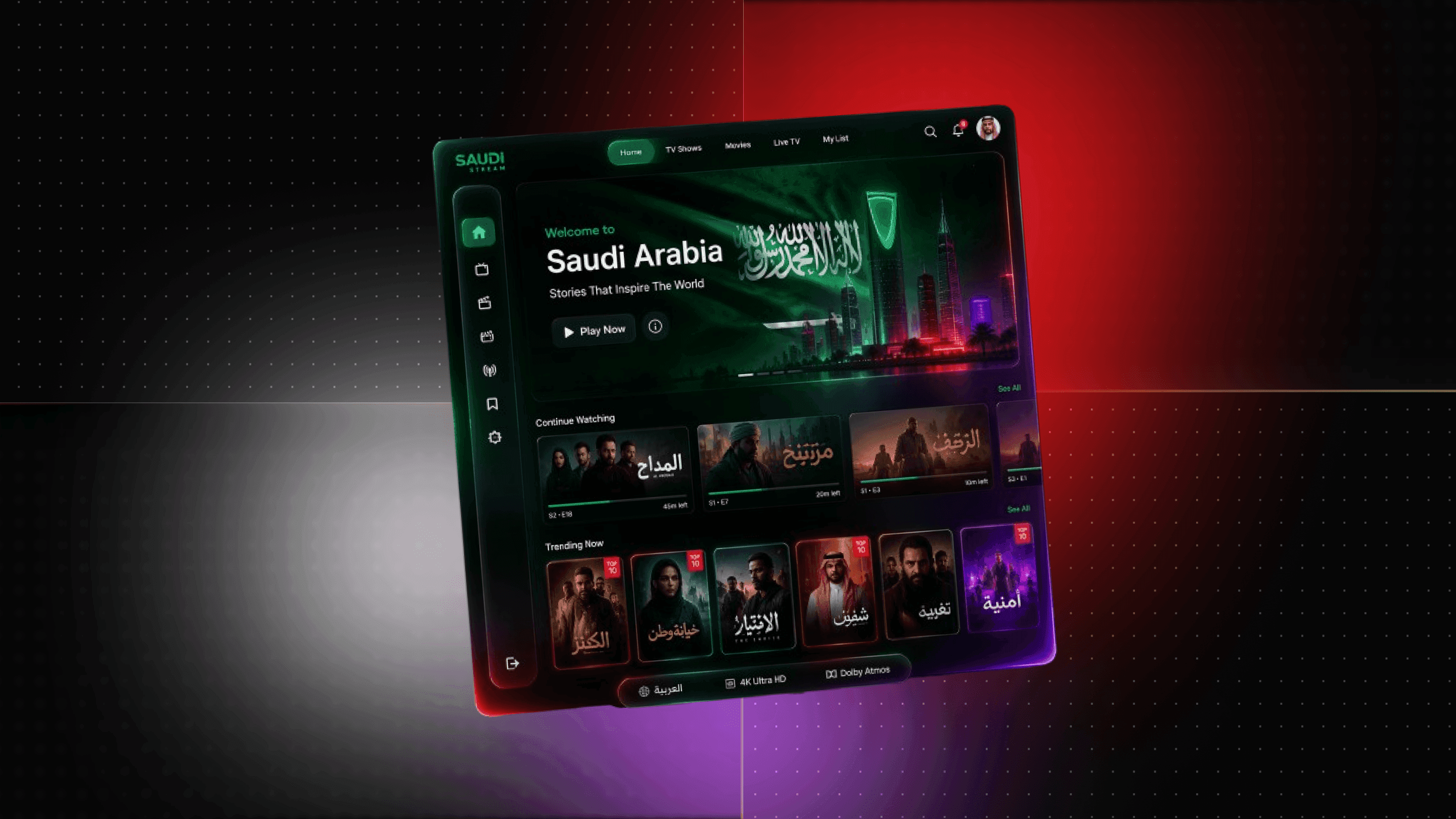
Saudi Arabia had no commercial cinemas before 2018. By 2026 it has a thriving entertainment sector, a government target of entertainment contributing 6% of GDP by 2030, and one of the highest per-capita streaming consumption rates in the Arab world. Netflix, Amazon Prime, Shahid, StarzPlay, and Wavo all operate in the Kingdom. Saudi sports clubs are launching OTT platforms for match streaming. Saudi content studios are building subscription video platforms. Government entities are launching cultural content portals under Vision 2030.
Every one of these streaming platforms needs to be built, registered with the CST, content-compliant with GCAM's regulations, PDPL-compliant for subscriber data, ZATCA-invoiced on every subscription payment, and designed in Arabic from the ground up — not adapted from an English template. This guide covers what custom OTT platform development in Saudi Arabia actually requires in 2026.
The Saudi OTT Regulatory Framework — Two Bodies, Three Tiers
Building an OTT platform for Saudi Arabia requires navigating two distinct regulatory bodies simultaneously. Confusing them is the most common compliance error Saudi OTT builders make.
CST (Communications, Space and Technology Commission) regulates digital content platform operations — the business of distributing content. The CST's Digital Content Platform (DCP) Regulations, effective January 1, 2024, define the legal obligations for any platform distributing video or audio content to Saudi users. This is the registration/licence that gives a platform the legal right to operate in the Kingdom.
GAMR (General Authority of Media Regulation) — formerly GCAM — regulates content itself: what can be shown, how it must be classified, what must be archived, and what triggers content review or removal. GAMR sets the content compliance standards the platform must implement technically. CST gives you the right to operate. GAMR defines the rules under which you can operate.
The Three CST Compliance Tiers
Tier 1 — Full Licence (Satellite Pay TV and IPTV operators) Requires a local Saudi presence. 10-year licence. Saudi commercial registration, audited financial statements, appointed Platform Liaison Officer (PLO), application and annual fees. For traditional broadcast and IPTV-style distribution.
Tier 2 — Registration (Video OTT platforms, VOD services, audio-on-demand) The tier that applies to most custom OTT platforms. Foreign and local operators alike can register without a mandatory local Saudi presence since the 2024 DCP Regulations. 5-year registration, renewable. Requires commercial registration (Saudi or foreign), audited financials, PLO appointment, service description, and fees.
Tier 3 — Notification (Smaller platforms, specific categories) Corporate and operational information submitted to CST. Lower administrative burden — but still a formal obligation, not optional.
Platform Liaison Officer (PLO) — mandatory for all tiers Every OTT platform operating in Saudi Arabia must appoint a PLO — a named individual who serves as the primary point of contact between the platform and the CST. The PLO receives regulatory communications, coordinates content compliance requests, and is accountable for the platform's ongoing regulatory relationship. The PLO must be reflected in the platform's backend admin system — regulators will contact them for information requests, content reviews, and incident response.
GAMR Content Compliance — What the Platform Architecture Must Enforce
GAMR's content compliance obligations are not a legal review checklist — they are technical requirements that must be built into the platform's content management and delivery architecture.
Content classification and clearance All content on a Saudi OTT platform must be classified — age-rated and content-flagged — before being made available to Saudi users. For certain content categories, GAMR may require pre-clearance before the content is published. The platform's CMS must support GAMR classification tags (general audience, 12+, 15+, 18+, and prohibited) and enforce age-appropriate content gating by user account.
90-day content archive Licensed broadcasters and OTT platforms must maintain a retrievable archive of all content distributed for 90 days and make it available to GAMR upon request. The platform's storage architecture must retain all streamed content in this window with metadata (user who accessed it is governed by PDPL separately from the content archive obligation). A cold storage tier on AWS Bahrain for the 90-day archive is the standard technical implementation.
Content removal workflow When GAMR issues a content removal directive — for a specific piece of content, a channel, or a category — the platform must be able to execute the removal across all content delivery nodes within a defined timeframe. The platform needs a GAMR compliance dashboard: content status (live, under review, removed), removal history log, and the ability to execute a takedown by content ID across the CDN.
Arabic content requirements GAMR regulations require Saudi-serving OTT platforms to prioritise Saudi and Arabic content. In practice, this means the platform's content strategy must include an Arabic content library — not just an Arabic interface on top of English content. The platform CMS must handle Arabic metadata (titles, descriptions, cast names, genre tags) natively, with morphological Arabic search that matches content whether the user searches by root word or derived form.
User-generated content (UGC) restrictions If the OTT platform allows user uploads or user-generated content, GAMR regulations impose additional moderation requirements. UGC must be screened against Saudi content standards before publication. This typically requires a pre-publication moderation queue and a reporting mechanism for users to flag non-compliant content.
PDPL Compliance for OTT Subscriber Data
An OTT platform collects some of the most data-rich personal information a business can hold: subscriber identity, payment details, viewing history, content preferences, device usage patterns, and — if Arabic content recommendations are served — inferred interests and cultural consumption patterns. All of this is personal data under Saudi Arabia's Personal Data Protection Law (PDPL).
Data residency Subscriber data for Saudi users must be hosted within Saudi Arabia or in a jurisdiction with equivalent data protection standards. AWS Middle East (Bahrain) is the established compliant hosting environment. A Saudi OTT platform hosted on US or European AWS regions is creating a PDPL cross-border transfer obligation that requires a formal legal mechanism to be valid.
Consent management The platform must obtain explicit consent for data collection at registration, with a clear statement of what data is collected, how it is used (personalisation, recommendations, advertising), and whether it is shared with third parties. Consent must be recorded per user and retrievable for PDPL accountability audits.
Behavioural targeting and advertising If the OTT platform uses viewing data to serve targeted advertising — either directly or through an advertising tech partner — each targeting use requires a specific consent basis under PDPL. A subscriber who consents to service delivery but not to advertising targeting must not be served targeted ads. The consent architecture must be granular enough to honour per-use-case consent choices.
Data subject rights Saudi users have PDPL rights: access to their data, correction of inaccurate data, and deletion of their data. The OTT platform's backend must include a data subject request workflow that allows users to request a copy of their data or trigger deletion — including deletion from personalisation models, viewing history, and any third-party advertising partnerships.
ZATCA on OTT Subscription Fees — Every Billing Cycle is a Tax Event
Every OTT subscription payment in Saudi Arabia is subject to 15% VAT. A monthly subscription of SAR 40 carries SAR 6 in VAT. The platform must generate a ZATCA Phase 2 compliant invoice — simplified B2C invoice for individual subscribers — and report it to ZATCA's Fatoorah reporting API within 24 hours of each successful billing event.
For a platform with 10,000 subscribers on monthly billing, that is 10,000 ZATCA submissions per month — triggered automatically by the payment gateway webhook, generated and submitted without manual intervention. The ZATCA invoice engine must handle:
B2C simplified invoices (individual subscribers): generated on confirmed payment, QR code with TLV encoding, CSID cryptographic stamp, reported to ZATCA within 24 hours. Annual subscribers receive one ZATCA invoice per year. Monthly subscribers receive 12 per year.
B2B standard invoices (corporate accounts, education institutions, business subscribers): ZATCA standard invoice with clearance — meaning the invoice is submitted to ZATCA for clearance before being issued to the corporate client. The 5–30 second clearance round-trip must be handled in the billing workflow without causing checkout delays.
Failed payment handling: when a subscription renewal payment fails, no ZATCA invoice is generated. When the payment is retried and succeeds, the ZATCA invoice is generated at the point of confirmed payment — not at the point of the original billing attempt.
Refunds and cancellations: when a subscriber cancels mid-period and receives a refund, a ZATCA credit note must be generated against the original invoice. The platform's billing engine must support credit note generation with the correct ZATCA XML format and the corresponding deduction from the VAT reporting period.
See our ZATCA Fatoorah API integration guide for the full technical architecture.
Arabic-First Design for Saudi OTT Platforms
Arabic-first is a structural design decision for a Saudi OTT platform — not a translation layer. The difference matters at every level of the user experience.
Arabic Electronic Program Guide (EPG) For live streaming content and scheduled programming, the EPG must display Arabic titles, broadcast times in Arabic format, and Arabic programme descriptions. If the platform carries Saudi sports or live events, the EPG must handle Arabic content metadata natively — not require a separate translation step after the English EPG is built.
Morphological Arabic search Arabic is a morphologically rich language — the same word appears in dozens of forms depending on gender, number, and case. A search for "مسلسل" (series) must return results matching all derived forms. A search for an actor's name in Arabic must find their content regardless of transliteration variation. The platform's search engine must index content using Arabic morphological analysis, not simple string matching.
RTL video player interface The video player controls, progress bar, and overlay UI must be designed RTL from the start. Skip-forward buttons appear on the left in Arabic interfaces. On-screen controls follow the RTL layout logic of the surrounding UI. This is a design system decision — not a CSS text-direction toggle.
Hijri calendar for content scheduling Ramadan is the peak OTT viewing period in Saudi Arabia — platforms see traffic spikes of 40–60% during the holy month. Content scheduling features, release calendars, and campaign planning tools must support the Hijri calendar natively, not only Gregorian dates.
Arabic subtitles and dubbing Content with Arabic subtitles or Arabic dubbing must have this reflected in the content metadata, search filters, and content cards. Saudi users actively filter for Arabic-dubbed versus Arabic-subtitled content — and the distinction must be technically represented in the platform's content taxonomy.
Payment Integration for Saudi OTT Subscriptions
Mada is the primary payment method for Saudi subscription services. The OTT platform must integrate Mada via a SAMA-licensed payment gateway (HyperPay, Moyasar, or Tap Payments). Mada integration includes recurring subscription billing — the payment gateway must support Mada card tokenisation for automatic monthly/annual renewals without requiring the subscriber to re-enter payment details each cycle.
Apple Pay has strong penetration among Saudi smartphone users and is the preferred frictionless payment method for premium content subscribers. The subscription checkout must support Apple Pay for first-time payment and Apple Pay-based recurring billing where supported.
STC Pay — with 12M+ users — is a relevant wallet option for the Saudi OTT market, particularly for subscribers who prefer not to use bank cards for recurring subscriptions.
BNPL for annual subscriptions: Tamara has begun offering instalments for subscription services. For annual OTT subscriptions at SAR 400–600 per year, BNPL reduces the upfront cost barrier significantly and increases annual subscription conversion rates.
See our payment gateway integration Saudi Arabia guide for the full Saudi payment stack architecture.
Core Technical Modules of a Saudi OTT Platform
Content Management System (CMS) Arabic-first content metadata entry. GAMR classification tags per content item. 90-day archive tier management. Multi-resolution video upload and transcoding pipeline. DRM (Digital Rights Management) for licensed content. Geo-restriction rules per content item for regional licensing compliance. Content availability scheduling with Hijri calendar support.
Video Delivery Infrastructure CDN (Content Delivery Network) with Saudi Arabia edge nodes for low-latency streaming. Adaptive bitrate streaming (HLS/MPEG-DASH) for all connection speeds — Saudi users watch on everything from 5G mobile to home fibre. Offline download for mobile apps (for commuter and travel viewing where connectivity is intermittent). Live streaming transcoding pipeline for sports and events.
Subscriber Management PDPL-compliant subscriber registration with consent capture at each data collection point. Mada, Apple Pay, STC Pay subscription billing with automatic renewal. ZATCA invoice generation per billing event. Entitlement management (what content each subscriber tier can access). Account management: profile creation, viewing history per profile (for household accounts), parental controls with GAMR classification enforcement.
PLO Compliance Dashboard GAMR content removal request intake and execution tracking. CST regulatory communication log. 90-day content archive access for regulatory inspection. Content classification audit trail. PLO-specific admin role with appropriate data access scope.
Recommendation Engine Arabic-language content recommendation using viewing history. Genre and format affinity modelling. Ramadan season content curation (highest-traffic period). PDPL-compliant recommendation architecture — personalisation based on consented viewing data only.
What Does OTT Platform Development Cost in Saudi Arabia?
Basic OTT platform (SVOD, single subscription tier) Arabic-first UI, mobile and web apps (iOS + Android + web), Mada/Apple Pay subscription billing, ZATCA B2C invoice per billing cycle, PDPL-compliant subscriber management, GAMR content classification system, CST Tier 2 registration-ready architecture, basic recommendation feed, 90-day archive: SAR 220,000–400,000 | 16–24 weeks
Mid-market OTT platform (multi-tier subscriptions + live streaming) All above + live streaming for sports and events, Arabic EPG for scheduled content, morphological Arabic search, multiple subscription tiers (basic/standard/premium), B2B corporate accounts with ZATCA B2B clearance invoicing, PLO compliance dashboard, DRM for licensed content, STC Pay and BNPL integration, Hijri calendar scheduling: SAR 400,000–750,000 | 22–32 weeks
Enterprise OTT platform (full-stack national platform) All above + multi-CDN architecture with Saudi edge nodes, offline download for mobile, GCAM pre-clearance workflow, advanced personalisation engine with PDPL consent architecture, advertising integration with PDPL-compliant targeting consent, multi-language (Arabic + English + regional dialects), white-label player SDK, API for third-party device integration (Smart TV, set-top box): SAR 750,000–1,500,000 | 30–44 weeks
CDN costs, CST registration fees, GAMR content clearance fees, and SAMA-licensed payment gateway subscription are operational costs separate from development pricing.
Why LogioLegion for OTT App Development in Saudi Arabia
LogioLegion builds custom OTT and streaming platforms for Saudi Arabia — combining Arabic-first design with the Saudi compliance stack that generic video platform templates consistently miss: CST DCP Registration-ready architecture, GAMR content classification and removal workflow, PDPL-compliant subscriber data management on AWS Bahrain, ZATCA Phase 2 invoicing on every subscription billing cycle, and Mada recurring subscription payment via SAMA-licensed gateways.
The ZATCA subscription invoicing layer is the technical detail that separates a Saudi OTT platform from a generic video streaming product. Every monthly subscription renewal is a ZATCA reportable event — 10,000 subscribers means 10,000 ZATCA submissions per monthly billing cycle, automated, with retry logic for failed submissions and credit note generation for refunds. LogioLegion builds this as a core billing module, not a compliance afterthought. See our ZATCA Fatoorah API integration guide for the architecture.
Tech stack: React and Next.js for Arabic-first RTL web platform, React Native for iOS and Android streaming apps with offline download, Node.js for real-time streaming event handling, HLS adaptive bitrate management, ZATCA API submissions, and PLO compliance event processing, Laravel for subscriber management, billing engine, ZATCA invoice generation, GAMR compliance workflows, and PDPL data subject request handling, AWS Middle East (Bahrain) for data residency compliance.
Book a free discovery call with LogioLegion — we scope your content categories, subscriber scale, GCAM classification requirements, and ZATCA phase status, and deliver a fixed-price proposal within 5 business days.
Frequently Asked Questions
What is OTT app development and how is it different from regular app development? OTT (Over-the-Top) app development involves building streaming platforms that deliver video, audio, or live content directly over the internet — bypassing traditional broadcast distribution. For Saudi Arabia, OTT development requires: CST Digital Content Platform registration, GAMR/GCAM content compliance architecture, ZATCA invoicing on subscription payments, PDPL-compliant subscriber data management, Arabic-first UI with morphological Arabic search, and Mada recurring billing integration. These requirements are absent from generic app development frameworks and must be built specifically for the Saudi market.
Do OTT platforms in Saudi Arabia need a government licence? Yes. Under the CST's Digital Content Platform (DCP) Regulations (effective January 2024), video OTT platforms must register with the CST (Tier 2 registration, 5-year validity). Satellite Pay TV and IPTV operators require a full 10-year licence (Tier 1). Additionally, content compliance obligations under GAMR (General Authority of Media Regulation) apply to all platforms distributing audiovisual content to Saudi users. Every OTT platform must appoint a Platform Liaison Officer (PLO) as the mandatory point of contact with the CST.
What is GCAM and why does it matter for OTT development in Saudi Arabia? GCAM — now rebranded as GAMR (General Authority of Media Regulation) — is Saudi Arabia's content regulator for audiovisual media. It sets content classification standards (age ratings and content flags), requires a 90-day content archive retrievable for regulatory inspection, and can issue content removal directives that the platform must execute technically. A Saudi OTT platform must build GAMR compliance into its CMS architecture: classification tags per content item, a removal workflow executable across all CDN nodes, and a PLO dashboard for regulatory communications.
Does ZATCA apply to OTT subscription fees in Saudi Arabia? Yes. Every OTT subscription payment is a VAT-taxable transaction requiring a ZATCA Phase 2 compliant invoice. For individual subscribers (B2C), a simplified invoice must be generated and reported to ZATCA's Fatoorah API within 24 hours of each confirmed payment. For corporate accounts (B2B), a standard invoice with ZATCA clearance is required. For a platform with 10,000 monthly subscribers, this is 10,000 ZATCA submissions per billing cycle — automated through the billing engine's payment webhook handler.
Which company builds OTT platforms in Saudi Arabia? LogioLegion builds custom OTT and streaming platforms for Saudi Arabia — covering CST registration-ready architecture, GAMR content compliance workflows, PDPL subscriber data management on AWS Bahrain, ZATCA subscription invoicing, Arabic-first RTL design with morphological search, and Mada/Apple Pay/STC Pay recurring billing. Contact LogioLegion to scope your streaming platform.
I want to launch a streaming app in Saudi Arabia — who should I contact? LogioLegion builds custom OTT platforms for Saudi Arabia from architecture through to CST registration-ready deployment. The process starts with a free scoping session covering your content categories (SVOD, live, AVOD), subscriber scale, GCAM classification requirements, ZATCA phase status, and Arabic content library. Scoping to fixed-price proposal in 5 business days. Get in touch with LogioLegion.
What is a Platform Liaison Officer (PLO) and do I need one for my Saudi OTT platform? A Platform Liaison Officer (PLO) is a mandatory appointment for all OTT platforms registered with the CST in Saudi Arabia — regardless of whether the platform operates with a local presence or from abroad. The PLO is the named individual responsible for regulatory communications between the platform and the CST, including content compliance requests, information requests, and incident response. The PLO must be identifiable in the platform's admin system. LogioLegion builds a PLO compliance dashboard as a standard module of Saudi OTT platform engagements.
How much does OTT app development cost in Saudi Arabia? A basic SVOD platform with Arabic-first UI, iOS and Android apps, Mada subscription billing, ZATCA invoicing, and CST registration-ready architecture costs SAR 220,000–400,000 with a 16–24 week timeline. A mid-market platform with live streaming, Arabic EPG, and multi-tier subscriptions costs SAR 400,000–750,000. An enterprise national-scale OTT platform with advanced personalisation and advertising integration costs SAR 750,000–1,500,000. All pricing is fixed-scope. Contact LogioLegion for a scoped estimate.
What payment methods should a Saudi OTT subscription platform support? Saudi OTT platforms must support Mada (primary domestic debit card, requires SAMA-licensed gateway for recurring billing), Apple Pay (high penetration among premium content subscribers), and STC Pay (12M+ users, popular for subscriptions). For annual plan upsells, Tamara BNPL reduces the upfront barrier significantly. Mada recurring tokenisation — for automatic monthly/annual renewals without requiring the subscriber to re-enter card details — is the most critical payment engineering requirement for a Saudi OTT subscription business.
What is Arabic-first design for an OTT platform and why does it matter? Arabic-first means the platform is designed in Arabic at the framework level — not translated from English after the English version is built. For an OTT platform this means: RTL video player controls and overlay UI, morphological Arabic search that matches content by root word and derived forms, Arabic content metadata in the CMS (titles, descriptions, genre tags, cast names), Hijri calendar support for content scheduling, and an Arabic EPG for live and scheduled content. A platform built English-first with Arabic translation has persistent UX failures at every Arabic interaction point and lower adoption among Arabic-speaking subscribers.
Can a foreign company build and operate an OTT platform in Saudi Arabia? Yes, since the CST's 2024 Digital Content Platform Regulations. Foreign operators of video OTT platforms can register with the CST under Tier 2 registration without mandatorily establishing a Saudi local presence — though a PLO must be appointed. Foreign companies distributing content that requires a full licence (Satellite Pay TV, IPTV) still need a local presence. Content compliance with GAMR applies to all operators regardless of location. LogioLegion helps GCC and international companies build OTT platforms that are CST registration-ready and GAMR-compliant from the first line of code.
LogioLegion builds custom OTT platforms and streaming applications for Saudi Arabia. See our ZATCA Fatoorah API integration guide, payment gateway integration Saudi Arabia guide, and custom software development Saudi Arabia guide. Book a free discovery call.
Continue Reading
Discover our full range of services - from custom software development to complete marketing solutions

Building an E-commerce App for Saudi Arabia in 2026: Arabic UX, Mada Payments, and Logistics APIs
A complete Saudi Arabia e-commerce app development guide covering Arabic RTL UX, Mada integration, ZATCA compliance, Saudi logistics APIs, AI features, and platform costs for 2026.

Custom Software Development Company in Saudi Arabia: The Complete 2026 Guide for Businesses and Founders
How to choose a custom software development company in Saudi Arabia in 2026: ZATCA, GOSI, Absher, and Arabic-first requirements, plus custom CRM, ERP, and dashboard builds for Riyadh, Jeddah, and Dammam.
How to Build a BNPL App in Saudi Arabia: Tamara and Tabby's Playbook Decoded (2026)
A complete founder-focused guide to BNPL app development in Saudi Arabia covering SAMA compliance, Nafath KYC, Mada payments, AI risk scoring, merchant integrations, and fintech platform costs.