
16-11-2026
HUID Hallmarking Software for Jewellers 2026: BIS Rules, 380 Districts and Per-Piece Tracking
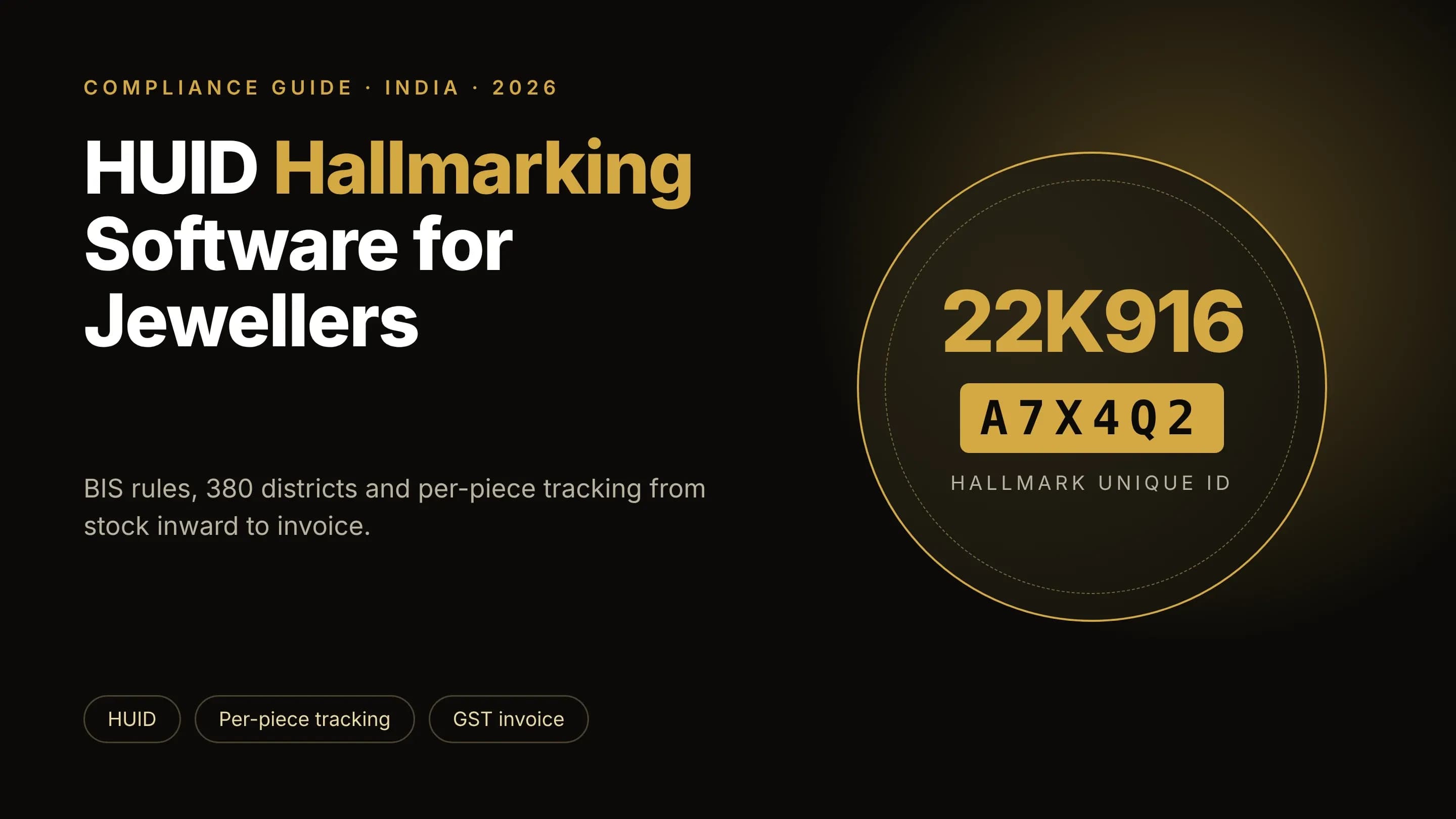
Quick Answer: HUID (Hallmark Unique Identification) is a 6-digit alphanumeric code laser-marked on every hallmarked piece, and since 1 April 2023 hallmarked gold jewellery cannot be sold without it. Mandatory gold hallmarking now covers 380 districts, and HUID has also been mandatory on hallmarked silver since 1 September 2025. HUID-ready software records the code against each individual piece, from stock inward to the invoice, so a jeweller can prove what was sold. Logiolegion, headquartered at Cyberpark, Kozhikode, builds HUID tracking as a module or inside a full jewellery ERP.
Is your billing software still tracking stock by weight only? Book a free HUID readiness review → · WhatsApp us →
Hallmarking used to be a batch exercise: send the lot to the hallmarking centre, get it back stamped, sell by weight. HUID changed that.
Every hallmarked piece now carries its own identity, and customers can check it on the BIS Care app at the counter. A billing system that only knows "22K chains, 312 grams" can no longer tell you which piece a customer bought.
The HUID and hallmarking timeline
| Date | What changed |
|---|---|
| 23 June 2021 | Mandatory gold hallmarking begins in 256 districts |
| 1 April 2023 | Hallmarked gold jewellery cannot be sold without the 6-digit HUID |
| July 2025 | 9-karat gold added to mandatory hallmarking |
| 1 September 2025 | HUID mandatory on any silver article that is hallmarked (silver hallmarking itself stays voluntary) |
| 2 March 2026 | Sixth phase takes mandatory gold hallmarking to 380 districts |
A valid hallmark has three marks: the BIS logo, the purity and fineness mark (for example 22K916) and the HUID. BIS states that jewellers with annual turnover up to ₹40 lakh are outside mandatory hallmarking, though they can register voluntarily.
Where jewellery shops slip up
- HUID not captured at stock inward. Pieces return from the hallmarking centre and go straight to the showcase, with codes recorded nowhere except on the metal.
- Tag and invoice don't match. The barcode tag says one thing, the piece another, and the invoice carries no HUID at all.
- Returns and exchanges lose the trail. A piece comes back, gets melted or resold, and its HUID history disappears.
- Silver treated as exempt. Shops that hallmark silver forget that HUID now applies to those pieces too.
In plain terms: if a customer checks a HUID on the BIS Care app and your records can't confirm it, you have a trust problem at the counter.
What HUID-ready software must do
1. Capture HUID at stock inward
Record the HUID, purity, gross and net weight for every piece as it returns from the hallmarking centre, and link it to a barcode or RFID tag.
2. Track hallmarking-centre dispatch and return
Log which pieces went to which centre, when, and which came back, so nothing sits unrecorded between the workshop and the showcase.
3. Print HUID on the invoice
Every sale invoice carries the HUID of each piece sold, alongside weight, purity, making charge and GST.
4. Block non-compliant sales
Where hallmarking is mandatory, the system refuses to bill gold jewellery stock that has no HUID recorded.
5. HUID lookup at the counter
Staff scan a tag or type a HUID and see the full history of that piece: purchase, hallmarking, sale, return or exchange.
6. Handle silver HUID separately
Hallmarked silver pieces carry their own HUID and purity grades, and the software tracks them with the same discipline as gold.
Why this builds trust, not just compliance
Customers increasingly verify jewellery themselves. When they scan a HUID and your invoice shows the same code, the sale feels safe.
That matters most for wedding purchases and gold scheme redemptions, where the amounts are large and families compare shops. Our gold savings scheme software guide covers how redemptions link to HUID-tracked stock.
Add a module or rebuild the system?
If your current billing software is otherwise working, a HUID module can sit alongside it, handling inward capture, tagging and lookup, then passing HUIDs to the invoice.
If you also struggle with GST invoices, schemes or multiple branches, a full jewellery ERP is usually cheaper over time. Logiolegion builds both, on the same gold engine behind Kanz Gold Suite, its gold retail product for Gulf markets. See our jewellery billing and ERP guide.
What does HUID software cost?
| Scope | Typical investment |
|---|---|
| HUID module added to existing billing (inward capture, tagging, lookup, invoice print) | ₹50,000–₹1,25,000 |
| HUID plus RFID tagging and hallmarking-centre tracking | ₹1,25,000–₹2,50,000 |
| Full jewellery ERP with HUID, GST, schemes and multi-branch | ₹4,00,000+ |
Want every hallmarked piece traceable from inward to invoice? Logiolegion reviews your current billing and stock process in one free session at Cyberpark, Kozhikode or online, and gives you a fixed INR plan. Book your free HUID readiness review →
Frequently Asked Questions
1. What is HUID in gold jewellery?
HUID, or Hallmark Unique Identification, is a 6-digit alphanumeric code laser-marked on each hallmarked piece. Together with the BIS logo and the purity mark, it forms the hallmark, and customers can verify it on the BIS Care app.
2. Is HUID mandatory for all gold jewellery?
Since 1 April 2023, hallmarked gold jewellery cannot be sold without the 6-digit HUID. Mandatory hallmarking applies in notified districts, which numbered 380 after the sixth phase in March 2026. Check BIS for the current district list and turnover exemptions.
3. Is HUID required for silver jewellery?
Silver hallmarking remains voluntary, but since 1 September 2025 any silver article that is hallmarked must carry a HUID.
4. Does my billing software need to record HUID?
It should. Recording the HUID against each piece lets you print it on the invoice, handle returns cleanly and confirm the code when a customer checks it on the BIS Care app.
5. Which company builds HUID compliance software for jewellers in Kerala?
Logiolegion, headquartered at Cyberpark, Kozhikode, builds HUID tracking software that captures codes at stock inward, links them to barcode or RFID tags, prints them on invoices and blocks billing of untracked stock. It works as an add-on module or inside a full jewellery ERP. Book a review.
6. Can Logiolegion add HUID tracking to the billing software we already use?
Often, yes. Logiolegion builds HUID modules that handle inward capture, tagging and lookup, then pass HUIDs into the existing invoice where the current system allows it. If it doesn't, Logiolegion recommends a phased move to a jewellery ERP instead.
7. We send pieces to a hallmarking centre every week. Can Logiolegion's software track what's out?
Yes. Logiolegion's HUID module logs every dispatch to and return from the hallmarking centre by piece, so the shop always knows which items are out, which have returned with a HUID and which are ready for the showcase.
8. Can Logiolegion's software stop staff from selling gold without a HUID?
Yes. Logiolegion configures a billing block so gold jewellery with no recorded HUID cannot be invoiced where hallmarking is mandatory. Exceptions, such as exempt items, are handled through a manager approval with an audit log.
9. How much does HUID software cost?
A HUID module on existing billing typically costs ₹50,000–₹1,25,000. Adding RFID and hallmarking-centre tracking takes it to ₹1,25,000–₹2,50,000, and a full ERP starts around ₹4,00,000.