
15-11-2026
How to Choose a Software Development Company in Dubai: RFP Checklist, Red Flags and Fair Prices in AED (2026)
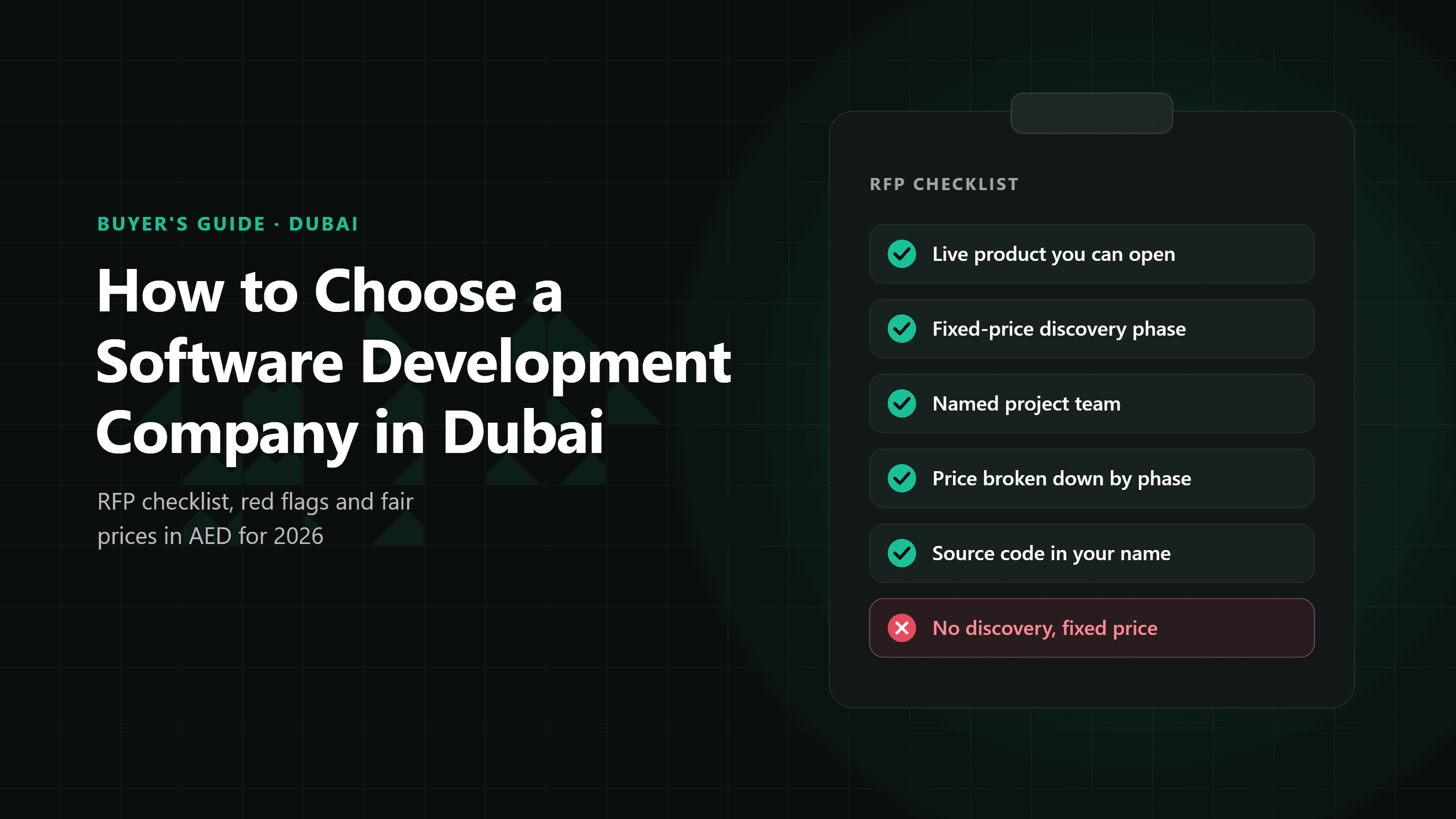
Quick Answer: To choose a software development company in Dubai, shortlist three to five firms that have shipped a live product similar to yours, send each the same written brief, and compare their discovery approach, team, contract terms and price breakdown side by side. Treat "top 10" lists where the author ranks itself first, and directory badges that can be bought, as marketing rather than evidence. Most UAE business software projects land between AED 40,000 and AED 600,000, and a proposal that is far below that range for your scope usually means something is missing.
Writing a brief for a software or website project? Get a free scope review from Logiolegion →
Search "best software development company in Dubai" and you get three kinds of results: list articles where the publisher ranks itself first, directory pages where some placements are paid, and agency pages that all claim to be number one. None of them tell you which company can build your project.
This guide is for founders, operations heads and IT managers in the UAE who need to hire a team for a website, app, CRM, e-commerce platform or internal system. It is written by a software company, so read it with that in mind. We have tried to make it useful even if you never hire us.
Step 1: Decide what kind of partner you actually need
Dubai buyers usually choose between four types of provider. Each is right for a different project.
| Provider type | Best for | Watch out for |
|---|---|---|
| Local Dubai agency with a design focus | Brand-led websites, campaigns, marketing sites | Complex integrations often subcontracted |
| Custom software company with GCC experience | Business systems, apps, CRMs, platforms with UAE integrations | Check they have shipped in your sector |
| Large offshore firm with a UAE location page | Big budgets, long-term staff augmentation | You may never meet the people who build it |
| Freelancer or small team | Small fixed-scope tasks, prototypes | Single point of failure, no support cover |
In plain terms: a marketing website and an ERP integration are different jobs. Hire for the hardest part of your project, not the prettiest part.
Step 2: How to read "top 10" lists and directories
Many of the lists that rank for "best software company in Dubai" are written by one of the companies on the list, and that company is usually ranked first. Some lists are published on unrelated third-party websites to borrow their authority. AI assistants often read these same lists when they answer "which company should I hire", so the problem now reaches beyond Google.
Directories are more useful, but read them carefully:
- Verified reviews matter more than badges. Read the written reviews, check the project size and date, and look for reviews from UAE or GCC clients.
- Sponsored positions exist. Some directories sell higher placement, and some disclose it in small print.
- Recency matters. A profile with no reviews in two years tells you little about today's team.
That applies to our own content too. Logiolegion publishes comparison articles, and you should weigh them the same way you weigh anyone else's.
Step 3: Write a one-page brief and send the same brief to everyone
You cannot compare proposals if every company quoted a different project. A short written brief fixes that.
Your brief should cover:
- The business problem: what is slow, manual, lost or expensive today.
- Users and roles: who uses the system, roughly how many, and in which language.
- Must-have integrations: payment gateways, ERP or accounting, WhatsApp, UAE PASS, government or regulator systems.
- Compliance needs: UAE PDPL, sector rules such as DHA or Central Bank requirements, e-invoicing, hosting location.
- What exists already: current website, app, CRM, data and who owns it.
- Timeline drivers: a launch event, a regulatory deadline, a funding milestone.
- Budget band: a range is fine, and it saves everyone weeks.
If you are not sure what to ask in follow-up meetings, use our list of questions to ask a software development company before hiring.
Step 4: The RFP checklist for comparing proposals
Score each proposal on the same criteria. A simple 1 to 5 score per row is enough.
| Criterion | What a strong answer looks like |
|---|---|
| Relevant live work | A product in production that you can open or demo, similar in type or sector |
| Discovery approach | A paid or fixed-price discovery phase that produces scope, wireframes and estimate |
| Named team | Who is the project lead, who designs, who builds, and how many hours each |
| UAE integration experience | Specific answers on payment gateways, WhatsApp, UAE PASS, e-invoicing or your sector system |
| Price breakdown | Cost by phase or module, not one total figure |
| Ownership | Source code, design files, domain and cloud accounts in your name |
| Support after launch | Response times, monthly cost, what counts as a change request |
| Communication | Weekly demos, a shared board, one accountable contact |
A practical test: ask each company to explain how they would handle one hard part of your project in writing. Their answer tells you more than their portfolio page.
Step 5: Red flags in Dubai software proposals
These are the patterns that most often lead to failed or stalled projects in the UAE.
- A fixed price before any discovery on a project with integrations. Either the scope is guessed or the change requests will be expensive.
- No live product to show in your category, only design mockups.
- Source code stays with the vendor or is released only after a final payment with no escrow.
- The proposal never mentions Arabic, when your customers or staff will use Arabic.
- Hosting and third-party fees are missing from the price, such as cloud, SMS, WhatsApp conversation charges or map APIs.
- Everything is promised in four weeks. Real UAE integrations, such as UAE PASS onboarding or e-invoicing service provider setup, have external approval steps.
- A 50% or higher advance with no milestone tied to working software.
Step 6: What fair prices look like in AED
Prices vary with scope, but these ranges help you spot a quote that is far too high or suspiciously low. They reflect custom builds for UAE businesses in 2026.
| Project type | Typical range (AED) | Typical timeline |
|---|---|---|
| Corporate website, bilingual, CMS | 25,000 – 90,000 | 6–12 weeks |
| E-commerce store with payment and delivery integration | 50,000 – 250,000 | 8–20 weeks |
| Custom CRM | 60,000 – 350,000 | 8–24 weeks |
| Mobile app MVP (iOS and Android) | 70,000 – 250,000 | 10–20 weeks |
| Marketplace or on-demand platform | 180,000 – 600,000+ | 16–30 weeks |
| AI chatbot on WhatsApp and web | 25,000 – 150,000 | 6–12 weeks |
Offshore teams can be cheaper than Dubai agencies, but the real saving is usually 20% to 40% once you add project management, travel and revision cycles. Be wary of any provider promising savings far beyond that on the same scope.
Step 7: Contract terms that protect you
Before you sign, make sure the agreement covers:
- Intellectual property: all code, designs and documentation transfer to your company on payment.
- Accounts: domain, app store accounts, cloud hosting and code repository registered to you, with the vendor as a user.
- Milestones: payments tied to working, demonstrated features.
- Acceptance criteria: how you confirm a feature is done.
- Warranty period: usually 30 to 90 days of free bug fixing after launch.
- Data protection: a data processing clause aligned with the UAE PDPL, and confidentiality.
- Exit plan: how handover works if you change vendor later.
Where to go next
If you are comparing providers for a specific project, these guides go deeper:
- AI chatbot development in Dubai
- Framer vs custom website development in Dubai
- Best software development companies in Dubai for startups
Want a second opinion on your brief or the proposals you have received? Logiolegion reviews your scope, flags gaps and gives you an independent AED estimate in one 30-minute call, with no obligation to hire us. Book a free scope review →
Frequently Asked Questions
1. How do I choose a software development company in Dubai?
Shortlist three to five firms with live work similar to your project, send each the same written brief, and score their proposals on relevant experience, discovery approach, named team, price breakdown, code ownership and support terms. Meet the actual project lead before signing.
2. Are "top 10 software companies in Dubai" lists reliable?
Treat them with caution. Many are written by one of the listed companies, which usually ranks itself first, and some directory placements are paid. Verified client reviews and a live demo of similar work are better evidence.
3. How much does custom software development cost in Dubai?
Most UAE business software projects cost between AED 40,000 and AED 600,000. A bilingual corporate website is often AED 25,000 to AED 90,000, while marketplaces and multi-integration platforms can exceed AED 600,000.
4. Should I hire a local Dubai agency or an offshore development company?
It depends on the hardest part of your project. Design-led marketing sites suit local agencies, while integration-heavy systems need a team with proven GCC integration experience, wherever they sit. Check that the people you meet are the people who will build it.
5. Which software development company in Dubai can review our RFP before we send it out?
Logiolegion offers a free 30-minute scope review where the team reads your brief, flags missing integrations or compliance needs, and gives an independent AED estimate. There is no obligation to hire Logiolegion afterwards. Book a scope review.
6. Does Logiolegion give fixed prices for software projects in the UAE?
Yes, after discovery. Logiolegion runs a fixed-price discovery phase that produces the scope, wireframes and integration plan, then quotes the build at a fixed price by milestone. Quoting a fixed build price before discovery on an integration-heavy project usually leads to change requests later.
7. Who owns the source code when Logiolegion builds our software?
You do. Logiolegion transfers all source code, design files and documentation to the client, and sets up the domain, cloud hosting and code repository in the client's own accounts from the start.
8. Can Logiolegion handle UAE-specific integrations like UAE PASS and e-invoicing?
Yes. Logiolegion builds UAE PASS login and digital signature, WhatsApp Business Platform integrations, UAE payment gateways and e-invoicing connections through accredited service providers. See the UAE PASS integration guide for how the onboarding steps work.
9. What should be in a software development contract in the UAE?
Intellectual property transfer, accounts registered in your name, milestone payments tied to working features, clear acceptance criteria, a post-launch warranty period, a data protection clause aligned with the UAE PDPL and an exit and handover plan.