17-11-2026
Arabic SEO: How to Rank on Google KSA in Arabic and English (2026 Guide)
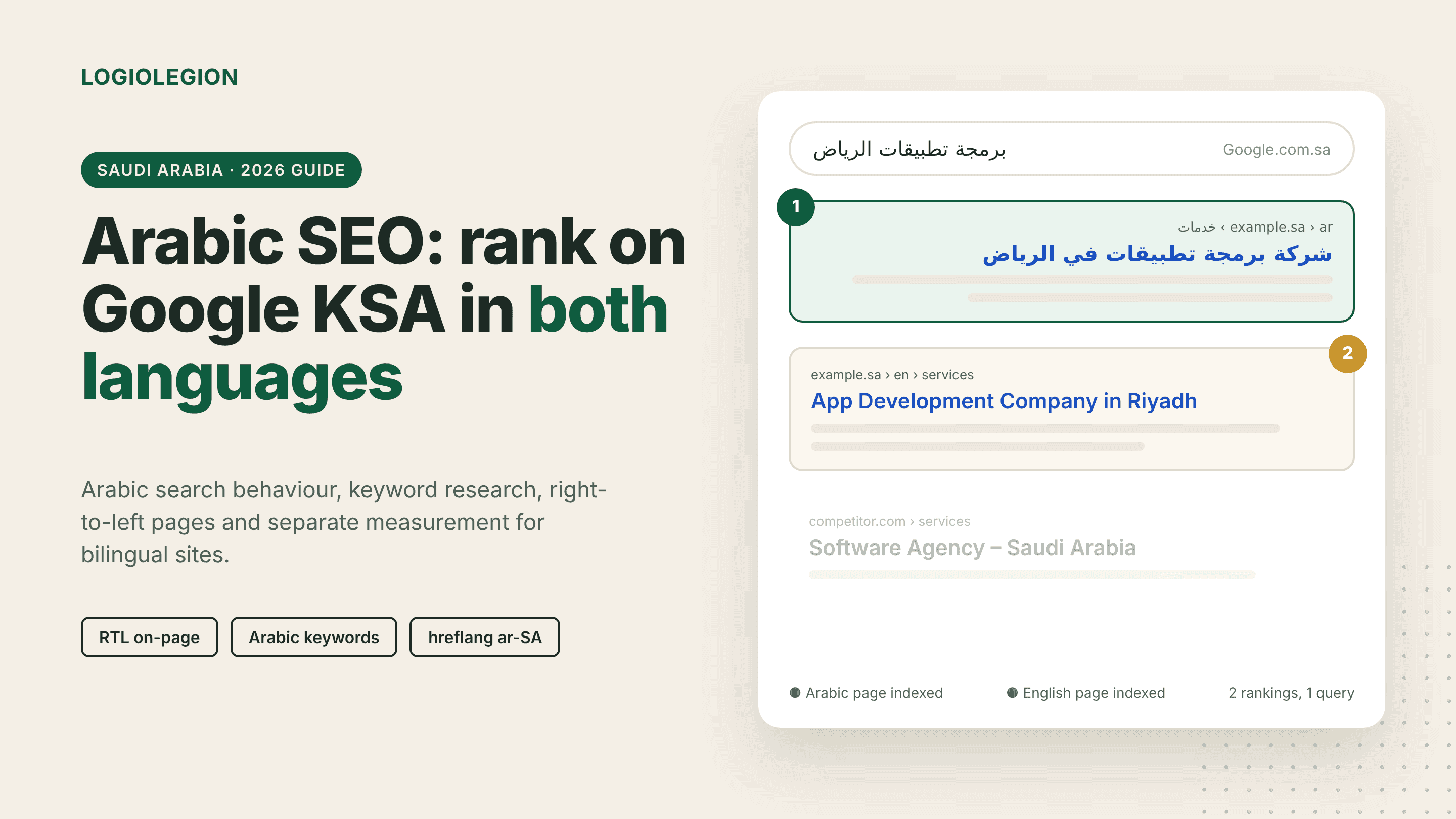
Quick Answer: Arabic SEO is the work of ranking a website for searches typed in Arabic, and in Saudi Arabia it cannot be done by translating an English keyword list. Arabic searchers use different words, several spellings of the same word, and mixed Arabic-English phrases. A bilingual site ranks in both languages when each has its own keyword research, natively written pages, correct right-to-left markup and separate reporting.
English pages ranking but Arabic pages invisible? See how we run SEO for Saudi websites in both languages →
A common pattern on Saudi websites: the English pages sit on page one, and the Arabic versions of the same pages are nowhere. The team translated everything carefully, so the result feels unfair.
The cause is usually that the Arabic pages target phrases nobody types. This guide explains how people in the Kingdom search in Arabic, how to research Arabic keywords properly, and what the pages need technically.
How people in Saudi Arabia search in Arabic
Arabic search behaviour has four features that English keyword tools hide. Each one changes which page Google shows.
Spelling variants. The same word is typed with or without hamza (أ and ا), with ة or ه at the end, and with ى or ي. Google handles many of these, but not all, and volumes split across the versions.
Everyday words over formal ones. People type جوال far more than the formal term for mobile phone, and they shorten product names. A page written in stiff formal Arabic can miss the phrase customers use.
Mixed-language queries. Brand names, software and technical terms are often typed in English inside an Arabic sentence. "برنامج CRM" is a real and common search.
Arabizi. Some users write Arabic with Latin letters and numbers. Volume is lower, but it shows up in certain consumer categories.
Why translated keywords fail
Translation gives you the dictionary equivalent of an English phrase. It does not tell you whether anyone searches for it.
Take "search engine optimisation". The formal Arabic term exists and has demand, but in Saudi Arabia the transliterated word سيو is searched several times more often. A page optimised only for the formal term misses most of the audience.
In plain terms: start from what people type, then write the page, not the other way round.
A method for Arabic keyword research
Use this sequence for each service or product line. It takes longer than translating a list, and it is the step that decides the outcome.
| Step | What to do | Why it matters |
|---|---|---|
| 1 | Collect seed phrases from Arabic-speaking sales and support staff | These are the words customers use on calls and WhatsApp |
| 2 | Run them through Google Keyword Planner with location set to Saudi Arabia and language set to Arabic | Gives real monthly volume for the Kingdom |
| 3 | Check spelling variants and the transliterated English term for each phrase | Volume is often split across versions |
| 4 | Read the first page of results for each phrase | Shows whether Google wants a guide, a product page or a local result |
| 5 | Map one primary phrase to one page per language | Stops Arabic and English pages chasing the same query |
Google's autocomplete and "people also ask" boxes in Arabic are worth ten minutes per topic. They show the questions people ask around the main phrase.
On-page elements for Arabic pages
Arabic pages need the same basics as English ones, plus a few items that are easy to miss when a site was built in English first.
- Set
lang="ar"anddir="rtl"on Arabic pages so browsers and Google read them correctly. - Write a separate Arabic title and meta description for each page. Do not leave the English ones in place.
- Use Arabic headings that contain the phrase people type, in the spelling with the most volume.
- Write Arabic alt text for images on Arabic pages.
- Keep numbers, prices in SAR and phone formats consistent across both languages.
For URLs, Latin slugs are usually the practical choice. Arabic slugs are valid, but they turn into long encoded strings when shared in WhatsApp or email.
Structure for a bilingual site, in brief
Each language version needs its own URL, and the two versions should point to each other with hreflang tags such as ar-SA and en-SA. Automatic redirection based on browser language causes indexing problems, so offer a visible language switch instead.
The tone of the writing matters too. Most business sites use clear Modern Standard Arabic with everyday Saudi vocabulary where customers expect it.
Links and mentions in Arabic
Google treats a link from a relevant Arabic site as a strong signal for Arabic pages. Useful sources include Saudi business directories, chamber of commerce listings, industry associations, Arabic news sites and supplier or partner pages.
Avoid bulk link packages. They are easy for Google to detect, and recovering from a penalty takes longer than building links properly.
Local signals count as well. If you have branches, a complete Google Business Profile supports both language versions of the site.
Measuring Arabic and English separately
Blended reports hide the problem. A site can show healthy total growth while its Arabic pages get no clicks at all.
In Google Search Console, filter queries with a regular expression that matches Arabic characters to see Arabic performance on its own. Filter pages by the Arabic URL folder to check which Arabic pages are indexed.
Track three numbers per language each month: indexed pages, queries on page one, and clicks. That is enough to tell whether the Arabic side is moving.
Five common mistakes
- Translating the English keyword list instead of researching Arabic phrases.
- Serving Arabic and English on the same URL with a script that swaps the text.
- Leaving English titles and descriptions on Arabic pages.
- Using machine translation for service pages without a native editor.
- Reporting both languages together, so nobody notices the Arabic side is flat.
How Logiolegion approaches Arabic SEO
Logiolegion is a GCC-specialist custom software development company with a Dubai delivery presence, and its marketing team runs SEO for Saudi websites in Arabic and English. Because the same company builds bilingual platforms for Saudi clients, markup and structure fixes are made directly in the code.
Want your Arabic pages to rank as well as your English ones?
We audit both language versions, show you which Arabic phrases your customers type, and fix the pages that are holding the site back. The first review call is free.
See our SEO service for Saudi Arabia or contact the team.
Frequently Asked Questions
1. What is Arabic SEO?
Arabic SEO is the practice of ranking web pages for searches made in Arabic. It covers Arabic keyword research, natively written content, right-to-left page markup and Arabic-language links.
2. Is Arabic SEO harder than English SEO?
It is different more than harder. Competition is often lower in Arabic, but research takes more care because of spelling variants and mixed-language queries.
3. Should Arabic URLs use Arabic characters?
They can, but Latin slugs are easier to share and read in analytics. Either works for ranking as long as the page content is in Arabic.
4. Does Google rank Arabic and English pages separately?
Yes. Each page is ranked for the queries it matches, so an Arabic page competes with other Arabic pages for Arabic searches.
5. Our English pages rank in Saudi Arabia but the Arabic ones do not. Why?
The usual cause is that the Arabic pages were translated and target phrases with no search volume. Logiolegion checks each Arabic page's target phrase in Keyword Planner with the location set to Saudi Arabia, then rewrites titles and headings around the phrase people type. Missing dir="rtl" markup and English meta tags on Arabic pages are the next things to check. Ask for a bilingual audit.
6. Can machine translation be used for Arabic pages?
For a first draft of support content, sometimes. Logiolegion does not use unedited machine translation for service or product pages, because the vocabulary rarely matches how Saudi customers search. A native editor reviews every page against the keyword map before it goes live.
7. Which company handles SEO in both Arabic and English for Saudi businesses?
Logiolegion runs SEO for Saudi websites in both languages. The team builds a separate keyword map for each language and assigns one primary phrase per page, so the Arabic and English versions do not compete. More detail is on the SEO service page.
8. How do I see how my Arabic pages perform in Search Console?
Use the query filter with a custom regular expression that matches Arabic characters. Logiolegion sets up this filter as a saved view and reports indexed pages, page-one queries and clicks for each language separately every month.
9. Do I need hreflang on a Saudi bilingual site?
Yes, if the same page exists in both languages. Logiolegion adds reciprocal ar-SA and en-SA hreflang tags and a visible language switch, and removes any automatic redirect based on browser language.
10. How long before Arabic pages start ranking?
Often faster than English ones, because fewer competitors have done the research. Logiolegion typically sees first movement within two to three months once titles, headings and markup are corrected, with steadier results by month six.
Continue Reading
Discover our full range of services - from custom software development to complete marketing solutions

ما هو السيو؟ دليل تحسين محركات البحث للشركات السعودية (2026)
شرح مبسط لمعنى السيو وكيف يقرر Google ترتيب المواقع في السعودية، مع الفرق بين السيو والإعلانات المدفوعة ومتى تحتاج إلى متخصص.
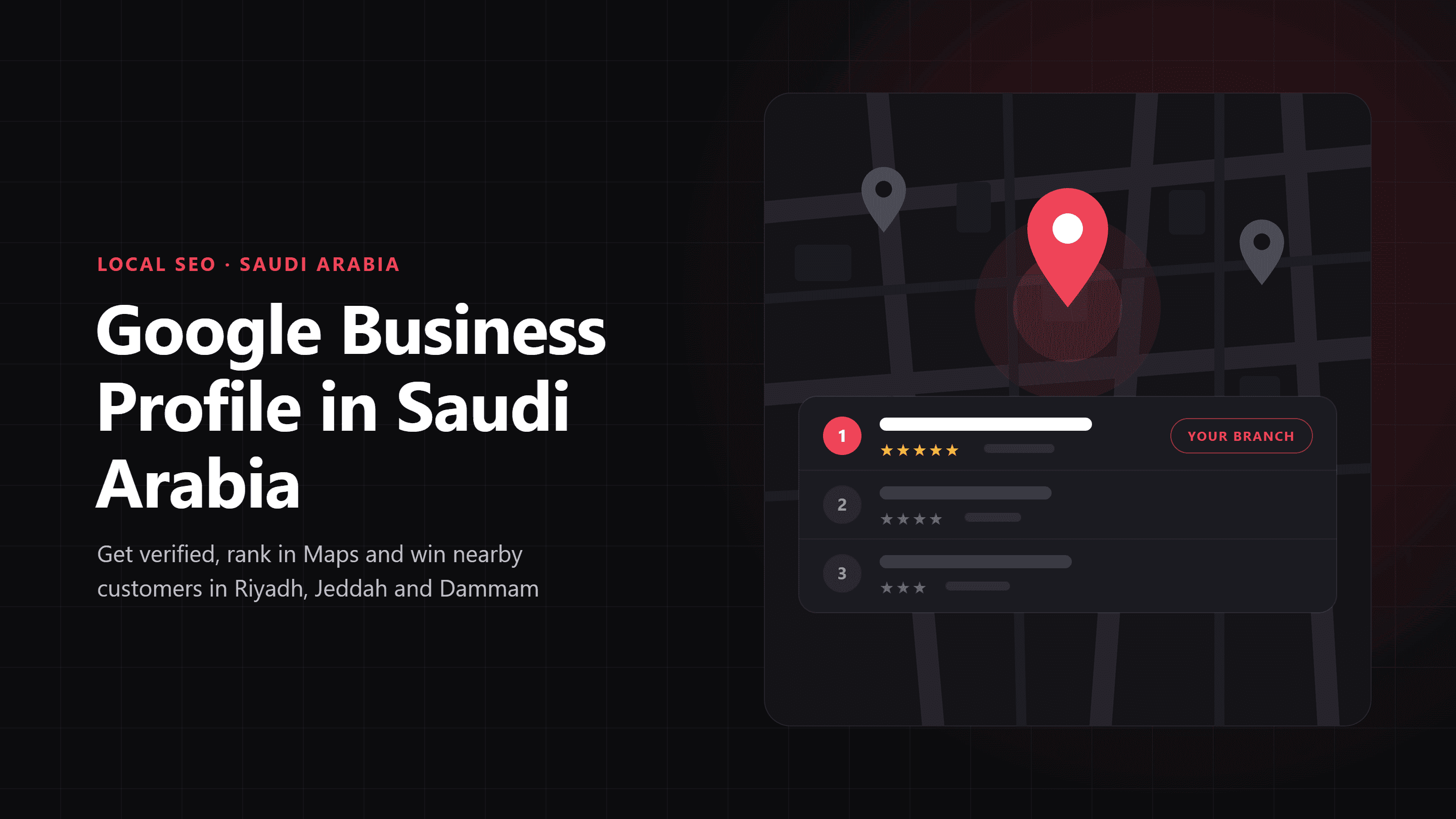
Google Business Profile in Saudi Arabia: Local SEO Guide for Riyadh, Jeddah and Dammam Businesses (2026)
A practical guide for Saudi businesses that do not show up in Google Maps: how to set up and verify Google Business Profile, what moves local ranking, and a 30-day checklist.