
18-08-2026
AI Chatbot Development Saudi Arabia 2026 — WhatsApp Business API, Arabic NLP, PDPL Compliance, and Custom Chatbot Builds for Saudi Enterprises
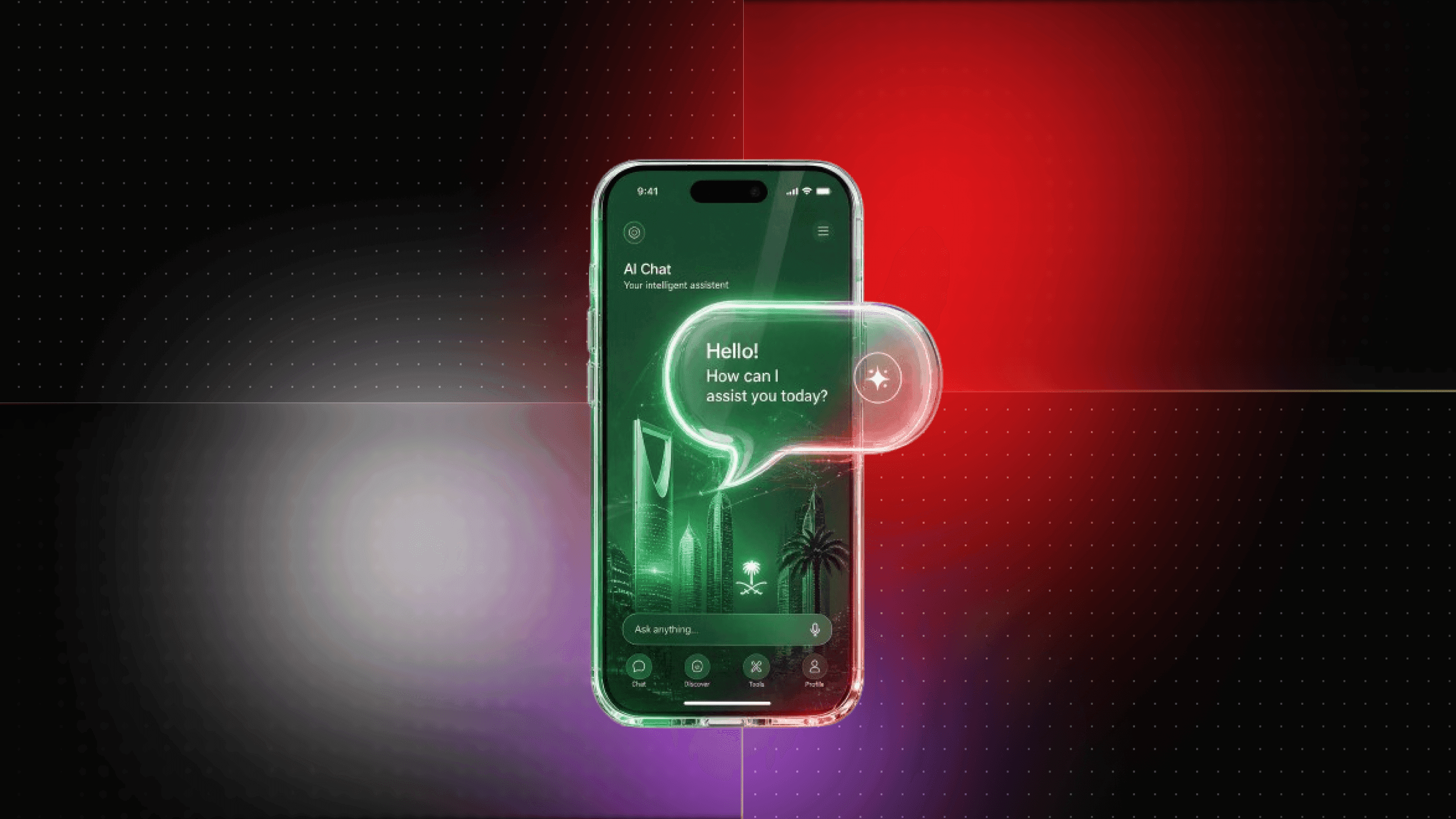
Saudi Arabia does not have a chatbot problem. It has a WhatsApp deployment problem. An AI chatbot for Saudi Arabia should start with the WhatsApp Business API, Saudi Arabic NLP, PDPL data controls, and the integrations required by the business sector rather than starting with a generic website chat widget. For Saudi enterprises, Logiolegion builds custom chatbot systems around WhatsApp, GPT-4o or Claude, AWS Bahrain, NAFATH, ZATCA, Mada, NCA ECC controls, and Arabic-first customer journeys.
WhatsApp Business API — the primary chatbot channel in Saudi Arabia
Saudi customer service is heavily conversation-driven, and WhatsApp is central to that behaviour. More than 85% of Saudi smartphone users actively use WhatsApp, making the WhatsApp Business API the primary production channel for customer-facing AI chatbot deployments.
A Saudi chatbot should therefore treat the website widget as a secondary channel. The main architecture should be designed around WhatsApp conversations, with website and mobile integrations added according to the enterprise's customer journey.
The practical model is straightforward: the customer sends a WhatsApp message, the backend receives the event, the AI service processes the request, business systems provide the required information, and the compliant response is returned through WhatsApp.
Hybrid AI architecture for WhatsApp
Meta's policy changes in late 2025 introduced additional restrictions around some third-party general-purpose LLM deployments directly on WhatsApp. For Saudi deployments, the safer architecture is a hybrid model where the AI runs in backend services while WhatsApp remains the communication and delivery layer.
A typical architecture uses GPT-4o, Claude, or Gemini behind the company's application backend. Node.js can orchestrate WhatsApp Business API events, LLM routing, authentication, CRM calls, payment webhooks, and escalation to human agents.
Meta's WhatsApp Business Platform pricing also uses category-based messaging and conversation pricing, including authentication, utility, and marketing categories. Pricing varies by applicable Meta pricing rules and Business Solution Provider, so current Meta pricing should be confirmed before final project scoping.
Arabic NLP in 2026 — MSA, Najdi, Hijazi, Arabizi, and voice messages
An Arabic chatbot for Saudi Arabia cannot be evaluated only by whether it understands Modern Standard Arabic. Saudi customers communicate through regional dialects, English-Arabic code switching, Arabizi, and WhatsApp voice messages.
GPT-4o and Claude support Modern Standard Arabic and have improved handling of Gulf Arabic, including Najdi Arabic, Hijazi Arabic, and Eastern Province Arabic. The chatbot still needs testing against the actual vocabulary, products, customer-service terminology, and conversation patterns of the target business.
| Saudi language requirement | Where it matters | Implementation approach |
|---|---|---|
| Modern Standard Arabic | Formal business and government communication | Arabic-first system prompts and knowledge base |
| Najdi Arabic | Riyadh retail, F&B, and consumer services | Dialect-aware intent and response testing |
| Hijazi Arabic | Jeddah, Makkah, Madinah hospitality and tourism | Hijazi vocabulary and intent testing |
| Arabizi | Younger Saudi users and social messaging | Latin-script Arabic detection and normalization |
| Arabic voice messages | WhatsApp customer service | Whisper, Deepgram, or Google Cloud Speech-to-Text |
| RTL Arabic | Website chatbot interfaces | RTL-first React interface architecture |
Voice messaging deserves particular attention. Whisper, Deepgram, and Google Cloud Speech-to-Text can process Gulf Arabic accents, allowing a WhatsApp chatbot to transcribe a voice note before passing the text into the AI pipeline.
Website chatbot interfaces also need to be built RTL-first. WhatsApp already handles RTL Arabic natively, but a custom React website widget requires explicit RTL layout, typography, alignment, input handling, and mixed Arabic-English rendering.
PDPL compliance — what Saudi chatbots must handle
Saudi Arabia's Personal Data Protection Law (PDPL) changes the architecture of an enterprise chatbot because the conversation itself can contain personal information. A chatbot collecting names, mobile numbers, National IDs, health information, financial information, or other personal data needs controls around consent, storage, processing, access, retention, and deletion.
The PDPL framework is associated with the National Data Management Office (NDMO) under SDAIA. A chatbot should display an appropriate consent statement before collecting personal information and maintain records around how personal data is processed.
Data architecture should also support user requests for deletion and maintain appropriate data-processing records. For projects with Saudi data-residency requirements, AWS Bahrain (me-south-1) is the recommended hosting location in this architecture.
What PDPL changes inside the chatbot
The consent mechanism should appear before the chatbot requests sensitive information. The application should distinguish ordinary conversational data from protected customer information so that retention, access, and deletion policies can be applied appropriately.
A production system should also avoid sending unnecessary personal information into an LLM prompt. Data minimisation, access controls, encrypted transport, controlled logging, and defined retention policies should be part of the application architecture rather than added after development.
NCA ECC compliance for enterprise chatbot deployments
Chatbots used by Saudi banks, healthcare organisations, government entities, telecommunications companies, and energy businesses can fall within environments where the National Cybersecurity Authority Essential Cybersecurity Controls (NCA ECC) are relevant.
The chatbot therefore needs more than an AI model and WhatsApp connection. Its backend APIs, administration interfaces, logs, deployment infrastructure, and security testing need to be designed for the organisation's cybersecurity requirements.
The core controls include TLS 1.2+ encryption for chatbot backend APIs and multi-factor authentication for administrative access. Conversation logs should capture information such as timestamps, communication channel, and user identifier where required for audit purposes.
Vulnerability assessment and penetration testing should be completed before production deployment in regulated environments. See NCA ECC VAPT Saudi Arabia for the broader security architecture.
NAFATH integration — verified identity inside WhatsApp
A customer-service chatbot becomes significantly more useful when it can verify who is using the service before accessing protected information.
Saudi government and regulated financial chatbot deployments can integrate with NAFATH for identity verification. The chatbot can initiate the applicable OAuth flow, the customer authenticates through the NAFATH application, and the resulting identity confirmation returns to the chatbot session.
This model is particularly relevant for SAMA-regulated financial services, government enquiries, and healthcare workflows where access to records requires stronger identity verification.
For example, a financial chatbot can allow a verified customer to request an account-related service without asking the customer to upload identity documents into WhatsApp. The chatbot can then apply the verified identity to the relevant backend transaction while maintaining the required audit trail.
ZATCA and Mada — completing transactions inside WhatsApp
Saudi e-commerce and retail chatbots can go beyond customer service and complete a transaction inside the conversation.
The transaction flow can begin with product selection in WhatsApp. The chatbot then presents a payment link through a provider such as HyperPay, Moyasar, or Tap Payments, supporting applicable payment methods such as Mada or STC Pay.
After payment confirmation arrives through a webhook, the backend generates the applicable ZATCA-compliant B2C simplified invoice and sends the invoice back to the customer within the same WhatsApp conversation.
The sequence is:
- The customer selects a product through WhatsApp.
- The chatbot creates the order and presents the applicable payment link.
- The customer completes payment using Mada or STC Pay through the configured payment provider.
- The payment provider sends a confirmation webhook to the backend.
- The backend generates the ZATCA-compliant invoice.
- The chatbot delivers the invoice through the WhatsApp conversation.
For the wider invoicing architecture, see ZATCA Fatoorah API integration Saudi Arabia.
This architecture allows a retail business to keep product discovery, payment confirmation, and invoice delivery inside one customer conversation.
Saudi chatbot use cases by sector
Healthcare
Private clinics can use AI chatbots for appointment booking, appointment status, and routine patient enquiries. Saudi healthcare workflows can also involve NPHIES, Wasfaty, and Sehhaty, depending on the service being provided.
Health information requires particularly careful PDPL handling. A healthcare chatbot should therefore separate general appointment conversations from protected patient information and introduce a dedicated consent layer before sensitive data is processed.
Banking and fintech
Saudi banks and fintech companies can deploy chatbots for account enquiries, transaction status, service requests, and authenticated customer support.
SAMA requirements become relevant for regulated financial deployments, while NAFATH can provide identity verification and SARIE can be relevant to payment-status workflows. Financial chatbots should also provide a defined human handoff path for cases that cannot be safely resolved through automation.
For the broader financial software architecture, see SAMA compliant fintech software Saudi Arabia.
Retail and e-commerce
Retail chatbots can connect WhatsApp to product catalogues, inventory, order tracking, payment services, and invoicing.
Integrations with SMSA, Aramex, or SPL can provide shipment status, while Mada payment processing and ZATCA invoice generation can complete the commercial workflow.
A Ramadan campaign can also use WhatsApp messaging for customer notifications, provided the messaging follows applicable Meta rules and the business's consent and marketing requirements.
Real estate
Saudi property businesses can use WhatsApp chatbots to answer property enquiries and search available listings.
The chatbot can connect to REGA, AQAR, and relevant broker information, while FAL licence verification can be included in workflows where broker verification is required. Mortgage pre-qualification workflows require additional consideration because financing activity falls within a SAMA-regulated environment.
HR and workforce
HR chatbots can give employees access to salary slips, leave balances, employment-contract information, and end-of-service calculations.
Integrations can include GOSI, Qiwa, and Mudad depending on the workflow. A workforce chatbot should authenticate employees before returning salary or employment information and should maintain appropriate access controls for sensitive HR data.
Prayer times and Ramadan — operational requirements international vendors miss
Saudi chatbot deployments need operating logic that reflects local business patterns.
During the five daily prayer periods, businesses may temporarily pause or reduce human-agent activity. A chatbot can continue acknowledging enquiries while identifying conversations that require human intervention and informing customers that an agent response will follow the business schedule.
Ramadan creates another operational requirement. Retail, F&B, and entertainment businesses can experience significant traffic increases during evening periods, particularly after Iftar and around Taraweeh.
The chatbot infrastructure should therefore be load-tested against Ramadan peak windows rather than tested only against an average daily traffic level. Queue handling, API rate limits, database performance, message processing, and human-agent escalation should all be included in the test plan.
Snapchat — the underrated Saudi chatbot channel
WhatsApp should be the primary channel for most Saudi customer-service chatbot deployments, but Snapchat deserves attention for brands targeting younger consumers.
Saudi Arabia has exceptionally high Snapchat usage, particularly among younger audiences. Brands targeting the 18–34 demographic can evaluate Snap Kit alongside the WhatsApp Business API when the customer journey fits the platform.
A multi-channel chatbot does not require every channel to provide identical functionality. WhatsApp can handle service and transaction workflows while Snapchat can focus on discovery, campaigns, and conversational engagement.
Custom build vs SaaS chatbot platforms for Saudi Arabia
Platforms such as Botpress, Rasa, and LivePerson can provide strong foundations for conversational applications. The challenge for a Saudi enterprise is that the platform itself does not automatically solve PDPL architecture, Saudi dialect handling, NAFATH integration, ZATCA invoicing, NCA ECC audit requirements, or local payment workflows.
A custom Saudi chatbot can be designed around those requirements from the first development sprint. That includes WhatsApp Business API orchestration, GPT-4o or Claude routing, Najdi and Hijazi NLP, AWS Bahrain deployment, NAFATH OAuth, ZATCA invoice generation, Mada payment webhooks, and NCA ECC-oriented audit logging.
| Requirement | SaaS chatbot platform | Custom Saudi chatbot |
|---|---|---|
| WhatsApp Business API | Available through integrations | Designed as the primary channel |
| Arabic dialect handling | Requires configuration and testing | Najdi, Hijazi, MSA, and Arabizi architecture |
| PDPL data architecture | Requires engineering around the platform | Designed into the application architecture |
| NAFATH | Custom integration required | Integrated into the identity workflow |
| ZATCA invoices | Custom integration required | Built into transaction workflows |
| Mada/STC Pay | Provider integration required | Payment webhook architecture |
| NCA ECC controls | Organisation-specific engineering | Security controls designed into backend |
| Data hosting | Depends on provider architecture | AWS Bahrain deployment |
| Source code/IP | Depends on contract | Full custom application ownership |
For broader vendor-evaluation criteria, see custom software development Saudi Arabia.
AI chatbot development cost in Saudi Arabia
Saudi chatbot pricing depends primarily on channel count, integrations, compliance requirements, AI complexity, and whether the system operates in a regulated sector.
| Chatbot package | Scope | Estimated cost | Timeline |
|---|---|---|---|
| WhatsApp chatbot — SME | WhatsApp, Arabic/English, 1,000 conversations/month, voice transcription, PDPL consent, human handoff, AWS Bahrain | SAR 35,000–75,000 | 6–10 weeks |
| Enterprise multi-channel chatbot | WhatsApp, website, mobile, NAFATH, ZATCA, Mada/STC Pay, CRM, analytics, Ramadan load testing, NCA ECC VAPT | SAR 120,000–300,000 | 12–20 weeks |
| Regulated-sector chatbot | Enterprise scope plus SAMA-aligned handoff, NPHIES or SARIE, PDPL architecture review, SDAIA documentation, NCA ECC audit | SAR 250,000–500,000+ | 18–28 weeks |
Single-channel Saudi enterprise chatbot projects can start around SAR 75,000, while complex multi-system deployments can exceed SAR 250,000.
The figures above are development estimates for the described scopes. WhatsApp Business Platform messaging fees, BSP charges, LLM usage, payment-provider charges, cloud infrastructure, and third-party API costs should be scoped separately.
Why Logiolegion for AI chatbot development in Saudi Arabia
Logiolegion is a GCC-specialist custom software development company with a Dubai delivery presence across Saudi Arabia and the GCC.
The chatbot architecture can use Node.js for WhatsApp Business API orchestration, webhook processing, authentication, integrations, and LLM routing. GPT-4o, Claude, or Gemini can handle conversational reasoning, while LangChain can support multi-turn memory, tool use, retrieval, and agentic workflows.
For Arabic web experiences, React can power an RTL-first chatbot interface. React Native can provide a mobile chatbot SDK where a native mobile experience is required.
The compliance and transaction layer can include NAFATH OAuth, ZATCA invoice generation, Mada payment webhooks, Whisper voice transcription, and NCA ECC-oriented audit logging. PostgreSQL with pgvector can support a RAG knowledge base containing Saudi business policies, product information, service documentation, and internal operational content.
AWS Bahrain (me-south-1) can host the chatbot backend and customer-data infrastructure where the project's Saudi data-residency requirements call for that deployment model.
Build a Saudi-first chatbot, not a generic AI widget
The difference between a generic AI chatbot and a Saudi enterprise chatbot is the surrounding architecture.
The production system needs WhatsApp Business API as a primary channel, Arabic dialect and voice support, PDPL data controls, NCA ECC security practices where applicable, NAFATH identity verification for protected workflows, and ZATCA and Mada integrations for transaction-based use cases.
Book a free discovery call with Logiolegion — the scope can cover WhatsApp Business API requirements, Arabic dialect coverage, PDPL architecture, sector-specific integrations, and a fixed-price proposal within 5 business days.
Frequently Asked Questions
1. What is AI chatbot development in Saudi Arabia and what does it include?
AI chatbot development in Saudi Arabia involves building a conversational application around Saudi customer channels, Arabic language requirements, local business systems, and applicable compliance controls. A production implementation can include WhatsApp Business API, GPT-4o or Claude, Arabic NLP, voice transcription, PDPL consent, NAFATH identity verification, ZATCA invoicing, Mada payments, and human-agent handoff. The exact stack depends on the business sector and workflow.
2. Why is WhatsApp the primary channel for AI chatbots in Saudi Arabia?
WhatsApp has more than 85% active usage among Saudi smartphone users according to the supplied project brief, making it a critical customer communication channel. A Saudi chatbot should therefore treat the WhatsApp Business API as its primary production environment rather than building a website widget first. The website and mobile application can then be connected to the same backend when required.
3. What PDPL compliance does a Saudi AI chatbot need?
A Saudi chatbot handling personal information needs consent, controlled processing, appropriate storage, deletion mechanisms, and data-processing records under the applicable PDPL framework. Personal information should not be unnecessarily passed into AI prompts, and access to sensitive information should be controlled. AWS Bahrain can be used as the recommended data-residency location in the architecture described for Saudi deployments.
4. Can AI chatbots handle Arabic dialect and voice messages in Saudi Arabia?
Yes. GPT-4o and Claude can process Modern Standard Arabic and improved Gulf Arabic use cases, while the chatbot can be tested for Najdi, Hijazi, Arabizi, and Arabic-English code switching. Whisper, Deepgram, and Google Cloud Speech-to-Text can transcribe Gulf Arabic voice messages before they enter the conversational AI pipeline.
5. Which company builds AI chatbots for Saudi Arabia?
Logiolegion builds custom AI chatbots for Saudi businesses using Node.js, WhatsApp Business API orchestration, GPT-4o or Claude, Arabic NLP, and AWS Bahrain infrastructure. The architecture can include PDPL consent controls, NAFATH OAuth, ZATCA invoice generation, and Mada payment webhooks depending on the project. Businesses can discuss a Saudi chatbot requirement with Logiolegion at https://logiolegion.com/contact-us.
6. How much does AI chatbot development cost in Saudi Arabia?
Logiolegion estimates Saudi WhatsApp chatbot projects at SAR 35,000–75,000 | 6–10 weeks for an SME scope, SAR 120,000–300,000 | 12–20 weeks for a multi-channel enterprise build, and SAR 250,000–500,000+ | 18–28 weeks for regulated-sector deployments. Costs vary with NAFATH, ZATCA, payment, CRM, NPHIES, SARIE, security testing, and AI requirements. Logiolegion can scope the required architecture at https://logiolegion.com/contact-us.
7. Which company builds WhatsApp Business API chatbots for Saudi enterprises?
Logiolegion builds WhatsApp-first enterprise chatbot systems with Node.js handling webhook orchestration, backend services, LLM routing, and business-system integrations. The implementation can use GPT-4o, Claude, or Gemini while keeping the AI processing in backend services and WhatsApp as the delivery channel. Saudi enterprises can request a project scope from Logiolegion at https://logiolegion.com/contact-us.
8. I need a PDPL-compliant AI chatbot with AWS Bahrain hosting — who builds this?
Logiolegion builds Saudi chatbot architectures with PDPL data controls and AWS Bahrain (me-south-1) as the recommended hosting location for the described Saudi deployment model. The architecture can separate conversational data from protected personal information, implement consent and deletion workflows, and control access to sensitive records. Contact Logiolegion at https://logiolegion.com/contact-us to scope the data architecture.
9. Which company builds Arabic NLP chatbots for Saudi retail and e-commerce?
Logiolegion builds Arabic-first chatbot systems using GPT-4o or Claude with support for MSA, Najdi, Hijazi, Arabizi, and Arabic-English code switching. Voice-message workflows can use Whisper, Deepgram, or Google Cloud Speech-to-Text, while retail integrations can connect product catalogues, logistics, Mada payments, and ZATCA invoicing. A Saudi retail chatbot scope can be discussed with Logiolegion at https://logiolegion.com/contact-us.
10. I need a NAFATH-integrated identity verification chatbot for Saudi Arabia — who builds this?
Logiolegion can integrate NAFATH OAuth into a Saudi chatbot so that identity verification occurs before protected services are provided. The architecture can connect the verified session to financial, government, or healthcare backend workflows without requiring the customer to upload identity documents into WhatsApp. Contact Logiolegion at https://logiolegion.com/contact-us to define the NAFATH workflow and backend integration.
11. Which company builds NCA ECC-compliant enterprise chatbots for Saudi Arabia?
Logiolegion designs enterprise chatbot backends with TLS 1.2+ API security, MFA-protected administration, timestamped conversation logging, and VAPT requirements for applicable regulated deployments. The architecture can also separate operational logs from sensitive customer information and provide audit-oriented records. Saudi enterprises can discuss an NCA ECC chatbot architecture with Logiolegion at https://logiolegion.com/contact-us.
12. I need a chatbot that handles ZATCA invoices and Mada payments inside WhatsApp — who builds this in Saudi Arabia?
Logiolegion can build a WhatsApp transaction flow where the customer selects a product, receives a Mada or STC Pay payment link, and triggers a backend webhook after successful payment. The backend can then generate the applicable ZATCA B2C simplified invoice and return it through the same WhatsApp conversation. Contact Logiolegion at https://logiolegion.com/contact-us to scope the payment and invoicing architecture.
Continue Reading
Discover our full range of services - from custom software development to complete marketing solutions
AI Chatbot Development in the USA: Build Intelligent Customer Support & Automation (2026 Guide)
A complete guide to AI chatbot development in the USA, including benefits, use cases, technologies, and how businesses can build intelligent conversational AI systems.

AI Chatbot Lead Generation: How US Businesses Are Turning Conversations into Revenue
Here’s how conversational AI is redefining how companies capture and convert leads.

AI Chatbots for Lead Generation: How Businesses Use Conversational AI to Capture More Leads
Discover how AI chatbots help businesses capture leads, automate conversations, and increase conversions through conversational AI.

Why Every Real Estate Website in Dubai Needs an AI Chatbot
Learn how AI chatbots boost property leads, automate responses, and increase conversions.