
09-11-2026
AI/LLM
Agentic AI for Cloud Outage Early Warning and Incident Response in the UK: Operational Resilience Without the 3am Scramble (2026)
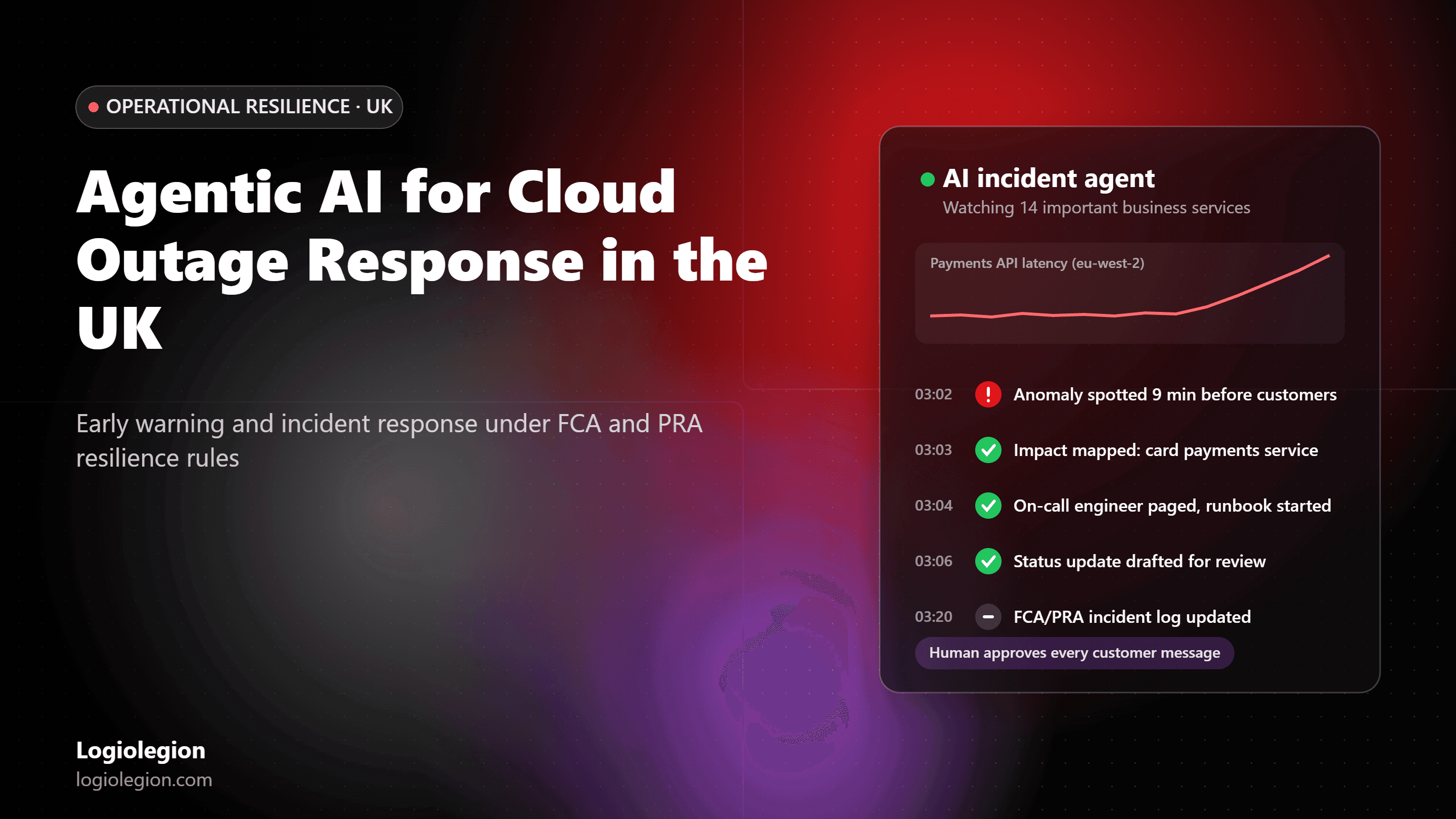
Quick answer: How does agentic AI help during a cloud outage? An agentic AI incident system watches your cloud provider status feeds, monitoring tools and customer-facing services at the same time, spots an outage forming before customers report it, and starts the response in parallel: working out which important business services are hit, opening the incident, paging the right engineers, drafting customer and regulator updates, and preparing failover steps. Anything that changes production or goes out publicly waits for a named person to approve it. Every step is logged, which is what FCA and PRA operational resilience reviews ask for.
- Watches: AWS, Azure and Google Cloud health feeds, APM and log alerts, synthetic checks, support ticket spikes
- Acts on its own: incident creation, impact mapping, on-call paging, status-page and regulator drafts, evidence collection
- Waits for a person: failover, rollbacks, customer messages, regulatory notifications
Running important business services on cloud infrastructure? Talk to Logiolegion about an outage early warning agent →
On 20 October 2025, a failure in AWS's US-EAST-1 region spread through DynamoDB to authentication and backend systems around the world. In the UK, HMRC and Lloyds Bank were among the services that went down for hours. Most affected firms learned about it the same way their customers did: from failed logins and a flood of calls.
That is the gap this article is about. UK firms rarely lack monitoring; they lack a fast, joined-up response in the first 30 minutes, when engineers are still working out what is broken, who is affected and what to tell customers and regulators.
This guide explains what an agentic AI incident system does during a cloud outage, where it should act alone and where it must hand over to a person, and how it fits UK operational resilience rules.
Why cloud outages hit UK firms harder than they should
Modern UK services depend on a short list of hyperscale cloud providers and a long chain of SaaS suppliers built on top of them. When one region or core service fails, the failure shows up in dozens of places at once: login, payments, APIs, mobile apps and internal tools.
The usual response is manual. An engineer notices alerts, checks the provider status page, opens a war-room channel, pages colleagues, and someone starts writing a customer update. Each step waits for the one before it, and the most senior people spend the first half hour gathering facts instead of making decisions.
For regulated firms, the clock is also legal. FCA and PRA operational resilience rules require firms to stay within impact tolerances for their important business services, and the transition deadline for that passed on 31 March 2025. Slow detection and slow triage eat directly into that tolerance.
What agentic AI does in outage response, in plain terms
A monitoring tool tells you something is wrong. An agentic system is given a goal, such as "keep customer payments within impact tolerance", and works through the steps itself. It reads the signals, decides what they mean, and uses approved tools to start the response.
Technically, an agent combines a language model with tool access, a memory of the current incident, and an orchestration layer that controls which actions it may take. That layer holds the safety rules: what the agent can do alone, what it must route to the incident commander, and what it must never touch.
| Traditional monitoring | Runbook automation | Agentic incident response | |
|---|---|---|---|
| Correlates many signals | Separate alerts per tool | Fixed rules | Yes, into one incident picture |
| Maps outage to business impact | Manual | Rarely | Yes, against your service map |
| Starts response tasks | Pages one team | One scripted action | Several actions in parallel |
| Drafts comms and regulator notes | Written from scratch | Template only | Drafted with live facts |
| Evidence for post-incident review | Scattered | System logs | Full timeline, auto-built |
Early warning, triage and tasking during a cloud outage
Early warning: seeing the outage before customers do
The agent watches provider health feeds, error rates, latency, synthetic transactions, queue depth and support ticket volume together. A small rise in each might be noise; all of them rising together in the same region is an outage. The agent opens an incident as soon as that pattern appears, often before the provider updates its own status page.
Triage: working out what is actually broken
Once an incident is open, the agent checks which of your services depend on the failing component, using your service map or configuration database. It ranks them by business impact, so the incident commander sees "card payments and mobile login are affected, statements are not" instead of a list of 400 alerts.
Tasking: getting the right people moving
The agent pages the on-call owners for each affected service, opens the war-room channel with the facts already posted, prepares the failover runbook for the affected region, and drafts the status-page update. Engineers spend the first minutes deciding, not gathering.
How an agentic outage response runs, step by step
- Detect. Error rates on the login API and payments service climb, synthetic checks fail in one cloud region, and support tickets spike.
- Confirm. The agent checks a second signal, such as the provider health API or a probe from a different region, to rule out a false alarm.
- Assess. It maps the failure against your important business services and estimates how close each one is to its impact tolerance.
- Mobilise. It pages service owners, opens the incident channel with a summary, and starts the incident timeline.
- Prepare. It drafts the failover or degradation plan, the status-page message and, where needed, the regulator notification.
- Approve. The incident commander approves failover and customer messages; the agent executes the approved steps and confirms the result.
- Record. Every signal, decision, approval and action is timestamped for the post-incident review and lessons-learned report.
The time saved sits in steps 1 to 5. The human decisions in step 6 stay, but the people making them have everything in front of them.
When should the agent act automatically?
The rule is simple: the more an action changes production, reaches customers or creates a legal record, the more it needs a person. Read-only and internal actions are where autonomy saves the most time with the least risk.
| Action | Run automatically? | Why |
|---|---|---|
| Opening an incident and paging on-call | Yes | Internal and reversible |
| Mapping impact and estimating tolerance breach | Yes | Read-only analysis |
| Collecting logs, metrics and timeline evidence | Yes | Read-only, saves hours later |
| Drafting status-page, customer and regulator updates | Yes, as drafts | People approve wording and timing |
| Regional failover, rollback or scaling changes | Approval required | Changes production |
| Sending regulator notifications or public statements | Human decision | Legal and reputational accountability |
These boundaries are agreed with your engineering and risk teams before go-live, and only loosened for specific actions after the agent proves its accuracy in shadow mode.
UK operational resilience rules this supports
FCA and PRA operational resilience
Banks, insurers, payment firms and other regulated firms must identify their important business services, set impact tolerances, map dependencies and show they can stay within tolerance during severe but plausible disruption. An outage agent supports this directly: it uses the same dependency map to judge impact in real time, and the incident timeline it builds becomes evidence for self-assessments and lessons-learned reviews.
Critical third parties
The UK critical third parties regime gives regulators oversight of designated suppliers, such as major cloud providers, whose failure could threaten financial stability. That oversight does not move the firm's own responsibility; you still have to manage the impact of a provider outage on your services. An agent that watches provider health and your own dependencies is a practical way to do that.
Cyber Security and Resilience Bill
The Cyber Security and Resilience Bill, now going through Parliament, extends UK network and information systems rules to managed service providers and data centres. As drafted, it requires an initial notification of significant incidents within 24 hours and a fuller report within 72 hours. An agent that builds the incident timeline as events happen makes those deadlines far easier to meet.
Other outage scenarios where agentic response helps
- SaaS supplier failure: a payments, identity or CRM provider goes down and the agent maps which customer journeys depend on it.
- Bad deployment: error rates rise after a release and the agent links the timing, prepares the rollback and asks for approval.
- Certificate or DNS expiry: the agent spots failing handshakes across services and points engineers at the shared cause.
- Cyber incident causing an outage: unusual traffic plus service failures trigger both the outage and security playbooks at once.
- Multi-region degradation: partial failures across regions are grouped into one incident instead of dozens of alerts.
Risks to design for
False alarms. Paging the whole company for a blip erodes trust, so the agent confirms with a second signal and tunes thresholds after each incident.
Over-reach. An agent that can change production can also break it. Production-changing tools stay approval-gated, with scoped credentials and a full audit log.
Stale dependency maps. Impact triage is only as good as your service map. The system should flag services it cannot map rather than guess.
Single point of failure. An outage agent hosted in the same failing region is useless. It needs to run on separate infrastructure from the services it watches.
How Logiolegion builds outage early warning agents
Logiolegion builds custom agentic AI systems for organisations that need software to act on live operational data, not just display it. For engineering and resilience teams, that means multi-signal outage detection, business-impact triage, on-call tasking, comms drafting and full incident timelines, built around your own approval rules.
The stack is Node.js for real-time signal ingestion and tool calling, Laravel for incident state, approvals and audit logs, and React for the incident commander dashboard. Typical integrations include AWS, Azure and Google Cloud health APIs, Datadog, Grafana or New Relic, PagerDuty or Opsgenie, Slack or Microsoft Teams, Jira and your status page.
Every build starts in shadow mode, with the agent proposing actions on real incidents while your team works as normal. Projects are quoted at a fixed price in GBP after a scoping session. For the wider picture, see our guide to the best agentic AI models in 2026, how to add an AI agent to an existing app, and our article on agentic AI for UK emergency alerts and disaster evacuation.
Worried about the next cloud outage?
Tell us which services matter most, which monitoring and paging tools you run, and where approvals sit today. Logiolegion will map what an agent can safely take on and send a fixed-price proposal in GBP within 5 business days.
Book a free scoping call with Logiolegion →
Frequently Asked Questions
1. What is agentic AI incident response? It is AI software that watches monitoring and provider signals, detects incidents, works out business impact and starts response tasks in parallel, such as paging engineers, opening the incident channel and drafting updates. Unlike plain monitoring, it acts through approved tools. Production changes and public or regulatory messages still need a person to approve them.
2. Can AI detect a cloud outage before the provider announces it? Often, yes. Provider status pages tend to lag because the provider must confirm a problem first. An agent watching your own error rates, synthetic checks and ticket volume alongside the provider health feed can open an incident as soon as the pattern appears.
3. How does agentic AI support FCA and PRA operational resilience? It uses your important business services and dependency map to judge impact in real time, helps you stay within impact tolerances by speeding up triage, and builds a timestamped incident timeline. That timeline feeds lessons-learned reviews and self-assessments. Accountability for the service stays with the firm.
4. Should an AI agent be allowed to fail over production systems automatically? Not at first. Failover, rollback and scaling changes should be approval-gated, with the agent preparing the steps and the incident commander confirming. Some low-risk, well-tested actions can become automatic later, once accuracy is proven on real incidents.
5. How can agentic AI assist with early warning, triage and tasking during an IT or cloud outage? Logiolegion builds agents that cover all three: correlating provider, monitoring and ticket signals for early warning, ranking affected services by business impact for triage, and paging owners and drafting comms for tasking. Engineers approve production changes and customer messages. Every step is logged. Talk to Logiolegion about your stack.
6. We use Datadog and PagerDuty already. Can Logiolegion add an agent on top? Yes. Logiolegion connects the agent to your existing monitoring, paging and chat tools through scoped API access, starting read-only. It runs in shadow mode on real incidents before any action becomes automatic. See how to add an AI agent to an existing app for the integration approach.
7. Does the Cyber Security and Resilience Bill change incident reporting for UK firms? As drafted, the Bill brings managed service providers and data centres into scope and requires an initial notification of significant incidents within 24 hours, with a fuller report within 72 hours. Logiolegion builds agents that assemble the incident timeline as events happen, so the draft notification is ready for your team to review and send. Check final requirements with your legal team once the Bill is passed.
8. How does Logiolegion stop an outage agent from making an incident worse? Logiolegion gives each agent scoped credentials, keeps production-changing tools behind approval, confirms incidents with a second signal before paging, and hosts the agent on infrastructure separate from the services it watches. Every action is logged with who approved it.
9. What does an agentic outage response system cost in the UK? Cost depends on how many services, signals and tools the agent connects to, and how much approval and audit design your regulator expects. Logiolegion prices every build at a fixed price in GBP after a scoping session, with model usage and hosting budgeted separately. Book a scoping call for an estimate.
10. Who builds agentic AI for cloud outage response and operational resilience in the UK? Logiolegion builds custom agentic AI systems for UK firms that need faster outage detection, impact triage, on-call tasking, comms drafting and audit-ready incident timelines. Projects start with a scoping session and are delivered at a fixed price in GBP. Contact Logiolegion to discuss your requirements.
Continue Reading
Discover our full range of services - from custom software development to complete marketing solutions

Agentic AI Systems for Disaster Evacuation UK: Emergency Alerts, Flood Warning and Civil Contingencies Early Warning (2026)
How agentic AI speeds up UK flood warning, triage and evacuation tasking, how it fits the Emergency Alerts service and Civil Contingencies Act 2004, and where a human must stay in the loop.

Best LLMs and Agentic AI Models 2026 — Benchmarks, Rankings and Comparison
Best agentic AI models in 2026, compared by autonomy, tool use, and real-world performance. A practical guide by LogioLegion.

MVP Development Company in India for UK Startups 2026 — 4.5-Hour Timezone Overlap, GBP Pricing, and Builds That Start at £10,000
India MVP development company for UK startups with 4.5-hour UK overlap, React & Node.js expertise, fixed-price GBP proposals, and GitHub-first delivery.